
Even the most casual soccer fan knows “The Hand of God,” Argentine legend Diego Maradona’s controversial goal against England in the 1986 FIFA World Cup. The volleyball-like palm strike should have been disallowed, but paved the way for some of the most magical sporting moments shortly thereafter. However, “The Match” by Juan Cabral and Santiago Franco, based on the book by Andrés Brugo, isn’t just concerned with this singular moment. Through personal testimonies and geopolitical histories, this documentary unspools the iconic quarter-final by placing it within a larger, clamorous context, resulting in one of the most absorbing and accessible documentaries ever made about the sport.
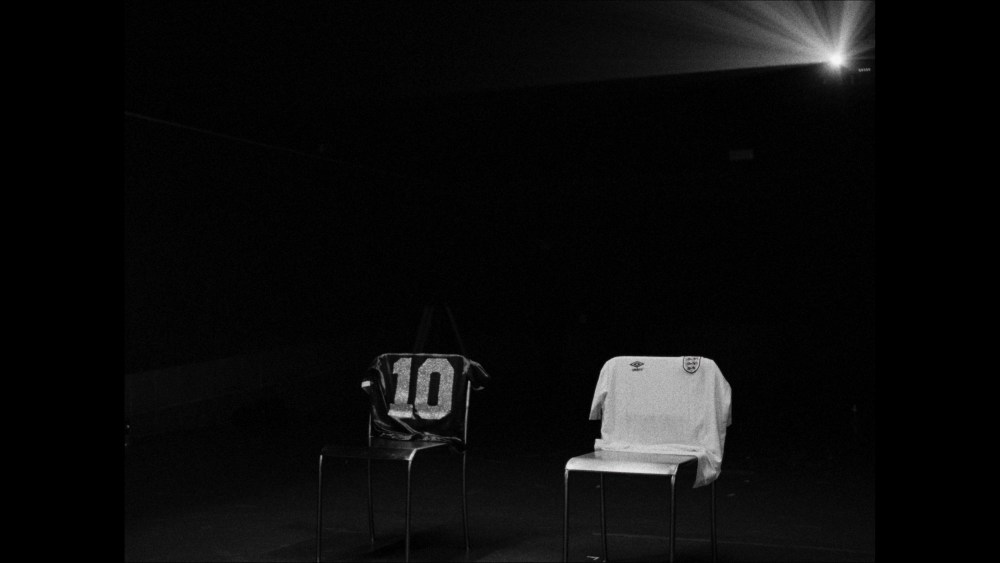
With the June 1986 fixture as its centerpiece, “The Match” plays temporal hopscotch, rapidly denoting the history of not only soccer, but of the Falkland Islands, the source of a dispute that would ignite an all-out English-Argentine war in 1982. (Or “Four years until The Match,” as the film notes). Its structure is deceptively simple. In stark black-and-white vignettes, men from both teams, now in their sixties, calmly reflect on the buildup while watching footage projected on enormous movie screens, placing these former TV stars within a cinematic context. They are both subjects and narrators, making personal the political tumult that was once foisted upon them, and which — through various media interviews — they were forced to answer for. Meanwhile, in color, archival footage strings us along, bringing us closer to the present, as the World Cup returns to Mexico after 40 years.
Both anniversary and pop document, “The Match” mirrors the two countries’ sporting histories with their geopolitical rivalry, setting the stage for a perfect storm of symphonic gameplay, in which the late Maradona — for better and worse —remains the unimpeachable standout. Like the bout itself, the film’s first half lays the foundations for all the drama, which its subjects (key among them, Englishman Gary Lineker and Argentine Jorge Valdano) look back upon wistfully, and even excitedly.
No matter how much time goes by, there’s a certain thrill to re-watching this particular footage, and doing so with the added context of everything from the mood in Azteca Stadium to both countries’ joint contribution to creating Red and Yellow cards (soccer’s cautioning system against violent play) makes it all the more delicious. Knowing the result doesn’t make the film any less invigorating, but as it happens, knowing nothing about the sport at all is just as rewarding too, as a defining peak into why “the beautiful game” is so globally beloved.
Although “The Match” seldom delves into the political details of the Falkland War, it features just enough footage of both countries’ leaders (Leopoldo Galtieri, Margaret Thatcher) to position soccer as a proxy battle fought by fans looking to exorcise the demons of wounded national pride. Caught up in this emotional melee are the players themselves, who — four decades on — have mostly come to peace with the skirmish, but occasionally find their old wounds picked at by the narrative at hand.
The film is essayistic in nature, and often forensic in its depiction of certain moments (the aforementioned hand ball especially), but it’s never academic. Its riveting rush lies in aping the structure of soccer itself, especially from the era, between its 4:3 aspect ratio — mirroring TV sets at the time — and its approximately 90-minute runtime, the length of the average game. In the process, it follows the very same ebb and flow of excitement and fleeting downtime that makes watching a World Cup match such an enthralling prospect. Most of all, it allows former rivals the catharsis, through intimate close ups, of being on the same side for once — the side of sport, and the side of cinema — as they revisit their heated enmity, and all the baggage that made that fateful morning such an enduring, magnetic flashpoint.