


Listen to this article
Estimated 3 minutes
The audio version of this article is generated by AI-based technology. Mispronunciations can occur. We are working with our partners to continually review and improve the results.
Despite a rainy spring, much of New Brunswick is in a state of moderate drought, which one environmental scientist says could mean problems for the summer ahead.
The most recent Canada Drought Monitor report from Agriculture and Agri-Food Canada reflects conditions up to April 31 and shows abnormally dry to moderate drought conditions all across the province except in the northwest.
This marks a slight improvement from severe drought in certain parts of the province last month. As of Feb. 28, parts of central New Brunswick were in extreme drought.
Matthew Alexander, a senior environmental scientist with Fundy Engineering with a PhD in groundwater hydrology, says drought conditions in the spring are “somewhat unusual” but are the result of last summer’s dry stretch.
“Last summer we had such a severe drought because we had very little precipitation in July, August and September, and it resulted in those conditions,” said Alexander, who was just elected mayor of Rothesay.
“It was going to take a lot of precipitation to bring us back up into non-drought conditions.”
According to last year’s data from the Canada Drought Monitor, the first signs of drought were reflected in a report on July 31, which showed much of the province was abnormally dry, with eastern regions in moderate or severe drought.
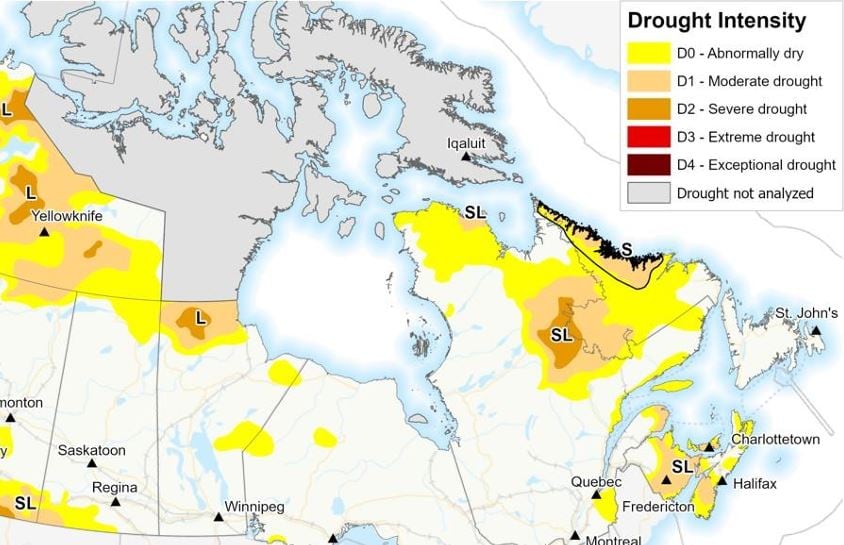 As of the end of April, most of New Brunswick was in moderate drought or abnormally dry conditions. The exception was northwest. (Canadian Drought Monitor)
By Aug. 31, the entire province had moderate, severe or extreme drought conditions.
“It means that we’re going to be starting at a sort of a deficit already,” Alexander said.
“They’re predicting a hot, dry summer again this year and if that occurs, then we could be seeing conditions that we were in last year, but they could actually happen sooner.”
According to Environment and Climate Change Canada’s seasonal forecast, there is a 66 per cent chance temperatures will be above normal from July until September.
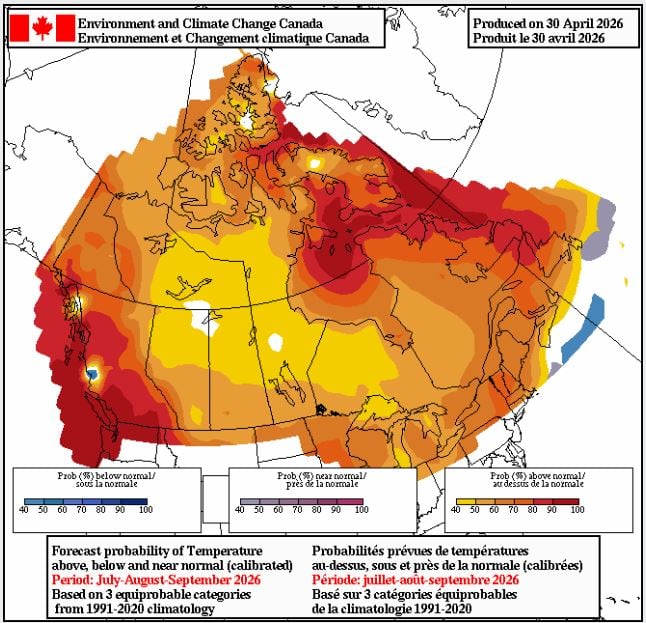 Environment and Climate Change Canada predicts temperatures from July to September will be higher than usual. (Environment and Climate Change Canada)
Precipitation levels are still unclear, with almost equal probability predicted for above, normal and below usual levels.
Many New Brunswickers experienced a dried-up wells last summer, and Alexander said this could happen again.
And even the precipitation in coming forecasts won’t relieve drought conditions immediately.
“It takes a very long time for water at the surface to actually make it down to the groundwater level that people are tapping into,” Alexander said.
“So, we could be months to two years before those levels really recover back to what they were.”
That timeline will depend on just how dry this coming summer is, compared to precipitation levels, Alexander said.
He said only about 20 to 30 per cent of rain actually makes it into the ground. Most of it runs off the surface or evaporates.
The province is encouraging New Brunswickers to conserve water as much as possible, with some solutions available online.
Spokesperson Vicky Lutes said in an email that “although conditions have improved, continued and sustained precipitation will be necessary to maintain this progress.”
“While both surface water and groundwater levels increased in April, most remain below normal.”