
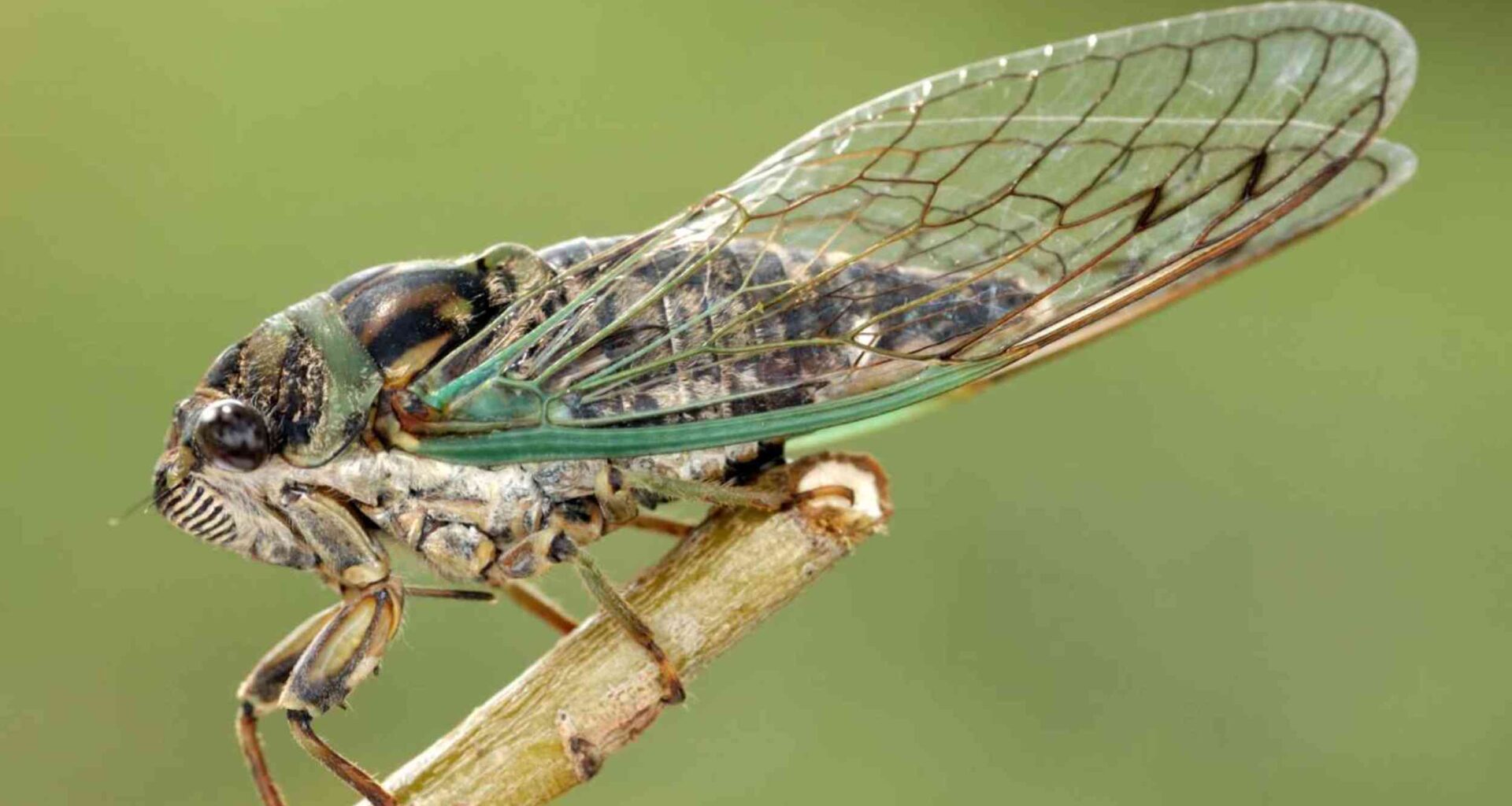
The empress cicada looks ordinary. It buzzes through Southeast Asian rainforests for a few weeks, then dies. Under a powerful microscope, its wings reveal something extraordinary.
The surface is covered in tiny columns – each one narrower than a virus – spaced with near-perfect regularity across the whole wing. Scientists just learned to turn that structure into a sensor capable of detecting molecules in quantities too small for most lab equipment.
A surface worth copying

The wing belongs to the empress cicada (Megapomponia imperatoria), a heavy-bodied insect found across Southeast Asian rainforests. Its wing skin is studded with vertical pillars resembling tiny bowling pins, each one roughly 74 nanometers across.
Those pillars sit in a hexagonal grid, evenly spaced and repeating. Engineers have spent years chasing that level of order. Chung-Hung Hong, lead author on the new work at China Medical University (CMU), decided to skip the chase and use the wing itself.
Cicada’s hidden pattern
Building artificial nanostructures with that level of uniformity usually takes specialized lithography equipment, clean rooms, and a lot of time. Each batch costs money. The cicada grows the same arrangement on every wing for free.
Hong’s team peeled wings from the insect, cleaned them, cut them to size, and mounted them onto flat supports. The natural pattern became the foundation – the hard work of getting nanoscale spacing right had already been done.
Coating wings with silver
The next step was adding a thin layer of metal. Silver works well for these sensors because it reacts strongly to visible light, which is why silver nanoparticles show up across this field. Earlier work has used the same metal on lab-built substrates.
Two coating methods went on the table. Sputtering knocks atoms loose from a silver target and lets them settle evenly across the surface, producing rounded cylinders.
Electron-beam evaporation produced something different. They produced sharper, more conical tips.
Finding the sweet spot
Getting the silver thickness right was the whole game. Coat it too sparingly and the gaps between pillars stayed too wide.
Coat it too heavily and the silver filled those gaps in entirely, burying the structure underneath.
The right amount – deposited by sputtering – left the pillars just barely separated from each other. The pillars were almost touching, and that tiny gap turned out to be everything.
Where hotspots live
When light hits two metal surfaces separated by a gap that small, the electric field in the space between them is thought to become enormous – concentrated enough to amplify the light signal dramatically. Researchers call these zones hotspots.
Those zones are the engine behind surface-enhanced Raman spectroscopy, amplifying a molecule’s light fingerprint from nearly nothing into a readable signal. Synthetic versions have existed for years but require costly lab-built structures.
The result on the cicada wing was striking. Compared with a plain, uncoated wing, the silver-treated version boosted the Raman signal by a factor of about a million.
To check that the geometry, not luck, was responsible, the team ran computer simulations. The numbers lined up. Cylindrical pillars at five-nanometer spacing concentrated the hotspots more tightly than the cone version did. The geometry confirmed the result.
No one had pulled off that step in quite this way before. A wing from a living insect, coated with two common methods, performed on par with the best lab-built sensors.
Molecules to medicine
What does that buy in practice? A way to spot molecules normally invisible to a sensor because there are too few of them.
Security teams and food safety labs already use surface-enhanced Raman spectroscopy for screening and testing. The cicada-based version could lower costs enough to expand the technology into more settings.
In medicine, sensors this sensitive could pick up disease biomarkers at concentrations far below what standard blood tests detect.
Earlier warnings for cancer, infection, or organ damage become realistic. Environmental teams could screen water or air for contaminants in minutes rather than days.
Expanding the technology
Hong and his collaborators at National Taiwan University (NTU) want to push the same trick into other wavelengths. Microwave and millimeter-wave detection are on their list, useful for sensing chemicals that don’t respond well to visible lasers.
Until this study, no one had shown that a real cicada wing, finished with off-the-shelf coating methods, could amplify a sensor’s signal a million times beyond what the bare wing produces.
Hong’s group achieved that result. Doctors could gain cheaper diagnostic strips, while regulators could receive faster pollutant alerts.
Borrowing from nature
They also see the door opening for other natural templates, including butterfly wings and plant leaves. Anywhere evolution has already worked out a fine-grained surface, engineers can borrow the design.
“We hope this research demonstrates how biological nanostructures can guide engineering design, opening a new path toward sustainable, low-cost, and highly sensitive sensing technologies,” said Hong.
The next generation of sensors may carry a fingerprint from the rainforest canopy.
The study is published in AIP Advances.
—–
Like what you read? Subscribe to our newsletter for engaging articles, exclusive content, and the latest updates.
Check us out on EarthSnap , a free app brought to you by Eric Ralls and Earth.com.
—–