
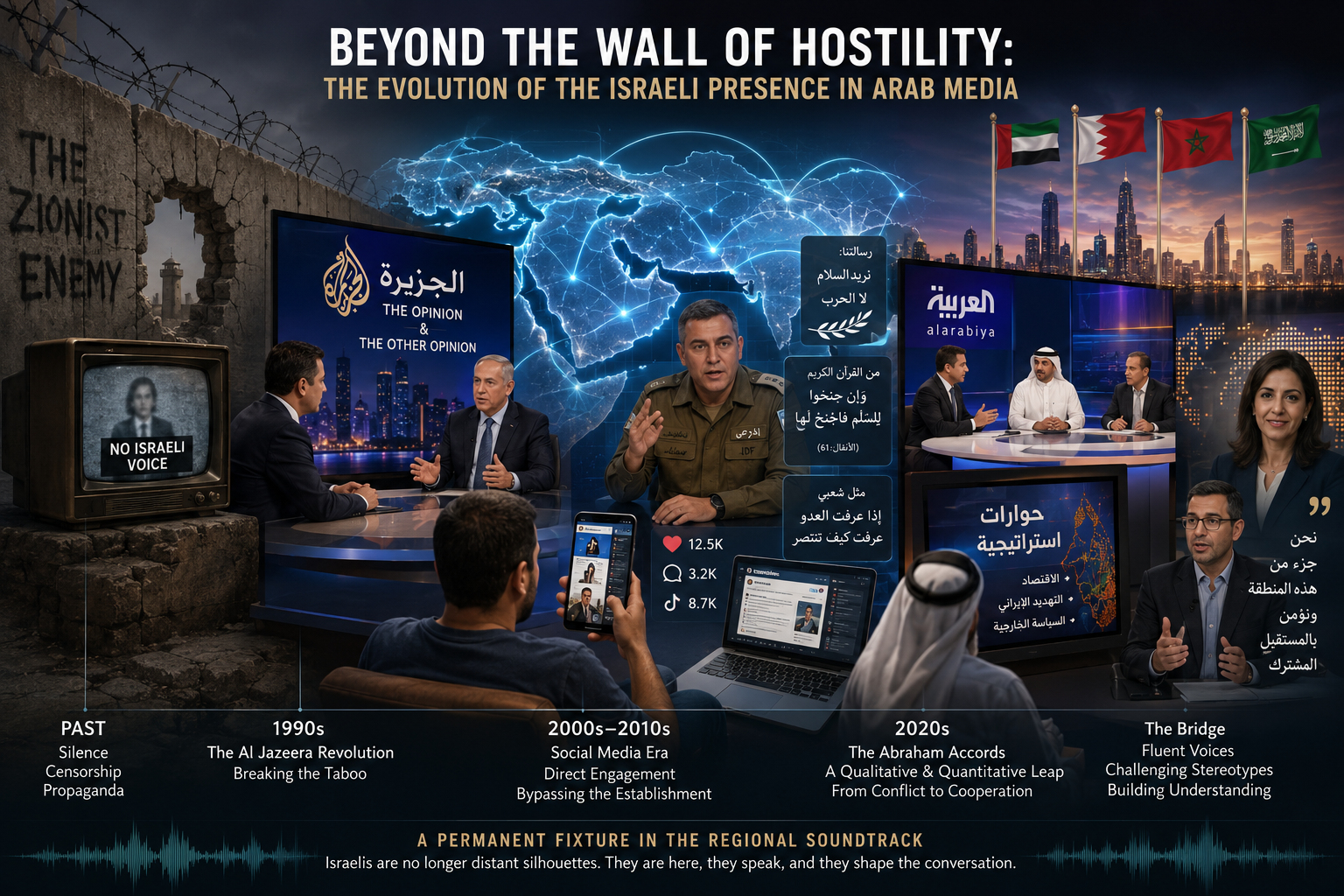
For decades, the appearance of Israeli speakers in Arab media was the stuff of science fiction. To the Arab mainstream press, Israel was a monolithic, distant entity, “the Zionist enemy”, whose voice was permitted only through the rigid filters of local propaganda and censorship. However, the last three decades have triggered a dramatic revolution, transforming Israelis from unseen adversaries into regular, and often fiery, participants in Arab public discourse.
Cracking the Taboo: The Al Jazeera Revolution
The historic turning point arrived in the mid-1990s with the launch of the Qatari network, Al Jazeera. Under its then-audacious slogan, “The Opinion and the Other Opinion,” the network stunned the Arab world by broadcasting Israeli politicians, military officials, and academics live on air.
For the first time, Arab viewers heard Hebrew, or Arabic with an Israeli accent, directly on their screens, unfiltered. While the move sparked immense public outrage and accusations of “normalization” at the time, it opened a dam that could never again be closed. Competing pan-Arab networks, such as the Saudi-owned Al Arabiya, were eventually forced to fall in line to remain relevant in the battle for credibility and ratings.
The Shift to Direct Presence: The Social Media Era
With the advent of digital media, the Israeli presence underwent a strategic shift: from passive interviewees at the mercy of Arab editors, Israeli entities, both official and private, became independent content creators.
Military Public Diplomacy: The IDF Spokesperson’s Unit in Arabic (notably under figures who became household names in the Arab world, such as Avichay Adraee) expanded its operations, becoming a social media phenomenon. By weaving Quranic citations, popular proverbs, and topical skits into their messaging, they cultivated direct, daily interactions with the Arab “street.”
Bypassing the Establishment: Social media platforms allowed Israelis, whether state institutions or Arabic-speaking influencers, to bypass the traditional hierarchies of regimes and television stations, speaking directly to the Arab public.
The Abraham Accords: A Qualitative and Quantitative Leap
The signing of the Abraham Accords in 2020 heralded an unprecedented wave of Israeli presence, particularly on Gulf-based networks like Sky News Arabia and major Emirati and Saudi channels.
At this stage, the discourse shifted significantly. It was no longer limited to wartime “hasbara” or shouting matches over the Palestinian issue. Instead, Israeli political analysts, journalists, and business leaders became routine participants in strategic discussions. They began appearing on professional panels debating regional economics, the Iranian threat, and foreign policy, increasingly regarded as legitimate partners in analyzing the Middle Eastern reality.
The Narrow Bridge: Fluent Arabic Speakers
A pivotal element of this evolution rests on the shoulders of Jewish media figures fluent in Arabic, alongside influencers and activists from Israel’s Arab minority who identify with the state. While few in number, their screen presence brought a new perspective: they challenged ingrained stereotypes about Israeli society, presenting it not as a uniform political or military bloc, but as a vibrant, multicultural mosaic with diverse social and political shades.
Conclusion: A Permanent fixture in the Regional Soundtrack
While deep polarization and geopolitical tensions, sharpened by recent conflicts, have left vast swaths of the Arab media landscape as “no-go zones” for Israelis, the Israeli presence in pan-Arab media is now a fait accompli. Israelis are no longer distant, cardboard cutouts; they are active, present, and influential players in the regional battle for hearts and minds. Whether through heated debates on satellite networks or via digital discourse, the Israeli voice has become an inseparable part of the new Middle Eastern soundtrack.
Former news editor in the IBA radio in Arabic and chief editor for the digital platforms in Arabic on both IBA and IPBC. He has written many articles in Arabic, English and Hebrew on various topics. He has academic degrees in Middle Eastern history, Member of the presidency of the Israeli Press Council, Member of the board of directors of the Journalists Association Jerusalem, Member of the board of directors of the Israeli Translators Association.