

Iran’s top negotiator and its foreign minister were in Doha on Monday for talks with Qatar’s prime minister on a potential deal with the US to end the three-month-old war, an official briefed on the visit said, after Washington and Tehran played down hopes for an imminent breakthrough.
US Secretary of State Marco Rubio told reporters in New Delhi earlier in the day that the US would give diplomacy every chance to succeed before considering whether to deal with Iran in “another way.”
There was a “pretty solid thing on the table in terms of their ability to open up the strait, get the strait (of Hormuz) open, enter into a very real, significant, time-limited negotiation on the nuclear matter, and hopefully we can pull it off,” Rubio said.
US President Donald Trump, meanwhile, said in a post on Truth Social that the deal with Iran “will either be a great and meaningful one, or there will be no deal.”
He reiterated his claim that the deal would be “the exact opposite” of the 2015 Joint Comprehensive Plan of Action negotiated under former US president Barack Obama, calling it a “direct and open path to a Nuclear Weapon for Iran.”
Get The Times of Israel’s Daily Edition
by email and never miss our top stories
By signing up, you agree to the terms
“I don’t do deals like that!” he added.
Strait of Hormuz central to current negotiations
Iran’s foreign ministry spokesperson Esmaeil Baghaei said in a weekly briefing on Monday that a conclusion had been reached on many topics, but that did not mean that “we’re close to signing an agreement.”
The official briefed on the talks in Doha told Reuters the discussions with Iranian negotiator Mohammad Bagher Ghalibaf and Foreign Minister Abbas Araghchi were focused primarily on the Strait of Hormuz and Iran’s stockpile of highly enriched uranium, while the country’s central bank governor is also part of the delegation to discuss the potential release of frozen Iranian funds as part of a final deal.
Baghaei said the potential memorandum of understanding contains 14 points and is focused on ending the war and the US naval blockade of the Strait of Hormuz, in exchange for Iran taking steps to ensure safe transit through the strategic waterway.
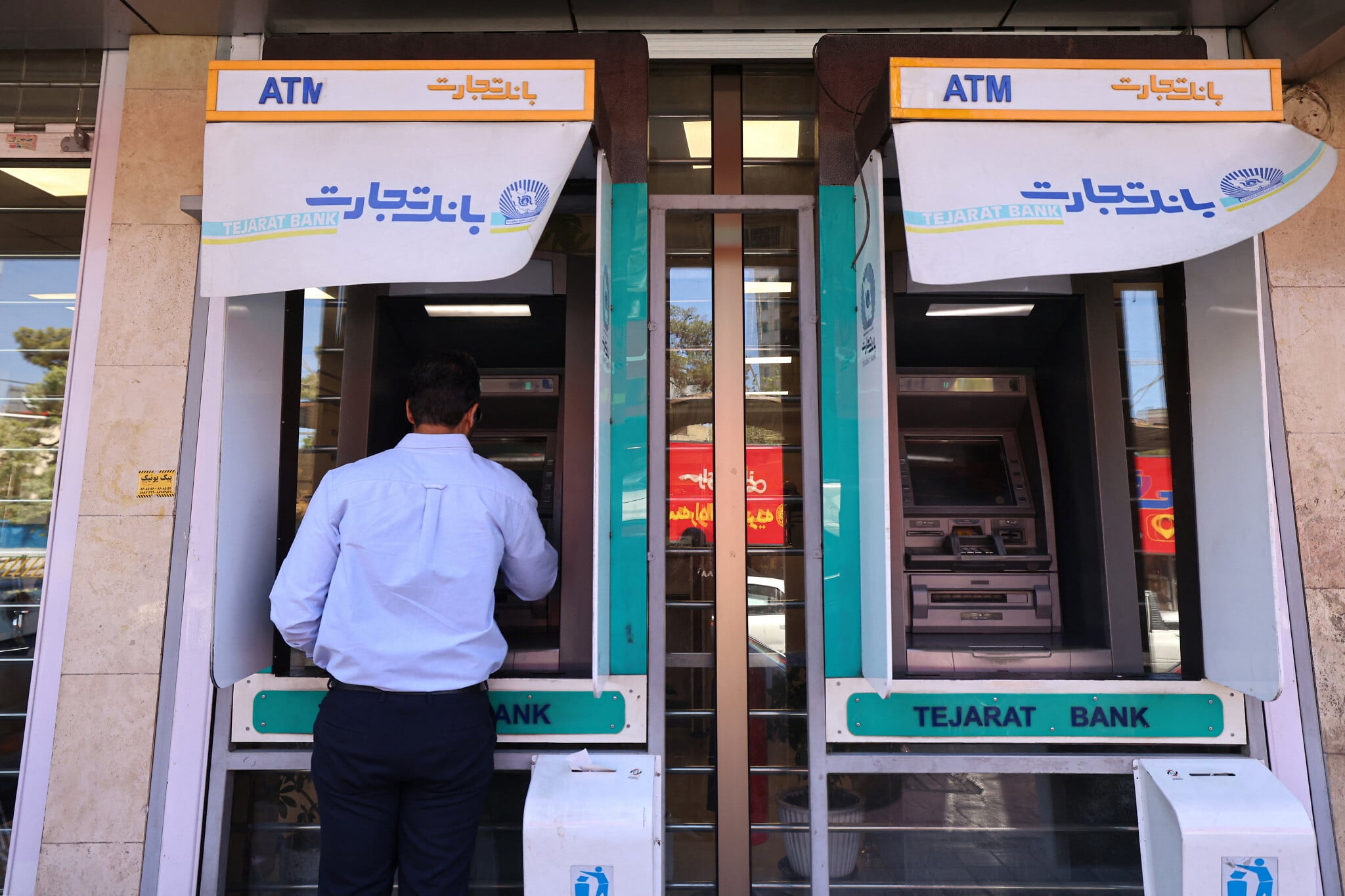
A man withdraws money from the Tejarat Bank ATM along a street in Tehran on May 25, 2026. (Atta Kenare/AFP)
He said the talks were not yet focusing on nuclear issues, however, which will be negotiated over a 60-day period if the framework accord is agreed.
The terms of the memorandum of understanding between the US and Iran have been widely reported to provide, first, for a 60-day extension of the current ceasefire.
The Strait of Hormuz will be reopened and Iran will remove the mines it has deployed in the strait in recent months. The US, for its part, will gradually remove its blockade of Iran’s ports. During the 60 days, Iran will be free to sell oil, and the US will lift some sanctions. If Iran implements various other steps, the US will thaw billions of dollars of Iranian assets held overseas. During the 60 days of negotiations, limitations on Iran’s nuclear program will be discussed.
According to Baghei, the current MoU contains no specific details on the management of the Strait of Hormuz, through which around a fifth of the world’s oil and liquefied gas usually flows.
He said Iran would not charge tolls for ships to pass through, but there would be a cost for services offered such as navigation and steps to protect the environment. These details would be worked out in a protocol with Oman, Baghei said, which shares the opposite shore of the waterway.
US stresses Israel’s right to self-defense
Rubio, amid reported dissatisfaction in Jerusalem over the terms of the emerging memorandum, emphasized on Monday that “Israel always has the right to protect itself.”
“If Hezbollah is going to launch missiles or launches missiles at them, Israel has every right to respond to that, or to prevent that from happening,” he said. “That’s always been understood. It’s being understood during the ceasefire.”
The war against Hezbollah in Lebanon is one of many key issues that remain unresolved, including Iran’s nuclear ambitions and its demand for the lifting of sanctions and the release of tens of billions of dollars of Iranian oil revenues frozen in foreign banks.
On Sunday, Israel’s Channel 12 reported that senior Israeli officials have also warned that the proposed deal does not address Tehran’s missile program or its regional proxy network.

A group of girls stand beside a ‘Khaybar-buster’ missile during a mass wedding ceremony for couples participating in the ‘Janfada’ (‘Sacrifice for Iran’) pro-government campaign in Tehran, Iran, May 18, 2026. (AP Photo/Vahid Salemi)
Even as efforts to reach a deal continued, Iran said on Monday afternoon that it had downed a “hostile” stealth drone using a new air defense system, Iranian news agencies reported, without saying where it had come from.
“This is a sign from us that no more stealth drones can penetrate the skies of the Persian Gulf,” Fars quoted unnamed officials as saying.
The apparent confirmation of a new air defense system being deployed in Iran coincided with an Israeli report citing US intelligence officials and a senior Israeli official claiming that Tehran had resumed production of critical weapons systems far faster than initially expected.
According to the Channel 12 report, Iran has restarted manufacturing ballistic missiles and missile launchers using surviving components, improvised underground facilities, and partially restored production lines, with assistance from Russia and China.
The report said Israeli defense officials now assess Iran could rebuild its drone capabilities within months and significantly ramp up ballistic missile production within about a year, or possibly sooner.
Channel 12 reported that updated intelligence assessments also indicate that roughly two-thirds of Iran’s missile launchers remain operational, contradicting earlier wartime estimates that about half had been destroyed.
The report added that US and Israeli intelligence officials are divided over how long Iran’s broader military reconstruction will take, though current estimates range from several months to a few years – rather than decades, as some officials had previously claimed.
Times of Israel staff contributed to this report.
You’re a dedicated reader

That’s why we started the Times of Israel – to provide discerning readers like you with must-read coverage of Israel and the Jewish world.
So now we have a request. Unlike other news outlets, we haven’t put up a paywall. But as the journalism we do is costly, we invite readers for whom The Times of Israel has become important to help support our work by joining The Times of Israel Community.
For as little as $6 a month you can help support our quality journalism while enjoying The Times of Israel AD-FREE, as well as accessing exclusive content available only to Times of Israel Community members.
Thank you,
David Horovitz, Founding Editor of The Times of Israel