
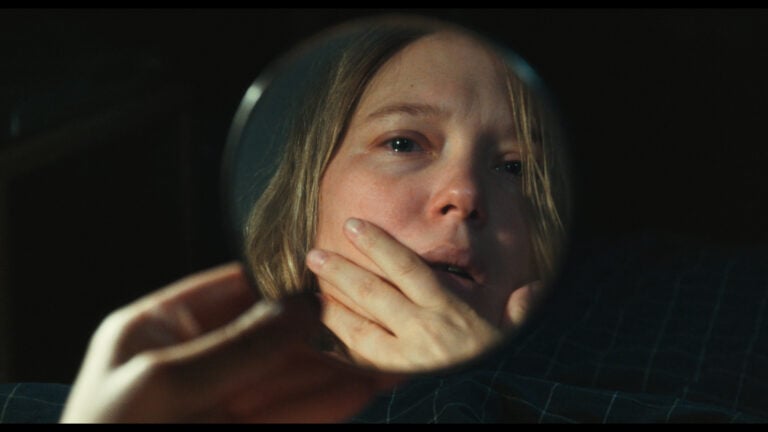
Snap judgments rule at Cannes, especially in an age of proliferating critics’ grids, timed standing ovations, and wall-to-wall awards punditry. But Arthur Harari’s mesmerizing The Unknown is a movie that works slowly, subcutaneously, on the viewer. No wonder that this highlight of the Competition was also one of its most divisive entries: the film cultivates a mood of creeping unease that lingers long after its haunting conclusion.
David (Niels Schneider), a 40ish photographer working on a secretive project to document long-term changes in the streetscapes of the greater Paris region, hooks up one night at a party with a woman he seems to recognize (Léa Seydoux). The next morning, he realizes he now occupies her body, which—some sleuthing reveals—once belonged to a German actress named Eva. When David, in Eva’s body, eventually locates his former physical self, it turns out to be housing a young woman named Malia (Lilith Grasmug).
Based on a 2024 graphic novel by Harari and his brother Lucas titled The Case of David Zimmerman—the English translation will be published this fall by Arsenal Pulp Press—The Unknown is notably uninterested in solving its implicit mysteries: how and why exactly the body swaps happen, how widespread the phenomenon may be, how it might be reversed, and so on. What emerges instead, as the film allows the implications of its outlandish premise to sink in, is an unnerving thought experiment about the utter strangeness of consciousness and embodiment.
Harari, who previously directed Dark Inclusion (2016) and Onoda: 10,000 Nights in the Jungle (2021), was last at Cannes in 2023 as the co-writer of the Palme d’Or– and Academy Award–winning Anatomy of a Fall (2023), directed by his partner, Justine Triet. A couple of days after his premiere, Harari spoke to me about the ideas underpinning his new film, and why cinema is a medium uniquely suited to expressing them.
I was talking about your film with some friends last night, and when we tried recounting the narrative, we felt compelled to diagram what happened. [Shows Harari photos on phone]
We actually had these kinds of diagrams in the film at one point—we shot them!
Did the writing process involve a mapping out of the various narrative intricacies and possibilities? It’s a film that dares to be quite narratively open and opaque, and the ambiguity is sustained to the end.
My aim wasn’t at all to bring confusion or ambiguity. What I wanted was something very simple that would, at the same time, provoke a feeling of vertigo. As I was writing, what came up was the idea of avoiding explanations. I felt that the characters would go through this experience in silence, and the film had to match that. There was a balance to find: not too opaque, but not too much explanation. I think this made the film more radical than I expected.
Was it a similar process with the graphic novel?
That’s precisely the difference between the graphic novel and the film. In the novel, there were more explanatory developments—or maybe I would say speculations, interpretations, attempts to approach explanations. This idea was at the heart of the writing for Anatomy of a Fall too: when you can’t explain or understand something, you try to approach the truth, and the more you try, the more confusion you create through words and explanations. Probably because we had done something like this in the graphic novel, I wanted to avoid it in the film, and I took the risk of not speculating too much.
As I haven’t read the graphic novel, I’m wondering if there are any tonal differences. The film is quite anguished and unsettling, and as I’m sure you know, the best-known body-swap movies tend to be comedies.
There was no comedy in the graphic novel either, but this tone probably comes from my obsession with making a realistic film. I didn’t want it to be a genre film. Even if something impossible was happening, I wanted it to be completely realistic all the way through. This also emerged in the editing—we shot scenes like the characters making drawings like those you showed me, but when we were editing, they didn’t make sense. The film tells you what it wants to be. You discover it when you see how the actors and the characters react to their bodies—bodies that they can’t recognize, that have been transformed. There was something else—something subjective and unsaid—and it didn’t match with explanations or diagrams or anything that would take us out of the subjectivity of this experience.
The question of realism is interesting. There’s an inherent realism with cinema—it’s an art of appearances that deals with the visible world. But your film forces an extra cognitive step in the viewer, where you’re always having to remind yourself that the character before your eyes is not who they appear to be, which creates a really interesting effect.
This is what I found fascinating when my brother first told me his idea for the story, and probably why I had the desire to turn it into a film. What we show, what we see, what we film is the phenomenon, the surface, the appearance. What is essential to us is unseen. I realized in making Onoda (and again, it’s always while making that I realize these things) that my purpose was to start from a distance, to be as far as possible from the character—ideologically, subjectively—and gradually get closer and closer, until we get inside. I really wanted the viewer to have this complete identification that doesn’t happen so easily in cinema.
It happens in literature, because with words, there is no boundary between the outside and the inside, the appearance and the essence. With words, you can go anywhere; you can get into the subjectivity of the material and the characters. Cinema has to find a way of reaching the interior. That takes time—the time and the depth of a narrative. You cannot start the film by being inside your character. This film is a way of questioning the paradox of cinema—the connection between what you see and what you know is there, what you are observing but cannot be seen.