
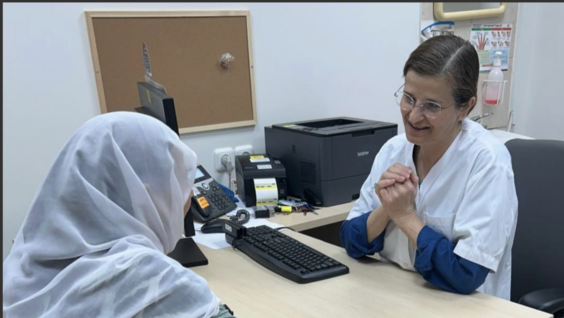
Maayan Hoffman’s profile of Dr. Nadia Khir begins with a woman who had every reason to stop and somehow never did. Raised in poverty in Peki’in, abandoned by her father at age 5, and pushed forward by the illness of a mother struggling to raise five children alone, Khir became Israel’s first female Druze doctor—and, in the process, helped change what Druze girls could imagine for themselves.
Khir’s story has the texture of a Sunday feature because the details do not need dressing up. She studied “on the weeds” because her family had no table. When the house was too noisy, she sat on the empty stairs of Jewish neighbors who had moved to Nahariya. She watched her sick mother seek treatment and decided she wanted to become someone who could help people when they were most vulnerable.
That dream was not simple. When Khir entered the Technion—Israel Institute of Technology in the mid-1980s, Druze society was far more traditional, and women leaving the village for higher education could face religious and social punishment. She worried not only about herself but about whether her mother would be ostracized. Support from her brother and a promise from Druze religious leader Sheik Farag Fadool helped her leave for medical school.
The Technion was another mountain. Khir had to study in Hebrew, compete with elite students, and carry the loneliness of being the only Druze woman in her path. Giving up, she says, “was never an option.”
Today, Khir works as a gynecologist in Clalit Health Services clinics in the Galilee, serving women in Julis, Tamra, Jatt, and Yanuh. She chose the specialty because Druze customs made women’s health care both culturally sensitive and urgently needed. Her three daughters are now pursuing medicine, electrical engineering, and software engineering.
Hoffman’s full article is worth reading because it is not only about one doctor’s rise. It is about poverty, willpower, women’s education, Druze identity, Israeli society, and the quiet revolution that begins when one person refuses to accept the limits handed to her.