
NASA says the meteor responsible for Saturday’s sonic boom released about as much energy as 300 tons of TNT as it broke into pieces 40 miles above New England.
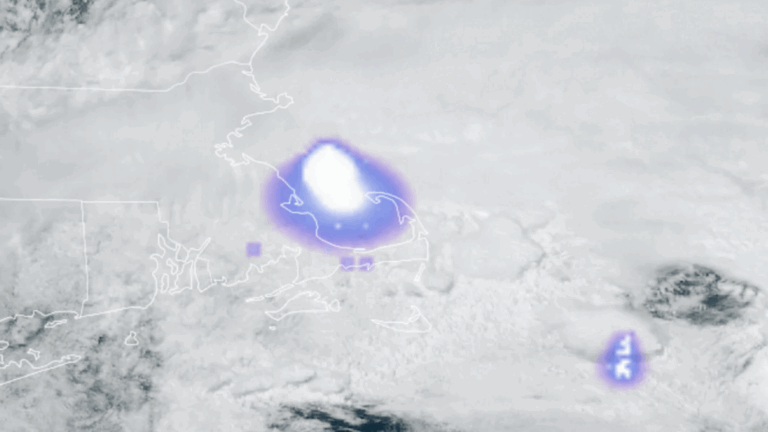
Satellite and radar imagery capturing the meteor crashing into Cape Cod Bay. NOAA
June 1, 2026 | 3:26 PM
2 minutes to read
The meteor that caused a sonic boom heard throughout Massachusetts Saturday released about as much energy as 300 tons of TNT as it broke into pieces and landed squarely in the middle of Cape Cod Bay, according to NASA.
“This fall into water is technically called a ‘fishy squisher’ in uber-serious scientific terms,” the agency said.
NASA described the falling meteor as a bolide, or an exceptionally bright type of fireball. The American Meteor Society logged more than 80 reports from witnesses who described seeing or hearing the phenomenon as far away as Ontario, Canada.
“We were driving on the highway and it just appeared out of nowhere and it looked like a missile falling or something,” one person from Montville, New Jersey, wrote.
Another witness from Sharon, Vermont, said they spotted the “highly brilliant fireball meteor” through their windshield while cruising down Interstate 89.
“It was a bright, vivid orange color and looked exactly like a blazing object engulfed in flames crashing down,” they wrote. “Because of my perspective driving forward on the highway, it created a strong optical illusion of falling straight down vertically into the distant tree line. Before disappearing from view, it looked like a rope of liquid lava. Brightest orange I’ve ever seen.”
According to NASA, the fireball fell around 2:06 p.m. and appears to have fragmented about 40 miles above the border between Massachusetts and New Hampshire. The meteorite pieces all landed in roughly 111 feet of water, the agency said.
“Most meteorites are strongly attracted to a magnet, and these ones are within reach of a 100′ length of rope dangled off of a boat,” NASA pointed out. “In case anyone is interested in such factoids.”
The original meteor was roughly 3 feet wide, or about the size of a large beach ball, and collided with Earth’s atmospheric shield at 75,000 mph, according to meteorologists at 1 Degree Outside. Still, the weather outlet suggested that Saturday’s sonic boom doesn’t mean Earth is at an increased risk of impact, as the atmosphere typically does an “incredible job” of burning up space debris before it can wreak havoc.
“Meteors are actually quite common,” NASA concurred. “They occur all the time, and fireballs can be seen on any given night. But they often occur over the ocean or unpopulated areas with no witnesses, or during the daytime, making them difficult to spot.”

Abby Patkin is a general assignment news reporter whose work touches on public transit, crime, health, and everything in between.
Sign up for the Today newsletter
Get everything you need to know to start your day, delivered right to your inbox every morning.