
The use of faunal tools by Neanderthals for their daily operations has intrigued researchers.
Archaeologists have long known that our distant cousins were skilled enough to make tools from animal remains.

Previous studies have shown the potential for using teeth from mammals such as bears, wolves, and foxes.
Now, researchers suggest that rhinoceros teeth may have also belonged in that toolkit.
A new multidisciplinary study suggests that Neanderthals might have used the teeth of extinct rhinoceros species as percussive tools.
The researchers think the Neanderthals may have used rhino teeth as soft hammers and anvils.
Study co-author Juan Marin is a professor at the National University of Distance Education in Spain.
“It’s a behavior that has not been identified in the Neanderthal world before,” Professor Marin tells Earth.com.
A strange discovery
At El Castillo Cave in Cantabria, Spain, and at Pech-de-l’Azé II in the Dordogne, France, researchers found hundreds of rhinoceros teeth. “This was the first thing that was strange to us,” says Marin.
According to Marin, archaeological sites typically showcase materials that Neanderthals could use. Bones and marrow are common in such sites.
But, “the teeth are something that you cannot use for eating or whatever,” he adds. “So the main question was, why are so many rhinoceros teeth in the sites?”
The team also found that these teeth had notches, pitted surfaces, and small fractures clustered on the biting surface.
The researchers hypothesized that Neanderthals might have used those teeth for making retouched elements.
They questioned whether these marks were evidence of deliberate tool use by Neanderthals, or were they simply the result of pressure, burial, and decay.
Testing the theory
To figure out what caused these marks, Marin and his colleagues analyzed 281 rhinoceros teeth from Middle Paleolithic sites.
They also examined 168 fossilized teeth from sites with almost no human presence to see what natural, post-depositional decay looks like.
The team tumbled three teeth in clay-and-sand sediment and water for seven days, and several tons of compressive force were applied to simulate natural, deep burial.
None of those buried teeth showed the same pattern of notches.
Natural processes like sediment abrasion produced smooth polishing, and mechanical compaction caused a few fissures, but nothing like the localized damage seen in the archaeological specimens.
This ruled out the natural cause and left human activity as the likely culprit.
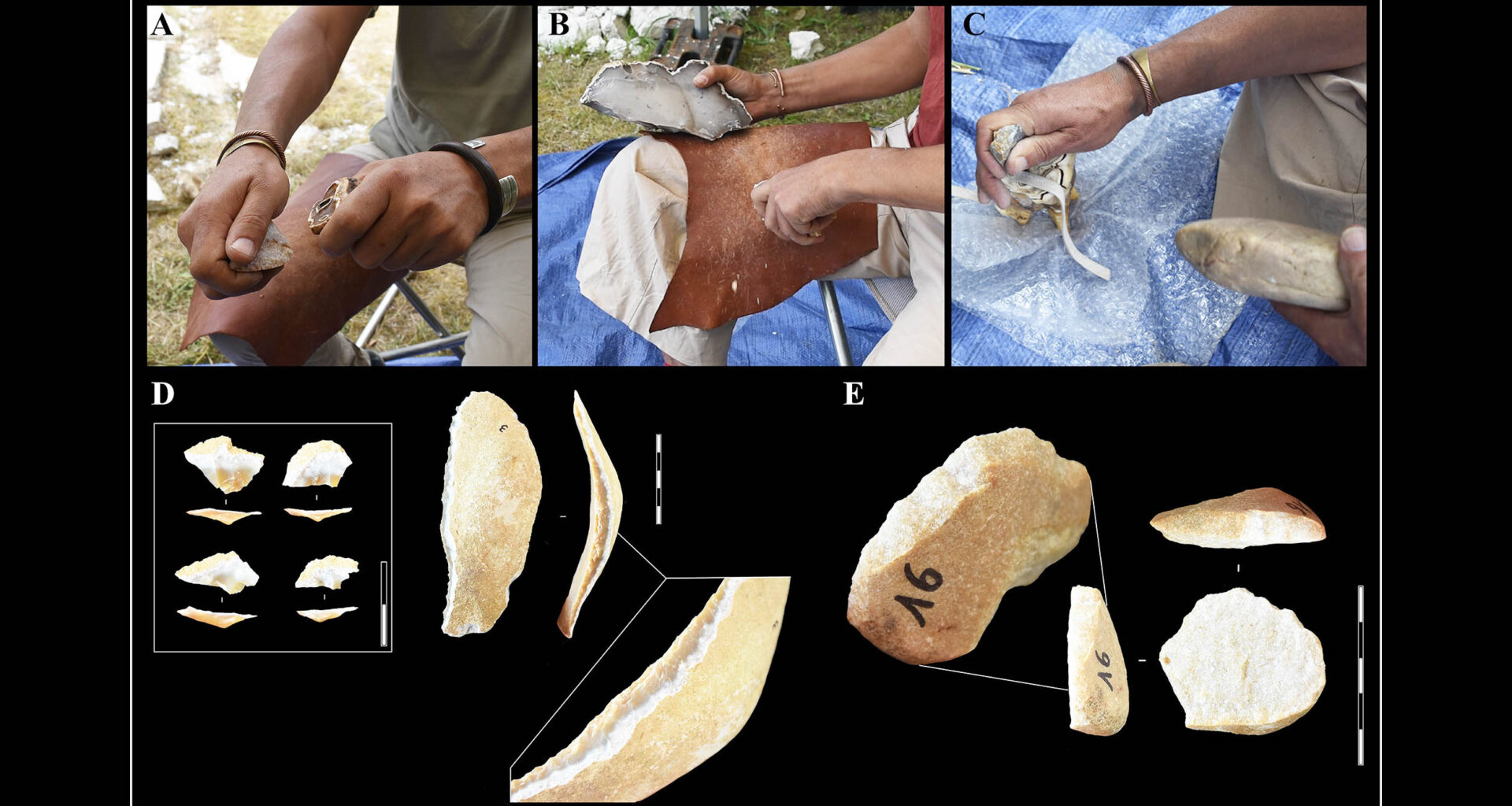
 Example of the activities carried out in the archaeological experiments and the associated products, proving Neanderthals likely used rhinoceros teeth as tools. A–C: percussive activities reproduced in this work: A) retouching quartz; B) knapping flint; C) tooth as an anvil with quartz flake. D–E: Lithics used for this work: D) Flint flake retouched with a rhinoceros tooth and retouch flakes; E) quartz flake retouched with a rhinoceros tooth. Credit: Journal of Human Evolution. Click image to enlarge.Reproducing the teeth marks
The extinct rhinoceros species known from the fossil record are long gone, and the theories cannot be tested on the artifacts.
Since rhinoceros teeth have a unique structure and exceptional hardness, no substitutes would do.
So, the team acquired 18 isolated teeth of modern rhino from three French zoos: the Safari de Peaugres, the Réserve Africaine de Sigean, and the Montpellier Zoo.
An experienced knapper used the teeth in a series of experimental tasks. He used them to retouch stone tools, knap flint, and, when placed flat, to cut plant fibers and leather.
Three experts in zooarchaeology and taphonomy observed and documented each session.
These knapping experiments produced marks that the researchers could then compare directly to the archaeological teeth.
To provide additional lines of evidence, the researchers conducted detailed three-dimensional reconstructions of surfaces at high magnification.
The aim was to look for microscopic wear that accumulates from chewing during an animal’s lifetime.
Inside the marks, the team found no tiny pits and scratches that would indicate a mark formed before the animal died.
The results point to the deliberate selection of rhinoceros teeth in their toolkits by the Neanderthals.
The upper jaw was intensely modified
The researchers found that the maxilla, the upper teeth, showed more intense modification than the lower ones.
“The rhinoceros teeth in the upper and lower parts are very different,” Marin told us.
Marins says that the upper teeth of rhinos are more square-like and are likely to have a flat surface.
“A rhinoceros’ teeth could have like a 7, 10 centimeter square, so it’s very big,” he adds. “The upper are more useful for that.”
The team also found that the marks were more dominant on teeth from the old rhinoceros. Marin told us that older individuals have a more worn surface of the teeth.
“The worn teeth have a very flat surface that they can use very well,” the archaeologist says.
The study has been published in the Journal of Human Evolution.
—–
Like what you read? Subscribe to our newsletter for engaging articles, exclusive content, and the latest updates.
Check us out on EarthSnap, a free app brought to you by Eric Ralls and Earth.com.
—–