
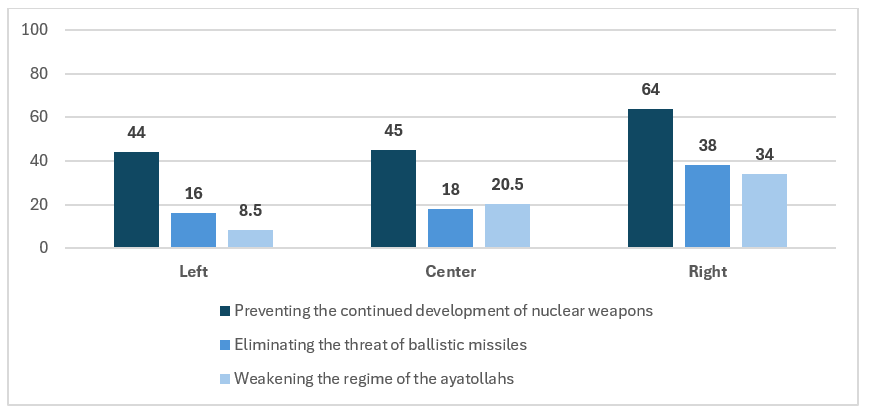
• Among the Arab sample, the share who think that the agreement will include a provision preventing the continued development of nuclear weapons is lower than among Jews (49% compared with 57%). By contrast, regarding the removal of the threat of ballistic missiles, the share of Arabs who think that the agreement will include the matter in question is higher than among Jews (37% compared with 30.5%). As for weakening the regime of the ayatollahs, Arabs are again somewhat more optimistic than Jews (33% compared with 27%). And yet it should be noted that except with regard to the nuclear threat, where there is a small majority of Jews who pin hope on the agreement, on the other questions only a small share believe that the agreement will serve Israel’s interests.
• A comparison among the three political camps (Jews) shows that on the Left and in the Center, less than half believe that an agreement between Iran and the United States, if signed, will include a provision regarding preventing the continued development of nuclear weapons. By contrast, on the Right, a majority of around two-thirds estimate that there will be such a provision. When it comes to removing the ballistic threat and weakening the regime of the ayatollahs, only a minority in all three camps believe that such provisions will be included in the agreement.
Assuming that the United States and Iran reach an agreement to end the war between them, will the agreement include or not include provisions to realize each of the following goals? (%, Jews)
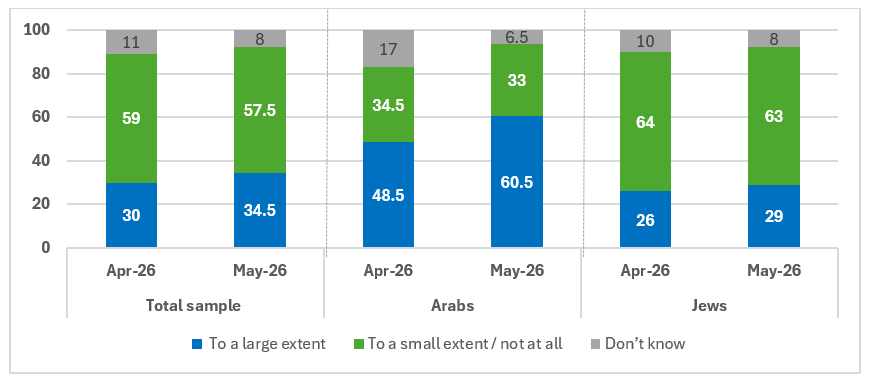
Is ending the war compatible with Israel’s security interests?
• A majority of the total sample (57.5%) think that ending the war with Iran under the current conditions is not at all compatible, or is compatible to only a small extent, for Israel’s security interests, similar to last month.
• Among Jews, less than one-third think that ending the war under the current conditions is compatible for Israel’s interests – a figure fairly similar to last month. Among Arabs, there was a significant jump in the share who think that ending the war is appropriate for Israel’s security interests.
If this means ending the war with Iran, to what extent is this compatible for Israel’s security interests? (%)
• Similar to last month, in all three political camps (Jews), less than one-third think that ending the war under the current conditions is appropriate for Israel’s security interests (Left – 30%, Center – 26.5%, Right – 29.5%).
The Campaign Against Hezbollah
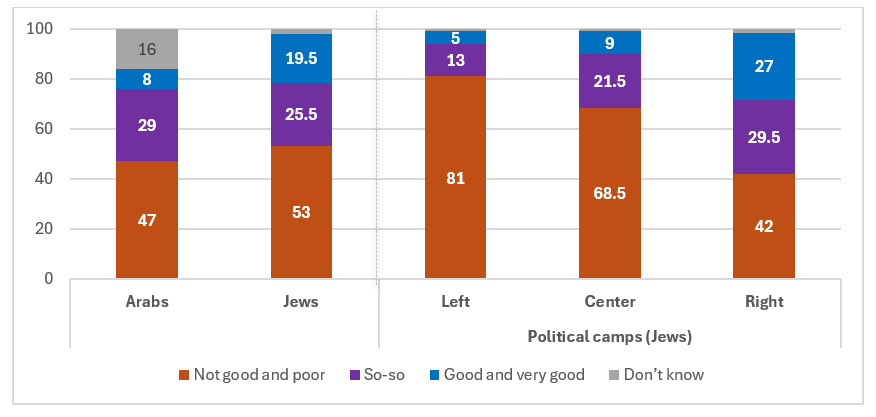
• 17.5% of the total public give Israel a good or very good grade for the way it is dealing with Hezbollah in the north (Jews – 19.5%, Arabs – 8%).
• On the Right (Jews), around one-quarter give a good or very good grade, while on the Left and in the Center only a negligible minority think so.
On a scale from 1 = poor to 5 = very good, what grade would you give to the way Israel is dealing with Hezbollah in the north? (%)
Limiting the Prime Minister’s Term of Office
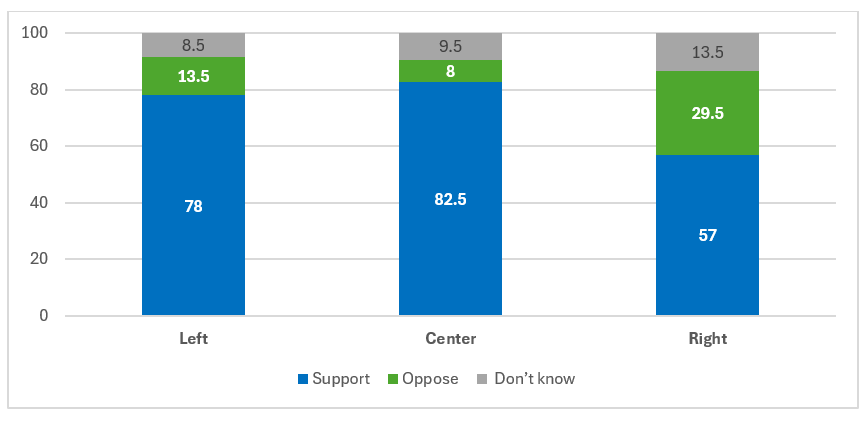
• 61% of the total public support a law that would limit the term of a prime minister to two terms, assuming that the law would apply only to those who begin their term after the law is enacted (that is, that the law would not apply to Prime Minister Netanyahu). One-quarter oppose it.
• Among Jews, 65% support limiting the term of office, while 22% oppose it. Among Arabs, identical shares (39%) support and oppose limiting the term of office, alongside a high share who answered that they don’t know (23%).
• A breakdown by political camps (Jews) reveals a majority in all camps supporting the term limit, although this majority is smaller among the Right.
Do you support or oppose a law that would limit the term of a prime minister to two terms, assuming that the law would apply only to those who begin their term after the law is enacted? (%, Jews)
Should Prime Minister Netanyahu Run in the Next Elections?
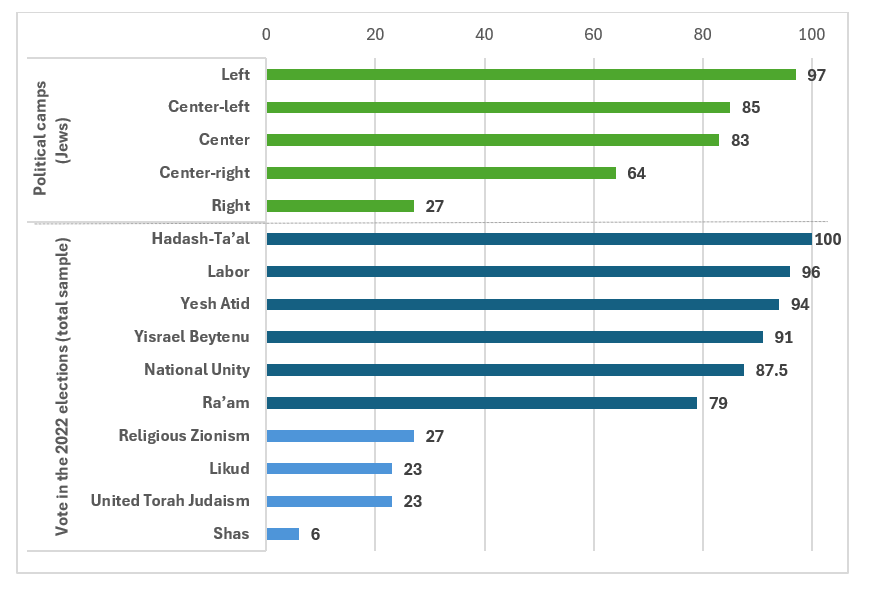
• 61% of the total public think that Prime Minister Netanyahu should not run in the next Knesset elections; 35% think that he should.
• Among Jews – 57% think that Netanyahu should not run, while 39.5% say that he should run. Among Arabs – 83% think that he should not run, compared with 11% who say that he should.
• An expanded breakdown by five political camps (Jews) reveals that the Right is divided: On the Center-right, a large majority – around two-thirds – think that Netanyahu should not run, while on the Right a similar majority (69%) think that he should run. As expected, a very large majority on the Left, the Center-left, and the Center think that Netanyahu should not run.
• A breakdown by vote in the 2022 elections (total sample) reveals that among coalition parties, there is a majority that supports his running in the elections, and yet – around one-quarter of Likud, Religious Zionism, and United Torah Judaism voters think that Netanyahu should not run in the next elections. As expected, a large majority of voters for opposition parties think that Netanyahu should not run.
Think that Prime Minister Netanyahu should not run in the next elections? (%)
The Political Blocs
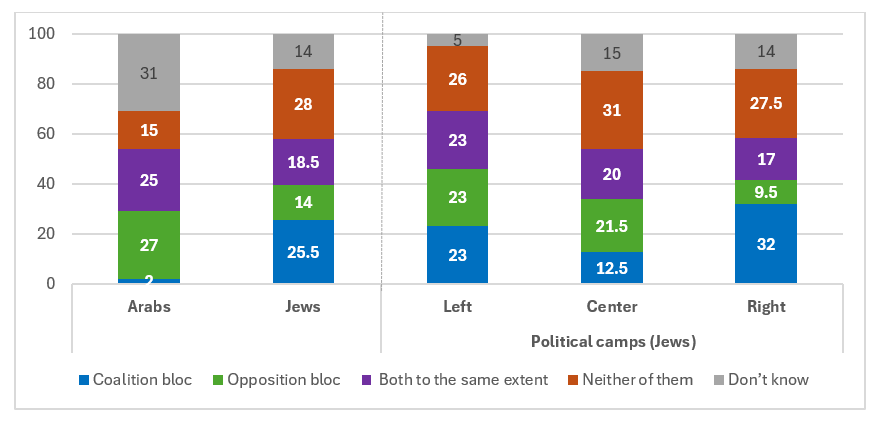
Which political bloc is more organized and prepared for elections?
• Among Arabs, around one-quarter estimate that the opposition bloc is more organized and prepared for elections; only 2% think that the coalition bloc is better prepared, and around one-third answered that they do not know. Among Jews, the largest share – more than one-quarter – think that neither bloc is currently prepared for elections; around one-quarter think that the coalition bloc is better prepared, and only 14% think that the opposition bloc is more prepared.
• Around one-third on the Right (Jews) say that the coalition bloc is more prepared for elections, while more than one-quarter think that neither bloc is currently prepared for elections. In the Center and on the Left, the largest share think that neither bloc is prepared for elections; in the Center, a higher share thinks that the opposition bloc is better prepared, while on the Left there is a tie in assessments of the blocs’ preparedness.
Which of the two political blocs is more organized and prepared for an election campaign at this time? (%)
Which bloc has a higher chance of forming the next government?
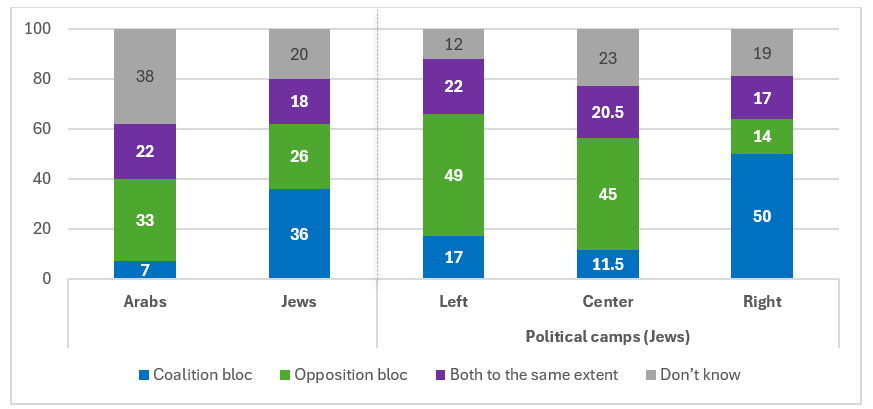
• Among Jews, the largest share – more than one-third – think that the coalition has a higher chance of forming the next government, compared with around one-quarter who think that the opposition does.
• Despite not assessing the opposition bloc as prepared for the election campaign, both on the Left and in the Center close to half think that the opposition’s chances of forming the next government are higher. On the Right, half assess the coalition’s chances as the highest.
Which of the two blocs has the highest chance of forming the next government? (%)
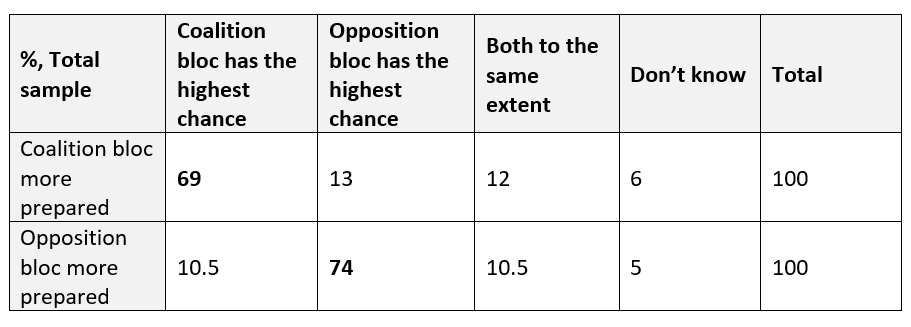
• A cross-tabulation of the two questions (total sample) reveals a strong connection between the assessment of the blocs’ preparedness and the assessment of the bloc’s chances of forming the next government: Among those who think that the coalition bloc is more organized and prepared, 69% think that this bloc will form the next government, and among those who think that the opposition bloc is more prepared, 74% think that this bloc will form the next government.
Losing and leaving?
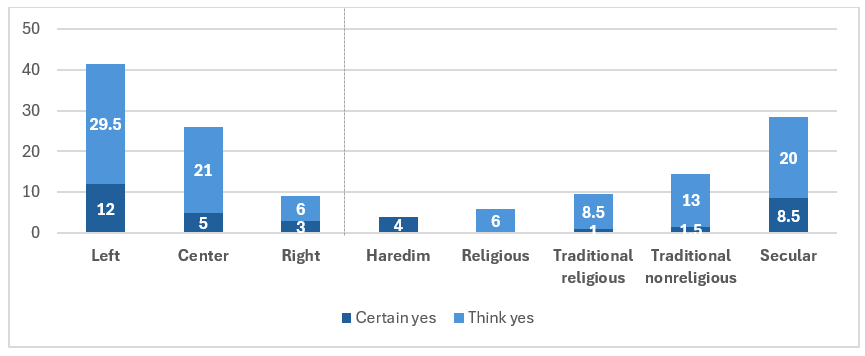
• About one-fifth of the total public (17%) think or are certain that they would consider leaving the country if the political bloc that they do not support wins the next elections and forms the next government. Jews – 18%, Arabs – 15%.
• A breakdown of the Jewish sample by political camps and by level of religiosity shows that among secular respondents (28.5%), as well as among those who identify with the Left (41.5%) and the Center (26%), the rates of willingness to consider leaving in a negative political scenario are the highest. The lowest rates are on the Right (9%) and among Haredim (4%) and religious respondents (6%).
Think and are certain that they would consider leaving the country if the political bloc that they do not support wins the next elections and forms the next government (%, Jews)
The May 2026 Israeli Voice Index was prepared by the Viterbi Center for Public Opinion and Policy Research at the Israel Democracy Institute. The survey was conducted on the internet and by telephone (to include groups that are not under-represented on the internet) between May 31 and June 5, 2026, with 603 men and women interviewed in Hebrew and 150 in Arabic, constituting a representative national sample of the entire adult population of Israel aged 18 and older. The maximum sampling error for the entire sample is ±3.57% at a confidence level of 95%. The fieldwork was carried out by the ShiluvI²R Research and Polling Institute. For the full data file, see: https://dataisrael.idi.org.il