

After a blistering run that sent prices to an all-time high of $5,608.35 per ounce in January 2026, gold has officially entered bear market territory. Spot gold prices have plunged more than 25% from their recent record highs, marking the precious metal’s first foray into a bear market since 2022.
What should investors in gold and gold stocks make of this fall?

Image source: Getty Images.
What has triggered the gold sell-off?
Gold was the undisputed darling for the last couple of years or so, delivering one of its most historic bull runs in decades. Gold prices surged nearly 160% between January 2024 and January 2026. Gold continued to appeal as a safe-haven asset to investors and central banks amid persistently high inflation and geopolitical uncertainty.
Gold’s sharp correction this year, though, has many investors scratching their heads. Inflation remains stubborn, and the conflict in the Middle East is arguably one of the most volatile geopolitical crises of our time. If history is anything to go by, the regional instability, in particular this should have triggered a massive gold rally.
Instead, gold is falling.
One reason is sticky inflation, which has forced the Federal Reserve to delay interest rate cuts. Annual inflation surged to 4.2% in May, according to the Bureau of Labor Statistics, to levels not seen since 2023. With prospects of rate cuts further dimming, institutional investors are pivoting toward U.S. Treasury bonds, which offer guaranteed yield, leaving non-interest-bearing assets like gold out in the cold.
What should investors in gold do?
Gold’s first bear market since 2022 may grab the headlines, but corrections are normal in commodity markets and bound to hurt companies whose revenues and cash flows are tied to the spot price of gold.
For instance, Newmont (NEM +4.67%) and Barrick Mining (B +5.35%) are among the world’s largest gold miners. On one hand, their balance sheets have rarely looked better. Thanks to the massive gold rally, both companies have generated billions of dollars in free cash flows in recent quarters.
On the other hand, both Newmont and Barrick have projected lower gold production for 2026, meaning they are pulling less gold out of the ground just as the price of gold is starting to drop. That is why both gold stocks are falling, especially after enjoying a massive run-up over the past year.
None of it changes company fundamentals, though. It’s all about how well investors can handle volatility. While it’s hard to predict where gold prices could head next, gold’s slide doesn’t mean it has lost its status as a safe-haven asset. Instead, what’s happening now is a stark reminder that in a high-interest-rate world, yield-bearing assets and cash are the king. It’s a dynamic market, and things can change quickly.
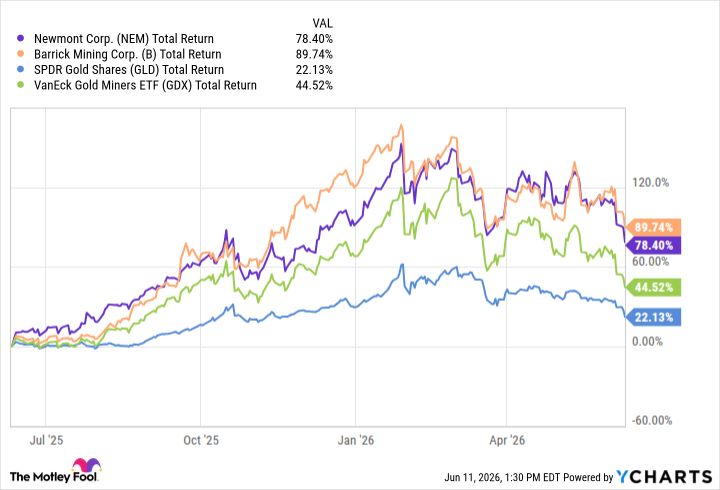
NEM Total Return Level data by YCharts
If you’re bullish on gold in the long term, treat this correction as an opportunity to buy, rather than a reason to panic-sell. If picking individual gold stocks feels too risky or daunting, gold exchange-traded funds (ETFs) are an efficient way to gain exposure to physical gold or a basket of gold stocks.
For a direct bet on gold itself, the SPDR Gold Trust (GLD +3.09%) is a top choice. It is the largest gold ETF backed by physical bullion, allowing investors to capture upside in gold prices at a low cost and without the risks of buying and holding the metal in its physical form.
For stocks, the VanEck Gold Miners ETF (GDX +5.47%) is the largest ETF focused on gold stocks. It owns shares in 60 of the largest global gold mining companies, mitigating single-stock risks. Its top three holdings include Newmont (11.4% of the fund’s net assets), Agnico Eagle Mines (11.2%), and Barrick Mining (8.6%).