Apple’s new AI model is the most powerful one the company has ever put on a phone. It runs completely offline too. During WWDC 2026, Apple showed off its third-generation Apple Foundation Models, known as AFM 3. The biggest reveal is a 20-billion-parameter model that runs on your iPhone without sending data to a cloud server. Here’s what changed, which devices get it, and why this goes past just specs.
How Apple AFM 3 Works
AFM (Apple Foundation Model) powers Apple Intelligence from Siri to dictation to photo editing. AFM 3, announced June 8, 2026, has five models: on-device and server.
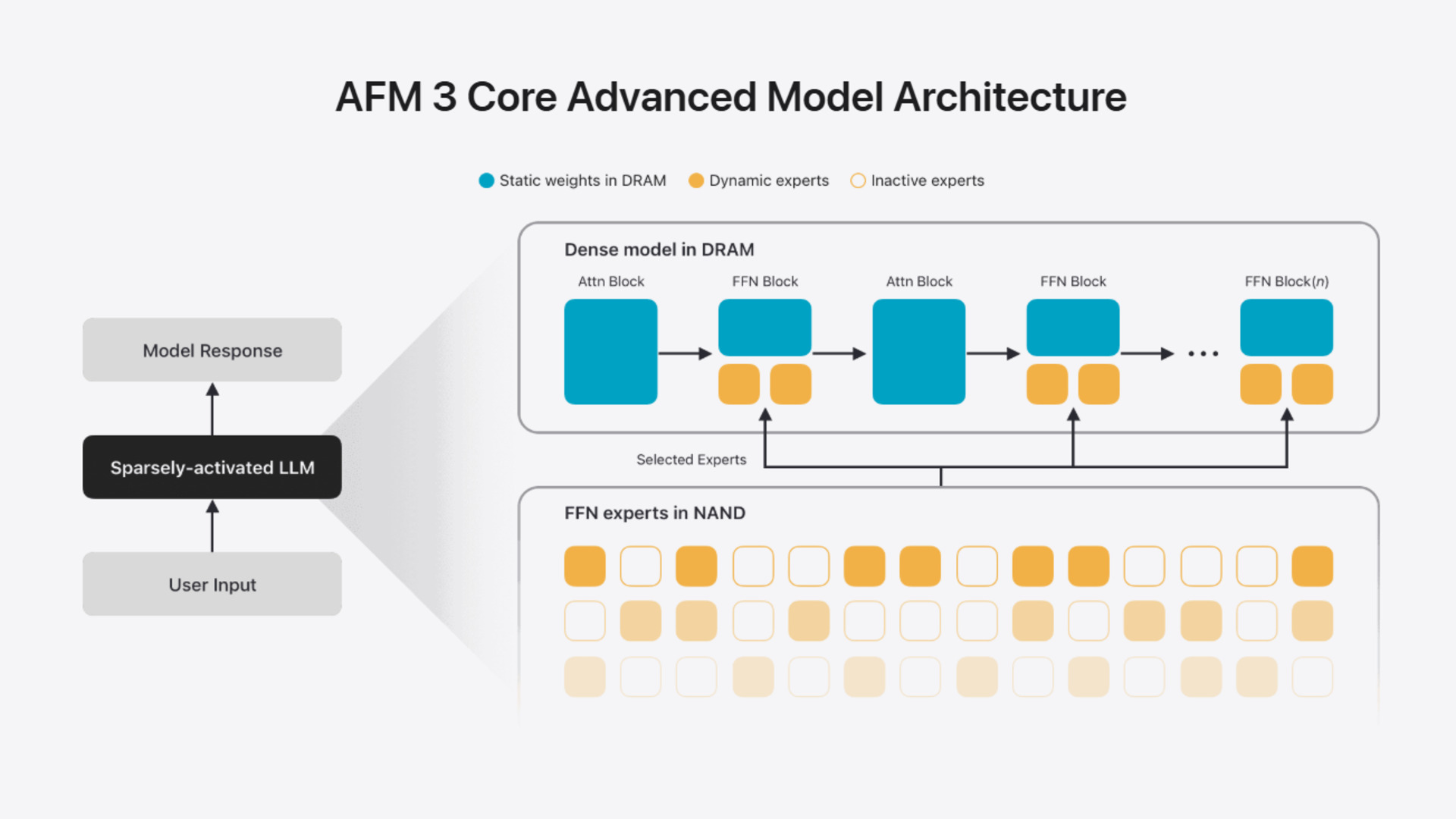
AFM 3 Core Advanced is the real story. It has 20 billion parameters using sparse architecture. The model activates only 1 to 4 billion per request based on the task. That’s how Apple fits it on a phone without draining the battery.
On-device models:
AFM 3 Core — ~3 billion parameters for everyday tasks like text suggestions and basic dictationAFM 3 Core Advanced — 20 billion parameters, handles text, images, and voice, but only works on Apple’s newest chipsServer-based models (via Private Cloud Compute):AFM 3 Cloud — general-purpose model for standard AI tasksADM 3 Cloud (Image) — dedicated to photo generation, Genmoji, and Image PlaygroundAFM 3 Cloud Pro — Apple’s most powerful model, designed for complex reasoning and multi-step agentic tasksAFM 3 Performance and Benchmark Results
Apple dropped detailed benchmarks, and the improvements are hard to ignore.
For text performance, AFM 3 Cloud jumped from 8.7% user preference (2025 model) to 64.7%. That’s nearly an 8x jump. On-device, AFM 3 Core moved from 23.3% to 45.6% preference. Overall satisfaction across all models improved by 36%. Instruction-following is up 21%.
Voice took a significant step forward too. Dictation quality preference rose from 17.6% to 44.7%. It improved across all six metrics including punctuation, casing, and meaning capture. Expressive voice now scores a Mean Opinion Score (MOS) of 4.15 to 4.24. That’s up 0.28 to 0.42 points from the previous generation.
Image understanding also improved. AFM 3 Cloud Pro showed a 14% gain over the standard cloud model for image tasks.
Apple, Google, and NVIDIA’s Role in AFM 3

In January 2026, Apple and Google said next-gen AFM would be “built with Google and its Gemini technology.” That raised questions about Apple outsourcing its AI.
The June 8 announcement tells a different story.
AFM 3 doesn’t contain “a drop of Gemini” for live processing. Gemini was used only during training for reinforcement learning refinement, not real-time requests. Apple, Google, and NVIDIA formed a partnership around infrastructure: AFM 3 Cloud Pro runs on NVIDIA GPUs in Google Cloud inside Apple’s Private Cloud Compute framework.
How Apple Handles Privacy in AFM 3
Apple’s privacy pitch for AFM 3 is consistent with its broader stance:
No personal user data is used to train any AFM 3 modelOn-device processing means data stays on your phoneServer-side processing happens inside Private Cloud Compute. Apple says it can’t access your data either.
Apple also confirmed AFM 3 includes bias-prevention measures. It has multilingual guardrails and red teaming by native speakers across supported languages.
Who Gets the 20B AFM 3 Model?
Not everyone. AFM 3 Core Advanced is the 20-billion-parameter on-device model. It requires Apple’s most powerful silicon. That likely means newer iPhone Pro models and M4-chip Macs, though Apple hasn’t confirmed exact devices yet. Older devices running Apple Intelligence will fall back to AFM 3 Core. That’s the 3-billion-parameter version.
The distinction matters practically. AFM 3 Core Advanced is natively multimodal. It understands text and images and generates expressive voice natively on-device. AFM 3 Core handles lighter tasks. Both represent significant upgrades over the 2025 generation.
What Can AFM 3 Actually Do?

For users, AFM 3 shows up through Apple Intelligence features rolling out with iOS 26:
AFM 3 becomes available when iOS 26 ships later in 2026, with features rolling out gradually through the year.
Why AFM 3 Matters for Apple’s AI Strategy
Apple faced years of criticism for its AI being too cautious and closed. AFM 3 changes that.
Putting 20 billion parameters on a phone is genuinely hard. Competitors like Google and OpenAI send everything to the cloud instead. Apple thinks privacy matters enough to users that they’ll prefer on-device processing.
There’s irony in the Google-NVIDIA partnership. Apple needed help building the cloud side. But the main promise still holds: iPhone AI runs locally, and your data doesn’t leave your device.
When iOS 26 arrives, users will decide if AFM 3 can compete with ChatGPT or Gemini in real use.
Jennie is a tech and AI writer at Memeburn, where she turns complex engineering into stories everyone can enjoy. With over two years of experience as a software engineer, she has built everything from smart automation tools to large-scale data systems. Because she knows firsthand how software is created, she has a knack for breaking down tricky tech trends and AI breakthroughs into clear, natural language. At Memeburn, Jennie uses her builder’s perspective to deliver fresh, insightful coverage on the latest in tech news, making advanced developer concepts accessible and engaging for all readers.