
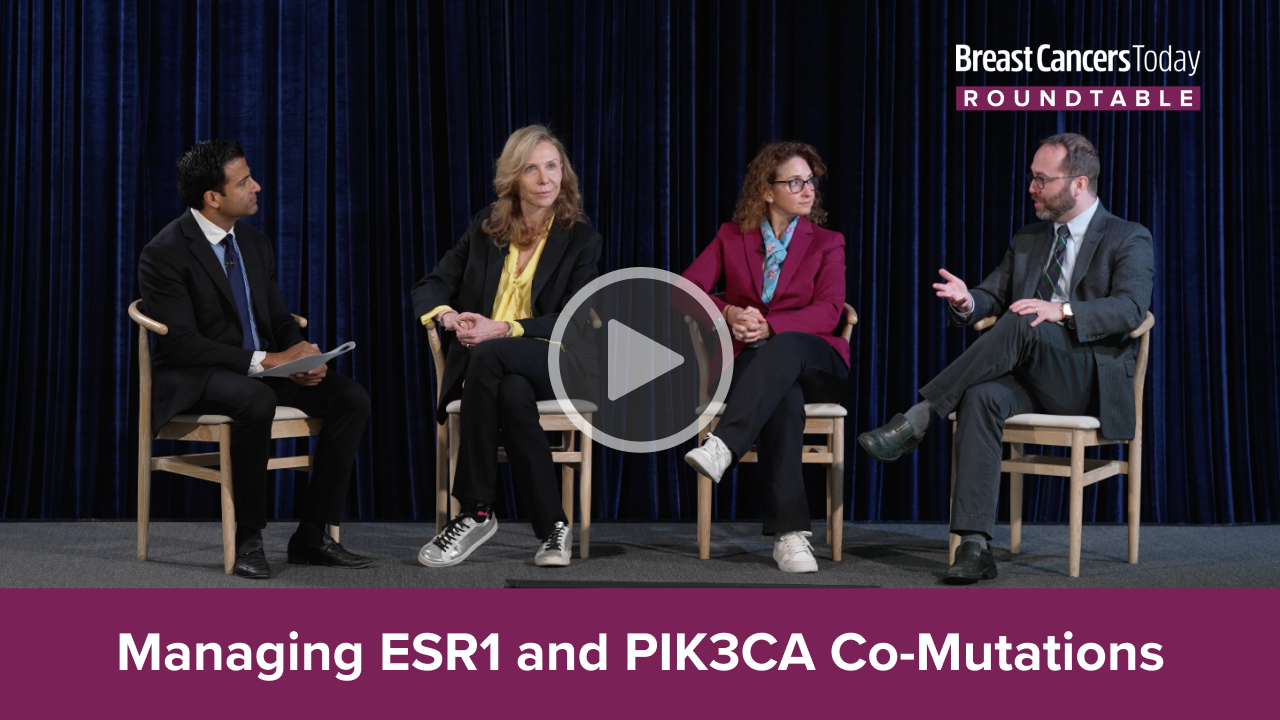
Drs. Seth Wander, Virginia Kaklamani, Monica Fornier, and Neil Iyengar examine the clinical challenges of managing patients with co-occurring ESR1 and PIK3CA mutations, including how to prioritize targeted therapies and balance efficacy with toxicity. The conversation expands to broader themes of personalization, unmet needs in later-line disease, and the future role of biomarkers and emerging therapies in guiding treatment.
Watch all four segments here:
ESR1 Testing in ER+ mBC: From Trial Evidence to Real-World Practice
Oral SERDs in ESR1-Mutated Disease: Clinical Differentiation and Use
What Do You Do After CDK4/6 Progression?
Managing ESR1 and PIK3CA Co-Mutations in ER+ Metastatic Breast Cancer
Transcript
Dr. Iyengar: So Monica, you mentioned co-mutations, particularly ESR1 and PIK3CA. And Seth, your group and other groups have published the activity of oral SERD monotherapy in the co-mutated setting. So then I guess I’ll ask the person in the middle, Virginia, what is your approach? Is it appropriate to use monotherapy for co-mutations or are you leaning towards combinations, or is there a different way that you differentiate when to use combinations for co-mutations versus monotherapy?
Dr. Kaklamani: Yeah, so when you look at the trials and the real world-data that’s been generated, the median PFS with a co-mutated subset of patients is regardless of whether you give a single agent SERD or you give a combination with a PI3 kinase inhibitor, it’s around five and a half months.
And so we know that these patients have more endocrine-resistant disease because of the PI3 kinase and the ESR1 mutations. I think that’s why it’s exciting to look at a combination of, let’s say, elacestrant and camizestrant, which is gonna be presented in a couple days, and that’s really what we were all hoping for.
So for now, based on all of these approvals, I try to do what Monica does. I really like my single agent oral SERD in the patients that have signs that they will have a good response to that next line endocrine therapy. If I see disease that seems to be a little bit more resistant and, you know, we’re using these definitions of sensitive and resistant wrong, but clinically that’s what we have, then I might think of giving that combination.
Again, thinking about the fact that if a patient doesn’t feel well on one of these drugs, they’re gonna discontinue both of these drugs and then they’re gonna come back into my office in a month having been on no therapy for a whole month.
Dr. Iyengar: Yeah, I think that’s so important, the adherence piece and-
Dr. Fornier: Absolutely, they don’t even start it sometimes because they’re concerned about side effects.
Dr. Kaklamani: And they might read the package insert, which even though you explained the drug it was in your office, then they take time or the pharmacist might tell them something and then they’ll come back and say, “Oh, I just didn’t feel comfortable taking it.”
Dr. Fornier: Right, exactly, a month later.
Dr. Wander: I think this is also an underappreciated point that everybody’s bringing up, which is, there are really two areas, in my opinion, of significant unmet need in the second line metastatic ER-positive setting.
We all have for a long time appreciated the fact that in a patient who has no mutations, right, no ESR1, no PAM alteration, this is an area where we don’t have adequate therapies in the post CDK4/6 setting. You’ve got fulvestrant, you’ve got maybe everolimus-based therapy, you’ve got first generation CDK after CDK. None of that is really exceeding, to your point, five to six months.
On the opposite side, the dual mutants are also, I think, an underappreciated area of unmet need where we know that they’re doing a little bit worse. We know that our conventional, you know, either doublet current generation PI3K/AKT, or single agent SERD doesn’t seem to kind of carry as much weight as it does in the single mutant.
So we’re doing better in the single mutant populations in the middle, but we’re struggling, I think, on the edges and we have good options coming on both sides for patients with no mutations and for patients with dual mutations. And so hopefully even just a year from now, we could be sitting down saying we have new options for both of these.
Dr. Iyengar: That’s great, and you perfectly foreshadowed my last question, which is what are the areas that you see as the most pressing unmet needs and how do you see this field progressing over the course of the next year if you take out your crystal balls. So we heard from Seth. Monica, let’s hear from you.
Dr. Fornier: I think selection of patients is the most important because I think we have to keep in mind toxicity a lot as we were just discussing. And so, if we could, you know, even though the SERENA-6 data is kind of compelling and interesting, but if we could somehow identify those patients that perhaps are going to have a faster progression or maybe with more visceral involvement, and so selecting them for more aggressive, so to speak, or maybe a doublet, maybe a triplet therapy and instead other patient that will do well with an oral SERD, I think to try to tailor better, I think that’s the most pressing, in my opinion, to try to spare toxicity for those people that might be doing great on an oral SERD or might just switch to a different CDK4/6 inhibitor, for example, and stay on the same endocrine therapy. I personally, that’s what I would like to see.
Dr. Iyengar: Truly personalized optimization. Virginia?
Dr. Kaklamani: So, this is really an exciting time. A few years ago we surpassed the five-year median overall survival in the metastatic year positive setting, which is really amazing to think about. And so we have all of these options and the reason we spent all this time talking about all of this is because of all of these options that we have.
And so, I’m hoping in the future, we do a couple of things a little bit better. First of all, deal with the adverse events of the drugs before these drugs get approved, understand how to deal with the stomatitis that’s happening, the hyperglycemia, the rash. And so, when this drug goes into clinic, we know how to treat our first patients instead of playing catch up and having these drugs approved and then five years later realizing that, “Oh, we should have given a steroidal mouthwash or we should have given metformin to mitigate the hyperglycemia.”
So that’s number one, and the second one is finding biomarkers of response and we still don’t have any biomarkers of response for CDK4/6 inhibitors. Like Monica said, do you really need to give a CDK4/6 inhibitor in the first line or can you give it in that second line? We have no clue.
So these are things that I feel our drug development can do better with so that once we have a drug approved, we can actually be able to use it for the appropriate patient.
Dr. Iyengar: Yeah, this is so exciting and thank you for all of those points to the full panel. And I think, Virginia, you brought this up earlier, but it’s sounding a lot to me that this is such a great opportunity for machine learning and the ability to pick up patterns, right, and individualize in that way.
So I suspect, and we’re already seeing these models that are being developed. So I suspect we’re going in that direction quickly. I want to thank my esteemed panel for joining today and hearing all of your excellent insights as this field gets more and more complex.
But I think you really gave us some pearls in terms of how to digest the data and actually apply it in our clinical practices. So thank you very much for this great discussion.