
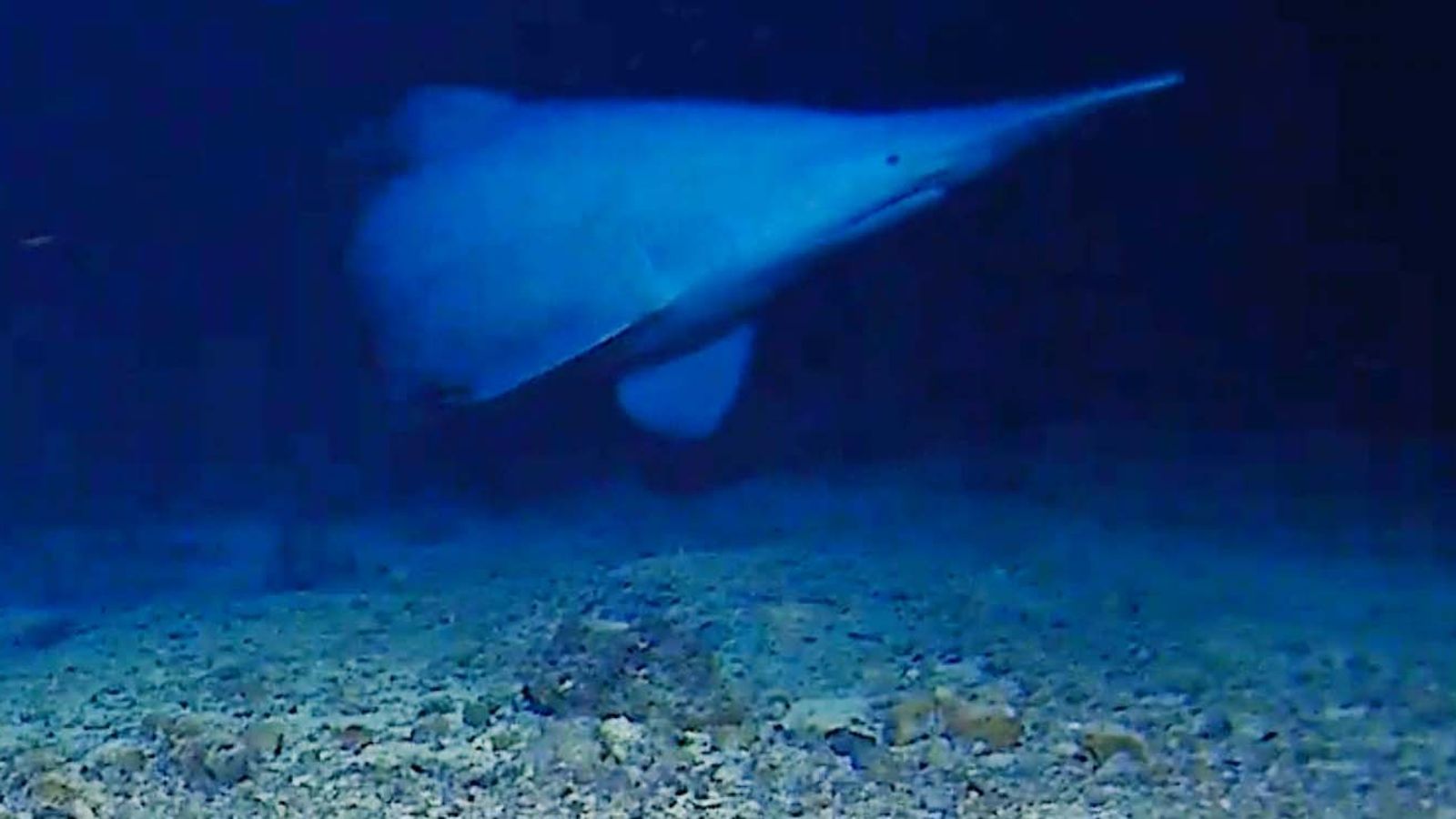
A rare, deep-sea goblin shark has been studied alive in its habitat for the first time.
A team of oceanographers at the University of Hawai’i at Manoa reported two live observations of one of the most elusive sharks on the planet in the Journal of Fish Biology.
Previously, the sharks had only been filmed and reported alive after being hooked on a fishing line and hauled to the surface. There, divers could observe them, but the sharks soon died.
What to know about goblin sharks
Goblin sharks have a long history.
They come from a lineage of sharks that is nearly 125 million years old – but they’re the only representatives left of their family.
For that reason, they’re sometimes called “living fossils”.
They are objectively weird-looking.
One shark expert told the Guardian they are “ridiculously horrendous to look at”.
“Not even their mother would love their faces,” according to Professor Culum Brown from Macquarie University.
Goblin sharks have long, pointy heads, semi-translucent skin and jaws that act like a rubber band when they feed, according to the Ocean Conservancy charity.
Their jaw catapults forward, grabs its prey and then retracts back into its mouth at a speed unmatched by any other animal on Earth.
They can also grow up to seven metres long and have flabby bodies that are likely due to a slow metabolism, often seen in deep-sea creatures.
However, while talking to colleagues, the study’s lead author, Aaron Judah, heard there had been a potential goblin shark sighting during an expedition in 2019.
That expedition was exploring deep-sea ecosystems near Jarvis Island, a protected wildlife refuge around 1,305 nautical miles south of Honolulu.
“I was shocked to hear this because this species was not known to be in the Central Pacific,” Mr Judah said.
He combed back through footage from the expedition and discovered that the team had, in fact, documented a goblin shark during a livestreamed dive northwest of Jarvis Island.
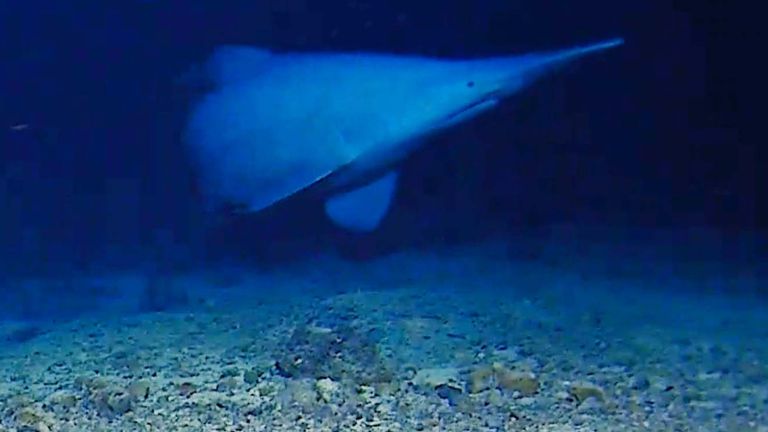
Image:
A goblin shark in the Tonga Trench. Credit: Minderoo-UWA Deep-Sea Research Centre and Inkfish
A second sighting came about when a team exploring the Tonga Trench in 2024 captured footage of a goblin shark in its natural habitat using a baited camera.
“The Goblin Shark is one of these deep-sea charismatic animals that I never thought we’d see alive, and then to do so was amazing, but to then learn that colleagues in Hawai’i also saw one was just incredible,” said Alan Jamieson, professor and founding director at the Minderoo-UWA Deep-Sea Research Center, who documented the 2024 sighting.
Mr Judah said seeing the “most iconic of all the deep-sea sharks alive and looking healthy in its natural habitat” was a “unique honour”.
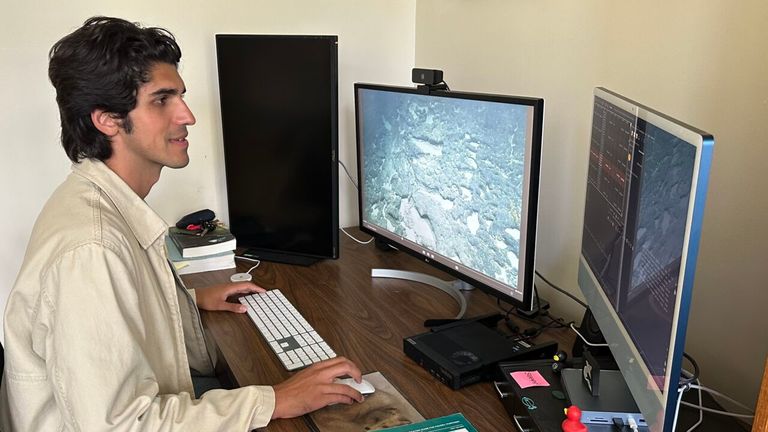
Image:
Aaron Judah combing through archive footage to confirm the goblin shark sighting. Pic: University of Hawai’i at Manoa
“I was also very surprised about how deep this species was found. The observation from the slope of the Tonga Trench is nearly 700 meters deeper than this species was known to live,” he added.
The new observations significantly extend the known range of the sharks, both in terms of depth and geography.
Read more from Sky News:
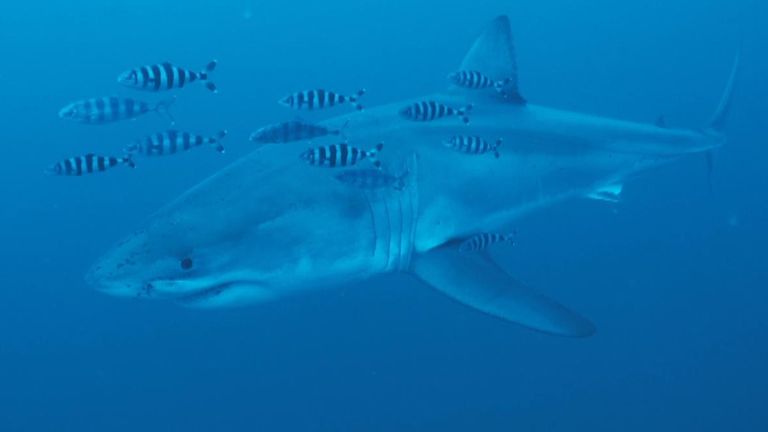
First-ever video of Great White shark in the Med
Risk of El Nino raising global temperatures
Share
First-ever footage of great white shark in the Med
“New discoveries like this demonstrate that there is still so much to explore in our deep-ocean home,” Mr Judah said.
“Given the newly expanded geographic range of the goblin shark, this species can be included in regional management and a nation’s biodiversity list, whereas beforehand we didn’t know it was even there.”