
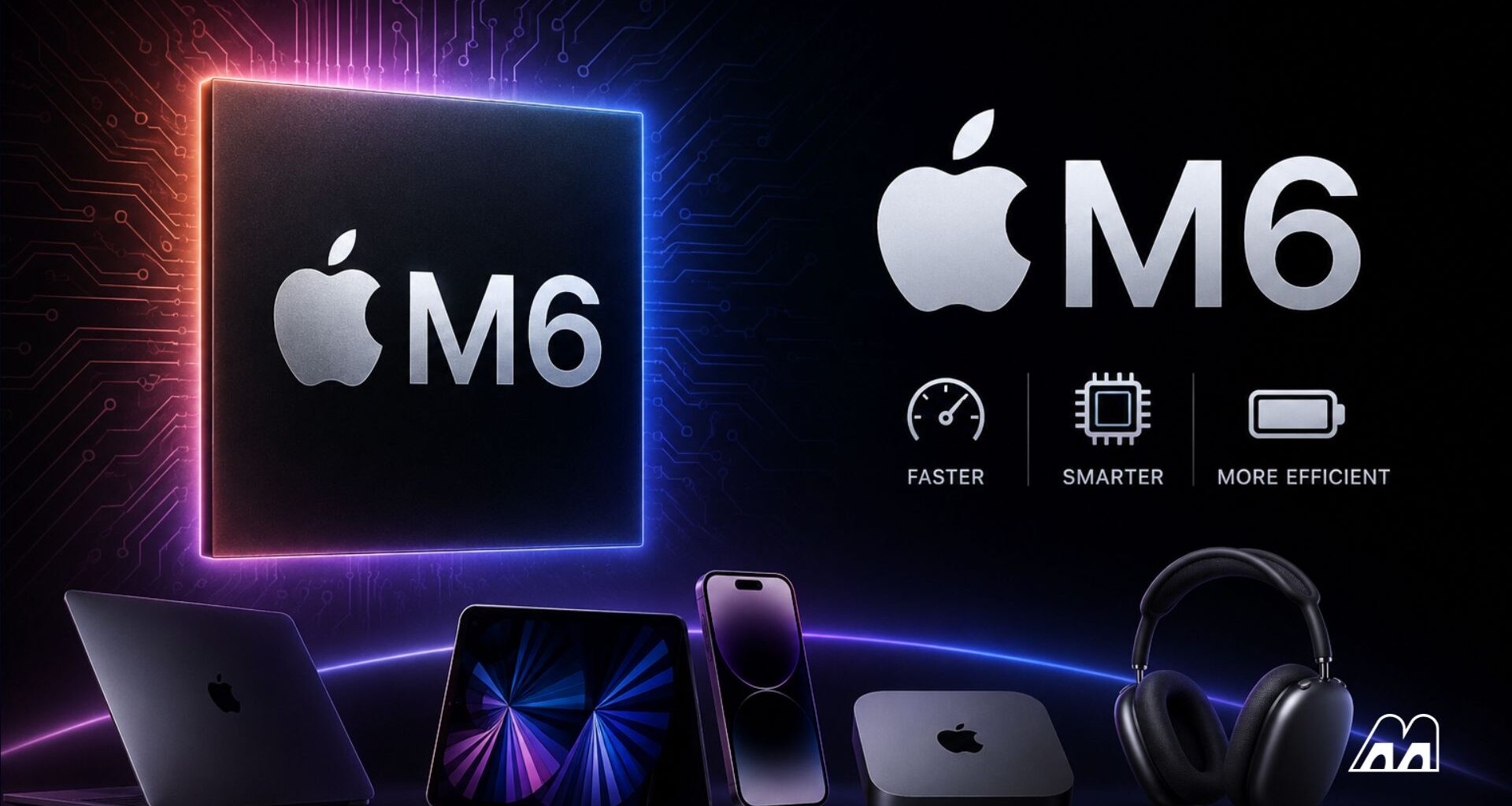
Apple’s upcoming M6 chip is shaping up to be the company’s biggest silicon upgrade since the M1 era. Built on TSMC’s 2-nanometer manufacturing node for the first time, the M6 is expected to power a wave of redesigned Macs and iPads starting this fall, headlined by a laptop Apple may brand the MacBook Ultra.
Here is everything we know so far about the Apple M6 chip release date, confirmed specs from supply chain reports, and which products are rumored to get it first.
What Is the Apple M6 Chip?
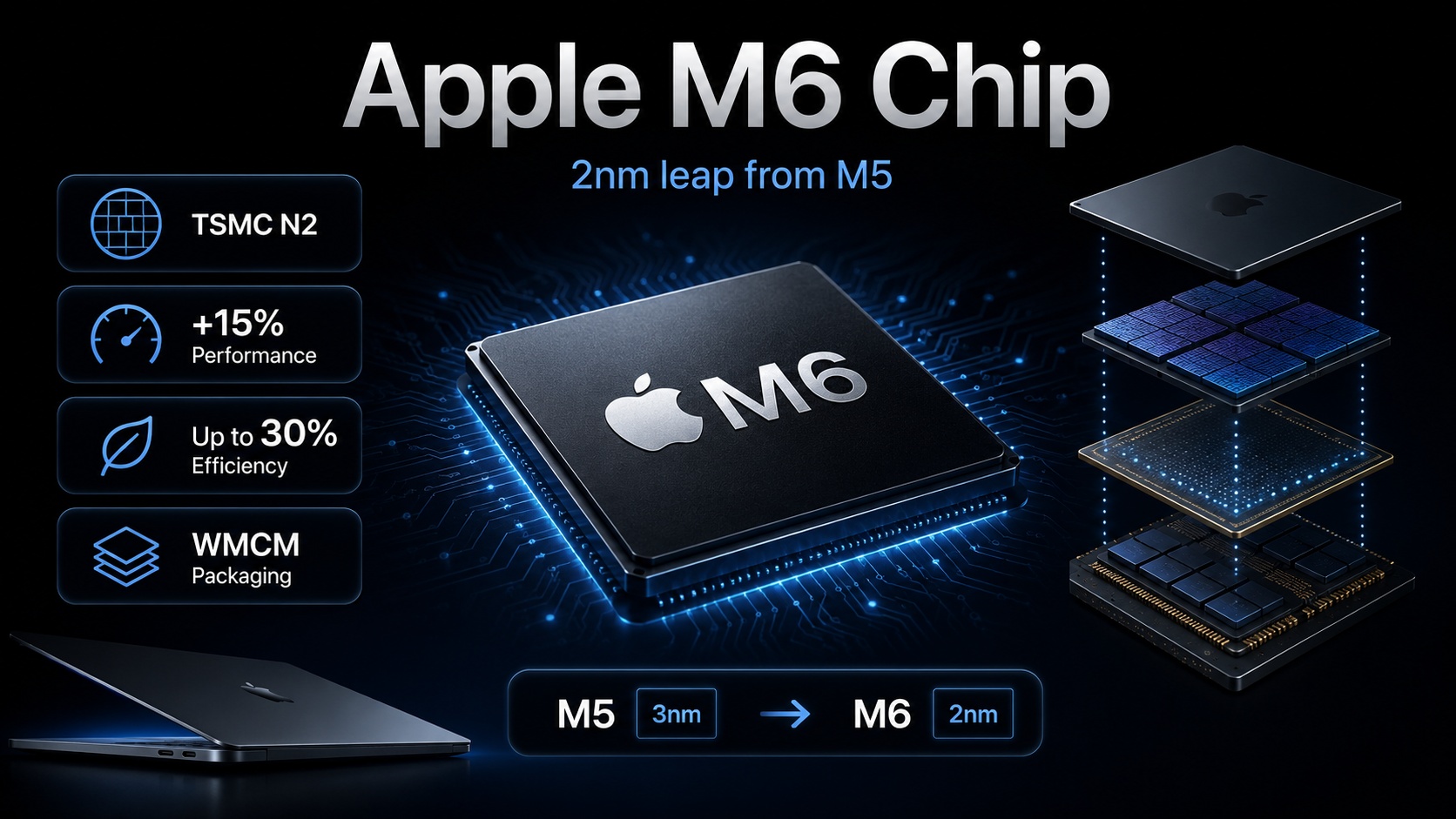
The Apple M6 chip is the next generation of Apple Silicon, succeeding the current M5 family that launched in late 2025. Unlike the M5, which used TSMC’s third-generation 3nm process, the M6 moves to an entirely new manufacturing node: TSMC’s 2nm (N2) process.
This is a complete generational leap from the 3nm process used in the M5. According to TechNode, Apple has already secured more than half of TSMC’s 2nm production capacity through 2026, covering the M6 alongside the A20 chips destined for the iPhone 18 lineup.
What the 2nm jump means in practical terms:
Higher transistor density, packing more compute power into the same physical spaceRoughly 15% faster performance at the same power draw, based on TSMC’s published figuresUp to 30% better power efficiency, translating directly to longer battery lifeLower thermal output, enabling thinner laptop designs without throttling
One notable detail is that Apple has chosen TSMC’s base N2 node rather than the newer N2P variant. According to Wccftech, this is a deliberate trade-off. N2P offers marginal extra performance, but sticking with N2 gives Apple better supply availability and faster time to market. Qualcomm and MediaTek are expected to adopt N2P instead.
The M6 will also reportedly use WMCM (Wafer-Level Multi-Chip Module) packaging for the first time. This technology positions the processor and memory modules adjacent to each other on a single module, improving thermal efficiency while reducing material costs.
Which Products Are Getting the Apple M6 First?
According to 9to5Mac, the headlining Mac launch later this year centers on the rumored MacBook Ultra, a new product tier sitting above the MacBook Pro. Multiple leakers now indicate that Apple will brand the OLED touchscreen MacBook as “Ultra” rather than releasing it as an updated MacBook Pro.
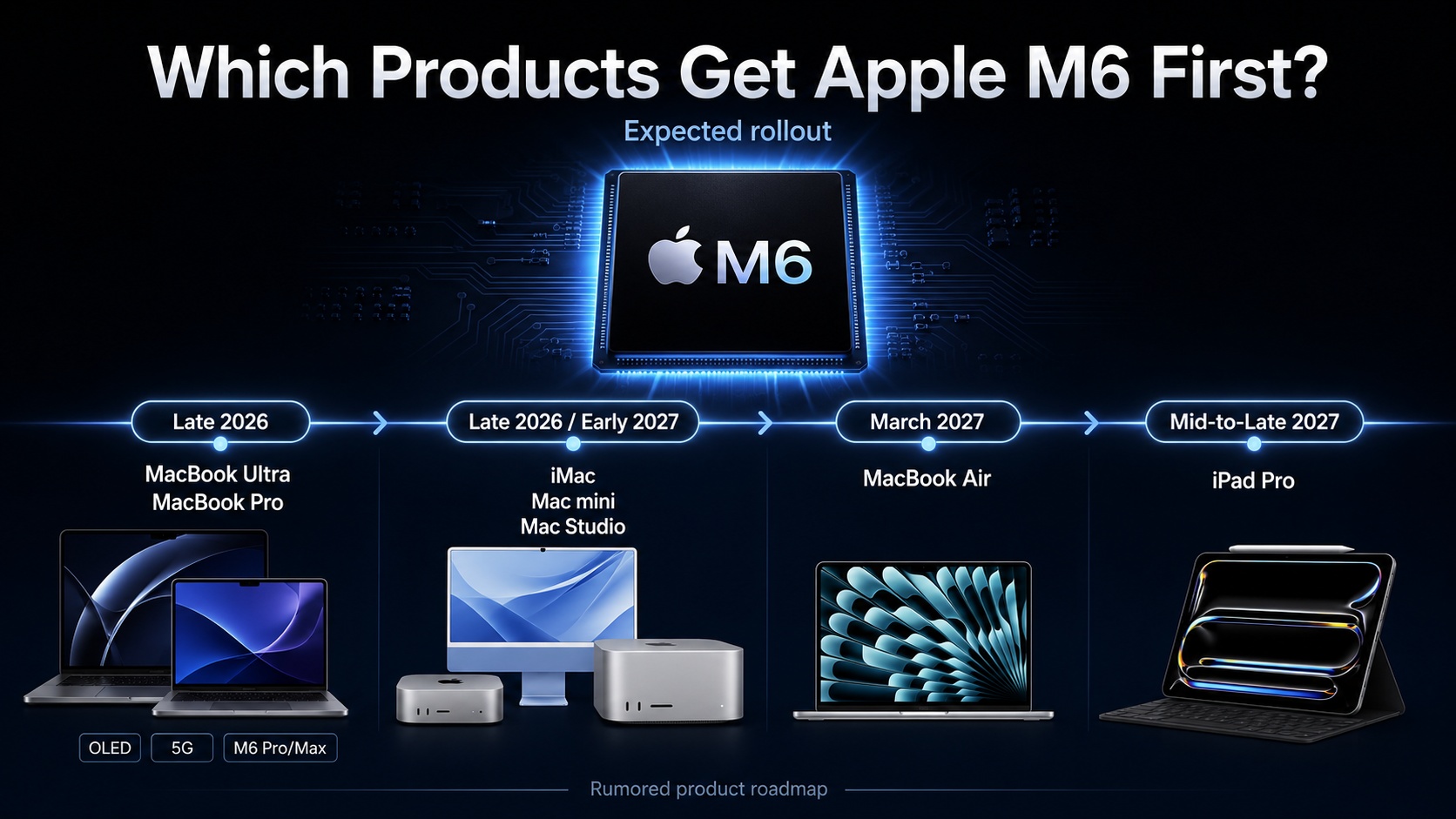
Here is the expected product rollout based on current supply chain reports and analyst predictions:
Late 2026 (October/November):
MacBook Ultra (14.3-inch and 16.3-inch) with M6 Pro and M6 Max chips, OLED touchscreen, Dynamic Island, and built-in 5G connectivityMacBook Pro spec refresh with the base M6 chip, retaining the current design and mini-LED display
Late 2026 to Early 2027:
iMac, Mac mini, and Mac Studio with M6 chips (exact timing depends on memory supply)
March 2027:
MacBook Air with base M6 chip
Mid-to-Late 2027:
iPad Pro with M6 chip and vapor chamber cooling
Bloomberg’s Mark Gurman has repeatedly noted that the M6 could appear “sooner than people anticipate.” One possibility is that Apple debuts the base M6 in a product like the iMac or Mac Studio ahead of the full MacBook Ultra redesign, similar to how the M4 first appeared in the iPad Pro before reaching MacBooks.
Apple M6 Chip Release Date: What We Know
The Apple M6 chip release date currently points to Q4 2026, with most sources expecting an October or November announcement. Several supply chain milestones support this timeline:
Samsung Display began mass production of OLED glass substrates in May 2026Full-scale panel production is underway, with deliveries to Foxconn expected from Q3 2026According to Notebookcheck, research firm Omdia places the MacBook Ultra launch in Q3 2026, which could mean a September debut alongside the iPhone 18 Pro
However, there is a real risk of delay. A global shortage of DRAM and NAND flash storage has already pushed back updates to the Mac Studio and Mac mini. According to MacRumors, Gurman has suggested the MacBook Ultra may slip into early 2027 rather than meeting the original Q4 2026 window, largely because of these memory constraints.
M6 MacBook Pro: What Is Actually Changing?
The M6 generation is not just a chip upgrade. The redesigned MacBook (whether Apple calls it MacBook Ultra or MacBook Pro) represents the most significant hardware overhaul since 2021. Here are the key changes:
OLED display: Tandem OLED technology replacing mini-LED, delivering deeper blacks, richer colors, and a 2,000,000:1 contrast ratioTouchscreen: Apple’s first touchscreen Mac, using on-cell touch technology built directly into the panelDynamic Island: Replacing the display notch with the iPhone-style interactive cutoutThinner design: The slimmer OLED panel enables a lighter chassis overall5G cellular connectivity: Built-in cellular using Apple’s own C2 modem, a first for any MacEstimated pricing: Starting around $2,499 for the 14-inch and $2,999 for the 16-inch, roughly 20% higher than current MacBook Pro models
The base M6 MacBook Pro (without the Ultra branding) is expected to receive the M6 chip but keep the current design, including the mini-LED display and existing chassis.
How the M6 Fits Into the Bigger Chip Battle
The M6 chip does not exist in a vacuum. NVIDIA unveiled its RTX Spark system-on-a-chip at Computex 2026, directly targeting Apple Silicon in the premium laptop space. RTX Spark offers roughly 1,000 TOPS of AI compute compared to Apple’s 38 TOPS Neural Engine, and includes full CUDA support for developers.
Meanwhile, Qualcomm’s Snapdragon X2 continues gaining ground in the Windows ecosystem, and Intel’s Nova Lake processors on a 2nm process are also expected in 2026.
Apple’s response is architectural. While competitors focus on raw AI compute numbers, the M6’s strength lies in its unified memory architecture, single-core performance leadership, and tight macOS integration. With macOS 27 adding touch-friendly interface elements, Apple is building the software foundation to match the M6’s hardware capabilities.
For a detailed comparison of NVIDIA’s new chip against current Apple Silicon, see our RTX Spark breakdown.
Should You Wait for the M6 MacBook Pro?
This depends entirely on your timeline and priorities.
Wait if:
You want the OLED display, touchscreen, or thinner designYou plan to run local AI workloads and want the 2nm efficiency gainsYour current Mac is still functional and does not need immediate replacement
Buy now if:
You need a laptop in the next three to six months for work or schoolThe current M5 MacBook Pro already exceeds your performance needsYou prefer proven first-generation hardware over a brand-new redesign that may have early production quirks
The M5 Pro and M5 Max MacBook Pros remain the fastest Mac laptops Apple has ever shipped. They are mature, deeply discounted by authorized resellers, and fully supported. The M6 generation brings excitement, but first-generation OLED panels and touchscreen software may take a cycle or two to fully mature.
FAQsWhen is the Apple M6 chip coming out?
The Apple M6 chip is expected to debut in Q4 2026, with an October or November unveiling being the most widely cited window. The redesigned MacBook Ultra featuring M6 Pro and M6 Max chips is the flagship launch product, though a global memory shortage could push availability to early 2027.
What is the Apple M6 chip built on?
The M6 uses TSMC’s 2nm (N2) manufacturing process, a complete generational leap from the 3nm process used in the M5. This enables higher transistor density, better power efficiency, and lower thermal output compared to its predecessor.
Will there be an M6 MacBook Pro?
Yes. Apple is expected to release both a standard M6 MacBook Pro (with the current design and mini-LED display) and a premium MacBook Ultra (with OLED touchscreen and redesigned chassis). The MacBook Ultra sits above the Pro as a new product tier.
How much faster is the M6 compared to M5?
Based on TSMC’s published process improvements, the 2nm node alone delivers roughly 15% faster performance and up to 30% better power efficiency. Additional architectural improvements from Apple’s silicon team could push these numbers higher, though official benchmarks are not yet available.
What is the Apple M6 chip price?
Apple does not sell chips separately. The base M6 MacBook Pro is expected to maintain pricing similar to the current lineup (starting around $1,599), while the MacBook Ultra with M6 Pro/Max chips is estimated to start at approximately $2,499 for the 14-inch model.