
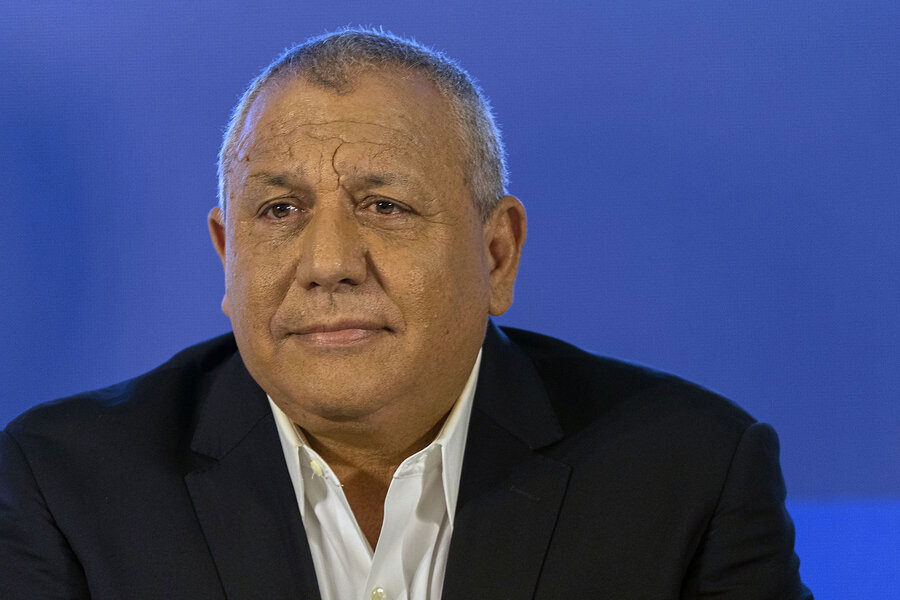
In interviews and public statements, Gadi Eisenkot, a retired general and bookworm, weighs his words carefully.
His mind for military strategy and his quiet but intense drive propelled him – a son of working-class Moroccan Jewish immigrants who grew up in the most remote corner of Israel – from foot soldier to army chief of staff.
Now he’s fighting to become Israel’s next leader while mourning his youngest son, Gal, who was killed during a mission in Gaza to retrieve the remains of Israeli hostages slain in the early weeks of the war in Gaza.
Why We Wrote This
As Israelis prepare for fall elections, Gadi Eisenkot is surging in polls to edge out Prime Minister Benjamin Netanyahu. The retired general’s security credentials and perceived integrity appear to resonate with voters exhausted by war and division.
“You can see a cloud of grief around him, but he’s not a man who seems broken; instead he seems even more determined,” says Amos Harel, a military reporter who has been covering Mr. Eisenkot since 1998.
“He sees it [his campaign] as a debt to his fallen son and the generation of Oct. 7 fighters who died,” says Mr. Harel, military analyst for the daily newspaper Haaretz. Hamas’ October 2023 attack on Israel – the deadliest security failure in the country’s history – sparked the war in Gaza and a multifront conflagration that still smolders almost three years later.
Mr. Eisenkot’s party is surging in polls ahead of Israel’s autumn election as Prime Minister Benjamin Netanyahu’s cultivated image as “Mr. Security” continues to crumble, most recently because of the U.S.-Iran agreement to end the Iran war.
Most Israelis see the deal, which seeks to constrain Israeli military operations against Iranian proxy Hezbollah in Lebanon and doesn’t secure any of Israel’s overall war aims, as a national security disaster that leaves them more vulnerable and isolated.
Yet Mr. Eisenkot’s appeal predates the Iran war. His security credentials and perceived integrity have been resonating with voters exhausted by war and division, experts say.

Lt. Gen. Gadi Eisenkot (at center), then the Israeli army’s chief of staff, attends the weekly Cabinet meeting in Jerusalem, Jan. 13, 2019.
In many ways, the uncharismatic Mr. Eisenkot is seen as the opposite of the silver-tongued, political showman Benjamin Netanyahu – a contrast that may turn out to be his greatest asset following the national trauma of Oct. 7.
Having lost Gal and two nephews, one of them the day after his son was killed, the retired general reflects the ultimate level of personal sacrifice, experts say. This resonates with those Israelis seeking a different kind of leader in an election being described as the most consequential in the nation’s history.
Mr. Eisenkot named his new political party Yashar, Hebrew for “straight,” signaling a path that is neither left nor right.
Recent polls show him edging past Mr. Netanyahu as the politician most suited to lead. His party also has been on an upward trajectory as numbers continue to drop both for Mr. Netanyahu’s party, Likud, and its current main competition in the opposition.
From humble origins
Mr. Eisenkot came of age far from Israel’s economic and political center. Born in the Galilee in the north, he was raised in Eilat, the Red Sea port city at the country’s southern tip, on the edge of the desert. He is married to his high school sweetheart and raised five children.
He rose through the ranks of the Israel Defense Forces in the Golani Brigade, a proud, tight-knit infantry unit known for its tough combat assignments.
When he became chief of staff in 2015, his mother’s reaction was she would have preferred he was a rabbi. During his tenure, he focused on strengthening Israel’s ground forces, implementing a multiyear military modernization plan, and conceptualized a “war between wars” strategy calling for Israel to carry out covert low-intensity operations to stymie enemies instead of all-out war.
When an Israeli soldier named Elor Azaria shot and killed a disarmed Palestinian assailant in 2016 in the West Bank, Mr. Eisenkot led the charge to punish him to the full extent of the law. Right-wing pushback followed, and the charges were reduced from murder to manslaughter; a far-right mob even shouted death threats against him.

Clodagh Kilcoyne/Reuters/File
Israeli Prime Minister Benjamin Netanyahu consoles Cabinet minister Gadi Eisenkot at the funeral of his son Gal Meir Eisenkot, an Israeli soldier killed in the northern Gaza Strip in the Israeli military’s ground operation in Gaza, in Herzliya, Israel, Dec. 8, 2023.
Mr. Eisenkot entered politics in 2022, joining a party led by Benny Gantz, who preceded him as the army’s top commander. After Oct. 7, they joined the war Cabinet under Mr. Netanyahu and the first thing they did was prevent a surprise attack against Hezbollah. Mr. Eisenkot argued the army wasn’t prepared to open a second front.
He was considered the strongest advocate within the war Cabinet for a deal with Hamas to secure the release of 251 hostages taken captive into Gaza during the Oct. 7 attack, which killed 1,200 people. By June 2024 he and Mr. Gantz resigned. According to Mr. Harel, Mr. Eisenkot felt Mr. Netanyahu was unnecessarily prolonging the war.
A healing figure?
The Israeli public is “looking for a healer … someone who will calm things down, put on a bandage, put on ointment. Someone who will lower the tones of hatred, of rift, of division,” says Ronen Tzur, a media strategist.
Because he comes from Israel’s geographic and social periphery, and is a bereaved father, a former chief of staff, and of Mizrahi (North African/Middle Eastern) heritage, Mr. Eisenkot “kind of fits the whole typecast of what people are looking for at this time,” Mr. Tzur says.
If his party is able to form a coalition, he’d become the first Mizrahi Israeli leader.
Mr. Eisenkot often comes across as thoughtful and deliberate, speaking softly and at length rather than relying on media-savvy sound bites. His public image is that of someone “unpolished and down to earth,” says Tal Schneider, political correspondent for The Times of Israel.
Despite knowing that his son Gal’s unit would likely be among the first forces to enter Gaza, the retired general supported a ground offensive after the war began.
“It was in my head all the time, the fear that Gal could be killed,” he said in an interview with Israel’s state television channel. But, he said, decades in the army helped him separate his personal plight from what appeared necessary for Israel’s security.
Analysts say he models himself on past leaders like David Ben-Gurion, the nation’s first prime minister, and Yitzhak Rabin, the former chief of staff and prime minister who signed the Oslo Accords, and is willing to discuss diplomatic solutions while making it clear that Israel must stand its ground against dangerous opponents.

A banner and a stand to attract voters to Gadi Eisenkot’s Yashar party in the north Tel Aviv neighborhood of Ramat Aviv Gimmel, June 19, 2026. The banner reads: “Leading Israel straight! with Eisenkot.”
Yet like most Israeli politicians in the aftermath of Oct. 7, he does not think it’s time to create a Palestinian state.
“Anyone who talks about peace now and two states for two peoples, in my opinion, does not understand the depth of the conflict,” he said in a recent television interview. “There are other solutions in the Palestinian arena that can be advanced.”
Campaign trail
Shaul Meridor, a Yashar candidate and the son and grandson of prominent Likud lawmakers, says he’s witnessing growing enthusiasm for Mr. Eisenkot, even in Likud strongholds.
He and another Yashar candidate recently met with high-tech workers at a parlor meeting near Tel Aviv. Over watermelon and croissants, the workers peppered the candidates with questions about Mr. Eisenkot’s ability to fend off the growing political offensive against him.
Zohar Scwartz, an executive, was among those at the parlor meeting swayed to support Mr. Eisenkot despite his concern over his “lack of political experience in a world of wolves,” because, he says, he has surrounded himself with experienced advisers.
Dan Halutz, another former army chief and prominent opponent of government attempts to weaken the judiciary, says by phone that Mr. Eisenkot “was considered an excellent officer and even more than that, he is a good person, what’s called in Yiddish a mensch. … He’s a man who thinks about processes and doesn’t just give answers for the here and now, but also looks ahead.”
The Golani Brigade, where Mr. Eisenkot started his military career, is known for its mantra of “sticking to the mission,” Mr. Halutz notes, and for drawing recruits from across Israeli society.
“What that gives Gadi is experience in leading a diverse group of people,” he says. Losing loved ones in the war, he adds, deepened Mr. Eisenkot’s sensitivity to the brutal cost of conflict.
“I think Gadi is a person who doesn’t think that endless war is our fate.”
Mr. Eisenkot said in the state TV interview that in the aftermath of his family’s tragedy, “I am mostly searching for meaning amid this heavy price, so that we will be worthy of it, as a family and as a country.”