
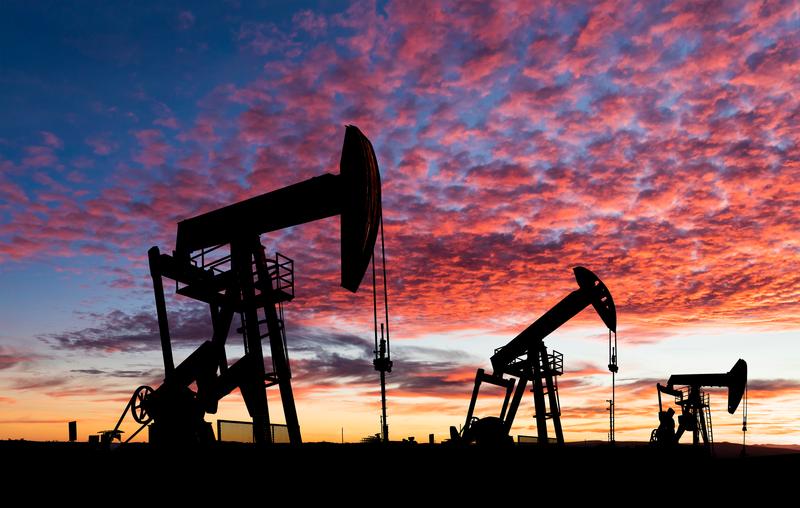
WTI, the primary U.S. oil price benchmark, fell about 4% by mid-afternoon Friday. That pushed its price below $70 a barrel. The crude price decline came even though Iran attacked a cargo ship near the coast of Oman in the Strait of Hormuz, while also recently ordering three oil tankers to turn back, causing confusion about the status of that key global trade route.
With WTI dipping below $70 a barrel, it begs the question of whether now’s a good time to buy oil stocks. Here’s a look at the current market environment.
Image source: Getty Images.
The Strait of Hormuz’s questionable status
Earlier this month, the U.S. and Iran signed a Memorandum of Understanding (MOU), setting the stage for a 60-day negotiation period toward a final peace agreement between the two countries. Among the points was that Iran was to fully reopen the Strait of Hormuz, toll-free, for 60 days.
Despite that agreement, it hasn’t been smooth sailing for ships trying to move through the Strait of Hormuz. Iran has ordered at least three oil tankers and two other ships to reverse their course. It has also warned vessels that crossing the Strait without identification signals or Iranian permission would be at their own risk. The threats culminated in Iran attacking a cargo ship.
Despite all this, oil now trades close to its pre-war level when the Strait of Hormuz was fully open. That’s also even though the global economy burned through more than 1 billion barrels of inventory as output from the Persian Gulf remained constrained, which the industry needs to rebuild. As a result, oil prices could remain volatile.
These oil stocks can still thrive at sub-$70 oil
While WTI has spent much of this year well above $70 a barrel, it was below that level last year, averaging less than $65. That was a more than adequate price point for most oil stocks. For example, ConocoPhillips (COP 0.42%) generated $19.9 billion of cash flow from operations last year, enough to cover its $12.6 billion capital budget with $7.3 billion to spare. The U.S. oil giant used its excess free cash flow to pay dividends ($4 billion) and repurchases shares ($4 billion), with the difference covered with non-core asset sales that also strengthened its balance sheet.

Today’s Change
(-0.42%) $-0.45
Current Price
$105.96
Key Data Points
Market Cap
$130B
Day’s Range
$104.64 – $106.80
52wk Range
$85.57 – $135.87
Volume
11.3M
Avg Vol
8.2M
Gross Margin
23.54%
Dividend Yield
3.10%
ConocoPhillips initially anticipated generating an additional $1 billion in free cash flow this year, driven solely by capital and cost-savings initiatives. Meanwhile, the company is on track to grow its free cash flow by $7 billion by 2029 at $70 oil (and $6 billion if oil averages $60 a barrel), fueled by the upcoming completion of several liquified natural gas projects and the Willow oil project in Alaska. That will give the oil giant more money to grow its dividend and repurchase shares.
Chevron (CVX 0.69%) also initially expected to thrive at $70 oil this year. The oil giant anticipated that a combination of recently completed expansion projects, cost-savings initiatives, and its Hess acquisition would boost its free cash flow by $12.5 billion at $70 oil. Meanwhile, the oil company expects to grow its free cash flow by more than 10% annually through 2030 at $70 oil, driven by growth capital projects. As a result, Chevron should have plenty of fuel to continue growing its dividend and repurchasing shares.
Oil stocks can still be attractive long-term investments
While WTI has dipped below $70 a barrel, that’s still a good pricing level for many oil producers. ConocoPhillips and Chevron both expected to produce significantly more free cash flow this year at that price point, while delivering robust growth through the end of the decade at that level. Because of that, they still look like good long-term investments. While their share prices could be volatile in the near term as confusion persists in the Strait of Hormuz, they can thrive over the long term.