

The war in Gaza could have ended a year “at least a year earlier,” former hostage pointman Maj. Gen. (res.) Nitzan Alon said Wednesday, hitting back at Finance Minister Bezalel Smotrich, who claimed credit this week for the return of all the captives held by terror groups in the Strip.
Smotrich voted repeatedly throughout the two-year war against deals that would have seen the hostages released earlier than they ultimately were.
Alon asserted that some of the hostages who were killed could have come home alive if different decisions had been made.
“In Gaza, we fought a long war that could have been ended at least a year earlier,” Alon said at the Herzliya Conference at Reichman University. “When talking about the return of all the hostages, it should be remembered that around 40 hostages who were abducted alive were killed in captivity, and I do not forget that.”
“In certain cases, with different conduct and decisions, or different negotiations, we might have been able to bring them back alive,” he said.
Get The Times of Israel’s Daily Edition
by email and never miss our top stories
By signing up, you agree to the terms
“Therefore, Minister Smotrich, who opposed some of the agreements at various stages, I do not think can take credit for the return of all the hostages,” he said.

Nitzan Alon attends the Herzliya Conference at the Reichman University in Herzliya, July 1, 2026. (Avshalom Sassoni/Flash90)
“The cabinet and the political leadership refused earlier comprehensive deals in the name of that ‘total victory,’ which is in fact a falsehood,” Alon added, referring to a slogan repeated by Prime Minister Benjamin Netanyahu and other coalition members during the war.
Smotrich drew outrage on Sunday for his comments, with former hostage Or Levy accusing him of spreading “gaslighting propaganda” with his claim.
“I think I have a dramatic, even decisive, impact on the war,” Smotrich said in an appearance on Nadav Perry’s “All In” podcast. “I think that if not for me, the war in Gaza would have been halted even before [the operation] in Rafah,” he added, referring to the offensive launched by the IDF in the southernmost Gaza city in May 2024.
“By the way,” he continued, “unlike how some are trying to portray me as some heartless person who doesn’t care about the hostages, I think it is thanks to me that all the hostages are here.”
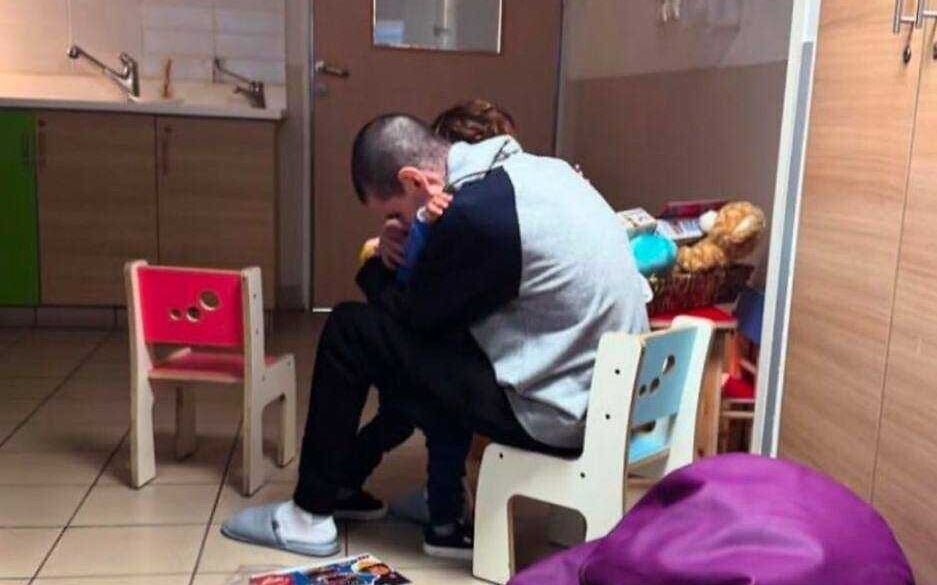
Released hostage Or Levy, whose wife was killed on October 7, reunites with his three-year-old son Almog after 491 days in captivity in Gaza, at Sheba Medical Center near Tel Aviv, February 8, 2025. (Courtesy)
To explain his reasoning, Smotrich said that after all but 21 of the living hostages were released in a January 2025 deal with Hamas, another partial deal was proposed that would return another eight living hostages, leaving 12 behind.
“If in this moment I hadn’t set a red line and told [Prime Minister Benjamin] Netanyahu that this would not happen… we would have been holding negotiations with Hamas to this day over another one, and another one, and another one,” he argued.
Despite Smotrich’s claim, had the deal he referenced not collapsed less than two months after it began, in early March 2025, it would have eventually progressed to a second phase that would have included the release of all remaining hostages, both living and dead.

Protesters at Habima Square in Tel Aviv hold up posters of some of the slain hostages who have not been returned to Israel, October 14, 2025. (Yael Gadot / Pro-Democracy Protest Movement)
Instead, it wouldn’t be until October 2025 that the last 20 living hostages were released followed by the return of the bodies of the deceased. The final body was handed over to Israel on January 26, 2026.
In total, of the 251 hostages abducted by Hamas and other terror groups during the October 7, 2023, invasion and massacre in southern Israel, 166 were released alive, and 85 were returned to Israel deceased.
Of the deceased, 44 were already dead at the time they were abducted, and 41 were abducted alive and killed in captivity. In many cases, they were murdered by their captors, and in others, the military confirmed that its own actions, including airstrikes, led to the deaths of hostages.
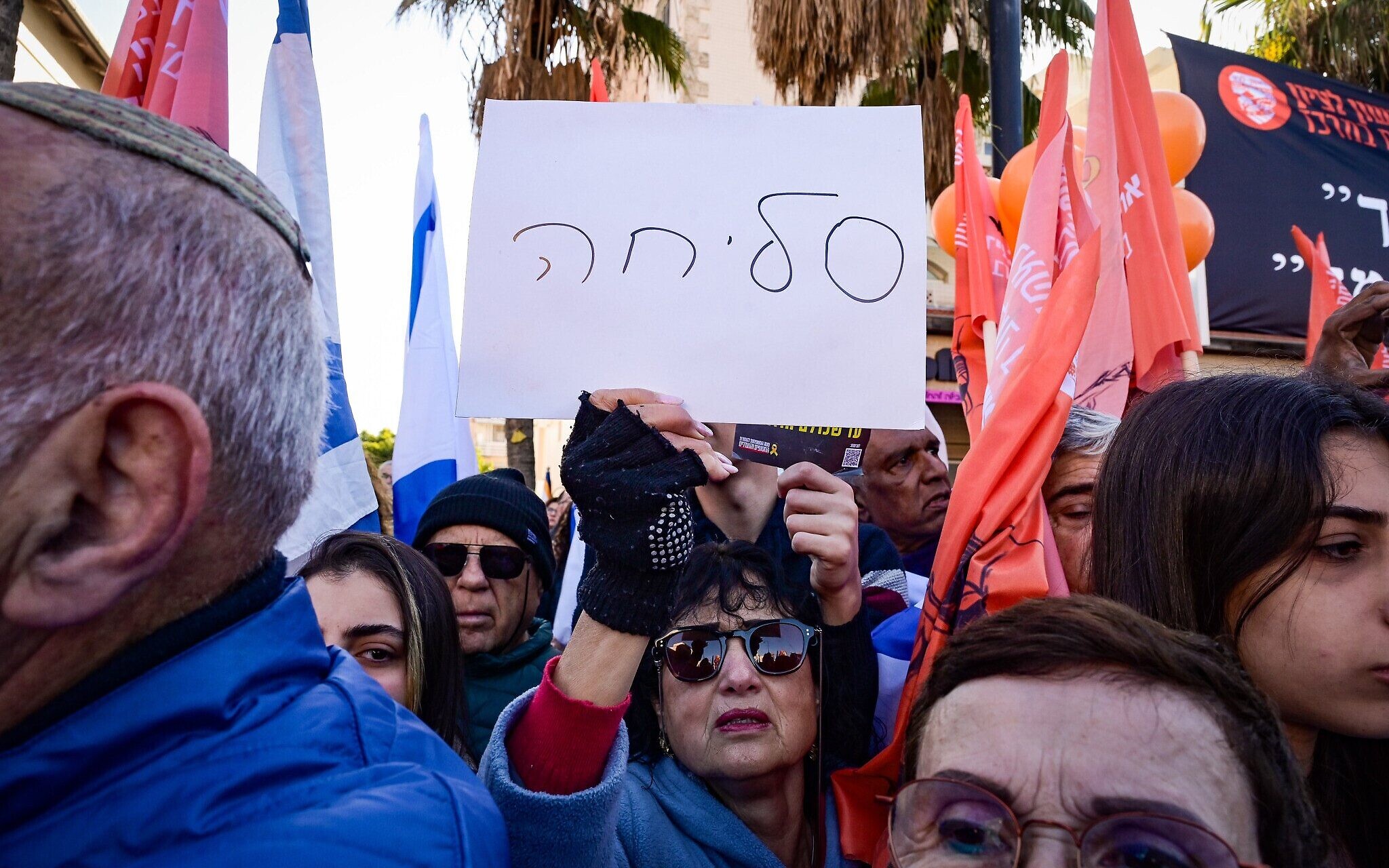
A woman holds a sign saying ‘sorry’ as people pay their respects during the funeral procession of slain hostages Shiri Bibas and her children Ariel and Kfir in Rishon LeZion, February 26, 2025 (Avshalom Sassoni/Flash90)
Smotrich consistently opposed, or gave only conditional support to, various proposals for hostage deals throughout the two-year war in Gaza, arguing that continuing the military offensive and overthrowing Hamas was more important.
He threatened, on multiple occasions, to pull his far-right Religious Zionism party from the government if a deal was signed that he disapproved of.
His remarks on Sunday sparked anger from released hostages and their families.
Levy, who was released in February 2025, accused the finance minister of spreading “gaslighting propaganda.”
“If you mean to say it is thanks to you that hostages were murdered while you torpedoed deals — then yes,” wrote Levy, whose wife, Eynav Levy, was murdered at the Nova music festival on October 7. “If it were up to you, we wouldn’t have returned to this day.”
Asserting that the hostages were nothing more than “collateral damage” as far as Smotrich was concerned, Levy dismissed the Religious Zionism leader as “a shameful minister, a shameful citizen, and a shameful human.”
We can’t do this work alone.

The war with Iran has been draining for all of us in Israel. But when I heard about a high casualty incident – ballistic missile impacts in Arad and Dimona that left nearly 200 people wounded – I drank a cup of coffee, packed a bag, and headed south.
There, I spoke with Shilgit, the head of an after-school program for underprivileged youth. Standing outside her destroyed center, Shilgit said it was a miracle that no children were hurt and spoke about the community coming together in the hours since.
As a Times of Israel reporter, I’m committed to telling stories of resilience like Shilgit’s. But my colleagues and I can’t do this alone. If you value work like this, please consider joining our reader support group, The Times of Israel Community. Your financial support is essential to keep real human reporting like this going.
— Stav Levaton, military reporter
Already a member? Sign in to stop seeing this
You’re a dedicated reader

That’s why we started the Times of Israel – to provide discerning readers like you with must-read coverage of Israel and the Jewish world.
So now we have a request. Unlike other news outlets, we haven’t put up a paywall. But as the journalism we do is costly, we invite readers for whom The Times of Israel has become important to help support our work by joining The Times of Israel Community.
For as little as $6 a month you can help support our quality journalism while enjoying The Times of Israel AD-FREE, as well as accessing exclusive content available only to Times of Israel Community members.
Thank you,
David Horovitz, Founding Editor of The Times of Israel