
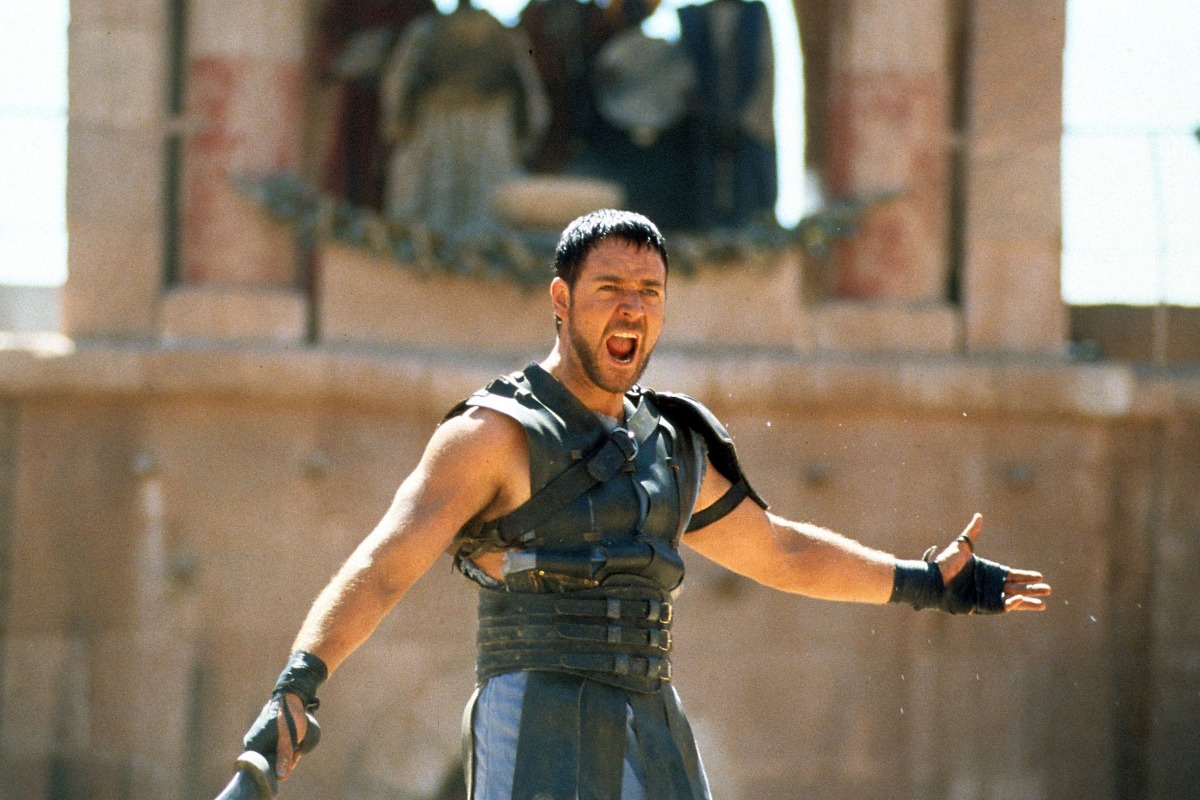
Russell Crowe has returned to Malta, the island where Ridley Scott shot Gladiator, to reflect on the role that reshaped his life. Speaking at the Mediterrane Film Festival, the actor described a punishing shoot that forced him to defend Maximus’s integrity day after day, a battle he now credits with far more than an Oscar-winning performance.
When Russell Crowe stepped onto the dusty sets of Malta in 1999, he had no idea he was about to shoot the film that would define his entire career. Speaking recently at the Mediterrane Film Festival, the actor opened up about the battles he fought behind the scenes of Ridley Scott’s Roman epic, struggles that shaped him as much as they shaped Maximus. More than a quarter century later, the movie remains a towering classic, backed by five Oscars and $465.5 million at the global box office. But for Crowe, its true legacy is far more personal than any trophy or ticket sale.
A turning point for Russell Crowe
Some roles change a career. Others change the person playing them. For Russell Crowe, the shoot for Gladiator, released in 2000, belongs firmly in the second category. Speaking at the Mediterrane Film Festival in Malta, where much of the epic was filmed, the actor looked back on the production as the moment everything shifted for him.
“In a strange way, I can say I became a man in Malta,” Crowe recalled. Nothing he had done before matched the scale of Ridley Scott’s Roman epic, he explained: not the ambition, not the budget, not the reach. “It wasn’t an easy shoot. I had to fight every day for the integrity of the character I was playing, just like the character does throughout the film.”
The grit of filming in Malta
The Maltese islands provided the backdrop for the film’s recreation of ancient Rome, and the conditions on set were as demanding as the story itself. Long days, physically punishing sequences, and constant creative battles turned the production into a personal trial for Crowe, one that oddly mirrored the arc of Maximus, the betrayed general fighting his way through the Colosseum.
That daily struggle, according to the actor, forged something lasting. Sometimes, he noted, you are lucky enough to make something that truly resonates with people. Gladiator did exactly that.
How Gladiator changed the game
The numbers back him up. The film earned $465.5 million at the global box office and turned Crowe into an international star almost overnight. It also revitalized the career of Ridley Scott, who had kept a lower profile through much of the 1990s.
Then came the awards. At the 2001 Academy Awards, Gladiator took home five Oscars, including Best Picture and Best Actor for Crowe, along with wins for costume design, sound mixing, and visual effects. Few historical epics of that era can claim a comparable sweep.
A timeless impact
Crowe shared one encounter that stuck with him. A towering man, a head lifeguard, grew emotional upon meeting him and explained why: at 8 years old, his mother sat him in front of the Gladiator VHS and told him this was the kind of man she expected him to become. Honor, integrity, faith. “A man made in Malta,” Crowe said.
Can a movie really shape a life like that? For its fans, the answer seems obvious. Twenty-six years on, the film’s themes of honor and resilience still land, and American audiences can revisit it anytime, as Gladiator is currently streaming on Prime Video.