
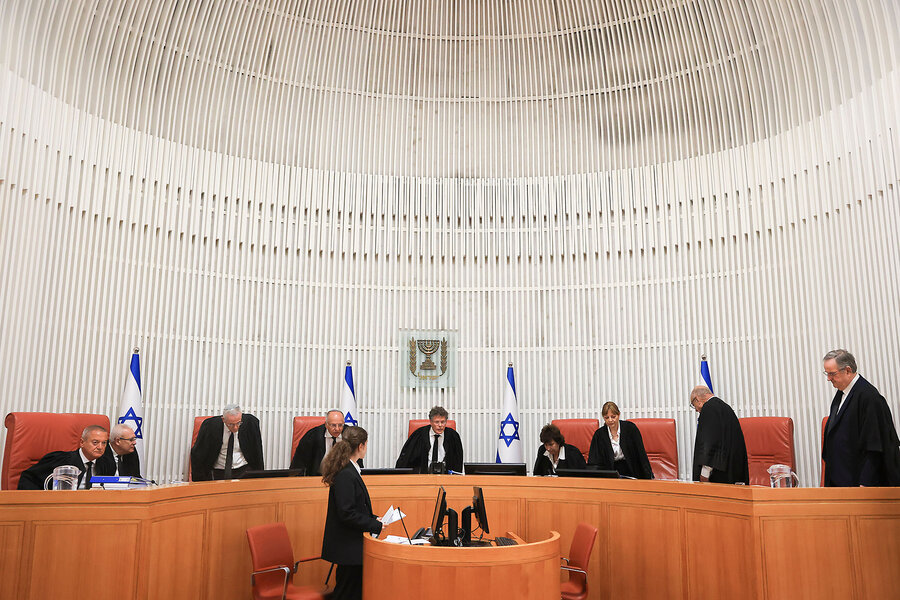
Prime Minister Benjamin Netanyahu’s far-right government has been attacking Israel’s judiciary for years, but for the first time, it has said it would defy a Supreme Court ruling, moving the country closer to the chaos of a possible constitutional crisis.
The government’s unprecedented move this week sparked condemnations across the political and legal spectrum, sounding the alarm that Israel was becoming a country whose executive no longer felt bound by the rule of law.
“Disobedience to court orders is the final nail in the coffin of democracy,” read a statement by all of Israel’s living former chief Supreme Court justices. “It completely disrupts the order of government and justice in the country, leading to anarchy and the concentration of all state power in the hands of a single body,” they said.
Why We Wrote This
The Israeli government’s agenda seeking overhaul of a judiciary it sees as too powerful, launched its first year in office, galvanized a massive pro-democracy movement. Sidelined by a series of wars, the agenda is once again in play, with national elections due this fall.
The stakes are high because, in Israel’s parliamentary system, the judiciary – traditionally seen as the defender of the public and private good – is the only check on the government.
Isaac Herzog, Israel’s figurehead president, called the government’s decision a “red line that must not be crossed under any circumstances.” He said such declarations “harm the very core of national unity.”
Technicalities vs. larger issues
At issue is a Cabinet resolution rejecting a Supreme Court decision regarding the composition of Israel’s commercial broadcast regulator. The decision would allow the regulator to continue to operate, but with fewer members than originally mandated. Government ministers called it a case of judicial overreach.
On the surface, it’s a rather technical dispute, but larger issues are at stake. In addition to the Netanyahu coalition’s attempts to overhaul the judicial system – including the office of the attorney general, the government’s watchdog – it is seeking to curtail the independence of the Israeli media.
The broadcast regulator, known as the Second Authority, oversees commercial channels, among them the highly watched Channel 13. Critics say the government wants to block the regulator from allowing the channel’s sale to a group from Israel’s high-tech sector, which is seen as critical of Mr. Netanyahu.

Maya Aidan, a journalist with Israeli Channel 13, takes cover while reporting, as a siren warns of incoming rockets fired by Iran-backed Houthis in Yemen, in Tel Aviv, Israel, Oct. 7, 2024, the anniversary of the Hamas attack.
“The government’s decision to escalate this case into an outright constitutional showdown with the court is a step forward in its parallel campaigns to delegitimize the judicial system and gain more control over the media,” wrote Alex Lederman, a senior policy associate at the Israel Policy Forum, in a paper published on the website of the New York-based think tank. “It feeds the [coalition’s] narrative that the court interprets laws to serve a political agenda and could be a trial balloon for future clashes over more high-profile cases.”
“This has been brewing for a long time,” says Amir Fuchs, a senior researcher at the Israel Democracy Institute, an independent think tank in Jerusalem. “It’s a battle people have been fearing and anticipating for a long time. The substance over which they are fighting is less important than the fight itself.”
That fight is about whether Israel will remain a liberal democracy or just “retain the veneer of a majoritarian democracy without commitment to liberal rights,” says Adam Shinar, a law professor at Reichman University, near Tel Aviv.
Responding to the high-level backlash, Cabinet Secretary Yossi Fuchs posted on X Tuesday that the government’s decision did not amount to flouting a Supreme Court order. Instead, he said, it was a “sharp criticism of a ruling.”
Daniel Levy, Israel’s police commissioner, also worked to dissuade fears of a full-blown constitutional crisis that would leave authorities, including his own, forced to choose between obeying the court or the government.
“We obey the law and will comply with every high court ruling without batting an eyelash. We represent the law, and we obey the law,” he said at a police ceremony on Wednesday.
Pro-democracy demonstrations
The controversial decision has put back on the front burner the government’s quest to check the authority of the Supreme Court, which it says has amassed outsize power.
In January 2022, just after Mr. Netanyahu returned to office, his government launched an aggressive legislative push that it termed “judicial reform.” Opposition lawmakers and other critics said it constituted a de facto coup.

Protesters wave flags and hold banners against Benjamin Netanyahu’s new government in front of the Knesset, Israel’s Parliament, in Jerusalem, Dec. 29, 2022. By the following summer, the nation’s largest-ever protest movement had formed to oppose the judicial overhaul sought by the most religious and ultranationalist government in Israel’s history.
It sparked 40 weeks of the largest and most-sustained street protests in Israel’s history and the creation of a self-described pro-democracy movement, whose mass demonstrations managed to stem some of the government’s efforts. But the protests came to an abrupt halt with the Oct. 7, 2023, Hamas attack on Israel and the war in Gaza it triggered.
Now, it is harder to galvanize public opposition at the same level, says Dr. Shinar.
“People are tired, exhausted from the protest themselves,” he says. “Then there was Oct. 7 and then the war, the plight of the hostages, and then the next two wars with Iran, the occupation of Lebanon and the Gaza war not ending, the toll on the economy and reservists. … It’s hard to motivate people to come out even if they do care.”
The government’s vow to defy the court comes as Israel prepares for elections at the end of October. It coincides with a raft of legislation that is highly contentious but intended to keep current coalition partners loyal, including the ultra-Orthodox bloc battling to keep its youth exempt from military draft.
The government is “trying to get as much done as they can before the election,” says Dr. Fuchs, the Democracy Institute researcher. “They are hoping the next government will not have the political power to delete everything they manage to do.”
This is also, he says, about Mr. Netanyahu keeping “an eye on building the next coalition.”