
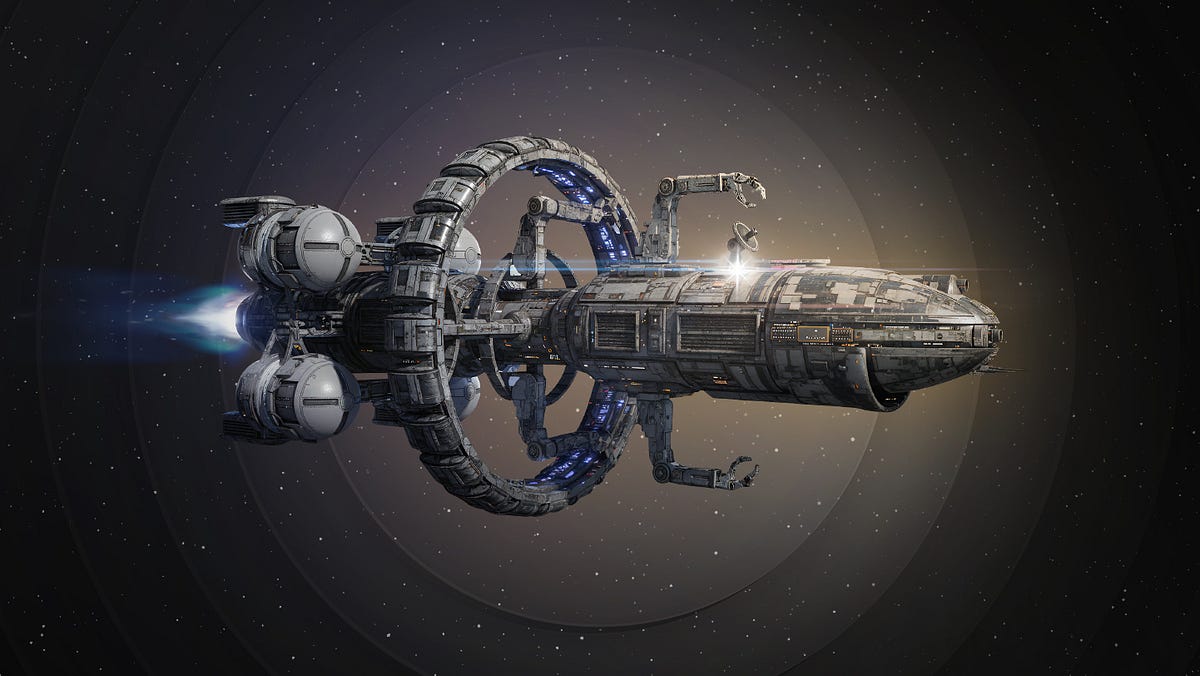
 Press enter or click to view image in full size
(Credit: Orbital Today)
As we await the World Cup final on July 19, 2026, it is timely to recall that over the past decade, astronomers discovered three interstellar objects larger than a soccer field as they traversed the inner Solar system: 1I/`Oumuamua, 2I/Borisov and 3I/ATLAS.
These are three missed opportunities.
If our technological civilization had been more ambitious, it would have planted a technological gadget inside these visitors. Interstellar objects like 3I/ATLAS travel a few times faster than all five human-made probes launched to interstellar space so far.
Hitchhiking interstellar objects which pass near Earth over the next billion years before the Sun will boil off all the oceans on Earth, could fill the Milky Way with hundreds of millions ambassadors from Earth. These technological messengers would masquerade as natural objects to outside observers, allowing them to penetrate even the most guarded territories of alien civilizations like Trojan Horses.
The gadgets can be activated once the background illumination from a nearby star exceeds the habitability threshold of order a kilowatt per square meters. As soon as their gravitational acceleration peaks at closest approach to the illuminating star, they would be programmed to depart from their interstellar hosts in a direction perpendicular to that acceleration. An Oberth maneuver in the opposite direction relative to their carrier’s velocity would be the most efficient way for using their engine to slow down to the desired bound orbit around the star. A follow-up search for nearby planets with suitable liquids and solids for seeding biological life could accomplish directed panspermia.
My calculations indicate that a few hundred of such probes could reach the habitable zone around Sun-like stars within a billion years. If a percent of all Sun-like stars in the Milky-Way leads to a civilization that engages in such an activity, then the habitable zones around all Milky-Way stars will be visited by technological hitchhikers on interstellar objects within just a tenth of the age of the galaxy.
However, even one ambitious civilization can accomplish much more by producing self-replicating spacecraft which land on planets and reproduce themselves out of raw materials, as envisioned by John von Neumann around 1950 and Ronald Bracewell a decade later here.
Realizing self-replicating spacecraft is very challenging since it requires escape from the planetary body where the replication occurs. This requires not only building semiconductor replication plants for computer chips that make up AI-assisted robots out of raw materials, but also enabling these robots to build spacecraft that will carry them out of the planet to destinations near other stars.
An interesting alternative is to use the raw materials of interstellar objects and convert them into spacecraft. This removes the need to land safely and later escape safely from the surface gravity of a planet. An interstellar object already carries the raw-materials above the escape speed from any particular planetary system. During the history of the Milky-Way galaxy one early civilization could have produced a few billion interstellar spacecraft out of the raw materials of natural interstellar objects on the scale of a soccer field. This scale is a thousand times more massive than any payload that humanity launched into space so far.
Whether we live in a reality where this idea was utilized by alien civilizations remains to be studied experimentally. Such a study is the focus of the Galileo Project under my leadership, in search for extraterrestrial technological artifacts near Earth. The Galileo Observatories measure distances of anomalous objects by observing them from different directions, using 3 observing units separated by 10 kilometers from each other. We are currently analyzing Unidentified Anomalous Phenomena (UAP) by comparing their measured speed to human-made objects. In parallel, the UAP Science Advisory Council (https://uapsac.com/) under my leadership is studying UAP data collected by the U.S. government.
UAP offer an opportunity to get the public excited about science at a time when the glory of science was demoted. Science is funded by taxpayers and there are two topics that all Americans agree about: maintaining national security and answering the question: “are we alone?” Finding the nature of UAP addresses both.
If we ever discover that earlier civilizations in the Milky Way history engaged in interstellar trips, that would encourage us to do the same. It is not too late for us to become an interstellar species that will be remembered beyond the next billion years.
Once we send out our ambassadors into the Milky Way galaxy, not all will be lost as a result of catastrophes on Earth. Obviously, none of us will be around to mourn at our own funeral. In his Letter to Menoeceus, providing a practical way to free the mind from anxiety, the ancient Greek philosopher Epicurus argued that death is nothing to fear because we cannot experience it. He reasoned: “When we exist, death is not; and when death exists, we are not.” Since all good and evil come from feeling, and death is the complete end of all sensation, it can never harm us. Life and death are mutually exclusive. The anticipation of our demise causes needless pain.
With a forward-looking mindset, lets hitchhike the next interstellar visitor: 4I/Rubin.
ABOUT THE AUTHOR
Press enter or click to view image in full size(Image Credit: Lotem Loeb, May 22, 2026)
Avi Loeb is chair of the UAP Science Advisory Council to the White House, Pentagon, FBI and intelligence agencies, director of the Galileo Project, founding director of Harvard University’s — Black Hole Initiative, former director of the Institute for Theory and Computation at the Harvard-Smithsonian Center for Astrophysics, and the former chair of the astronomy department at Harvard University (2011–2020). He is a former member of the President’s Council of Advisors on Science and Technology and a former chair of the Board on Physics and Astronomy of the National Academies. He is the bestselling author of “Extraterrestrial: The First Sign of Intelligent Life Beyond Earth” and a co-author of the textbook “Life in the Cosmos”, both published in 2021. The paperback edition of his new book, titled “Interstellar”, was published in August 2024.
Professional website:
https://lweb.cfa.harvard.edu/~loeb/
Social media:
https://avi-loeb.medium.com/
https://www.youtube.com/@ProfessorAviLoeb
https://open.spotify.com/show/1zhndXkvSY2b8FdjspFpCd
https://x.com/ProfAviLoeb