
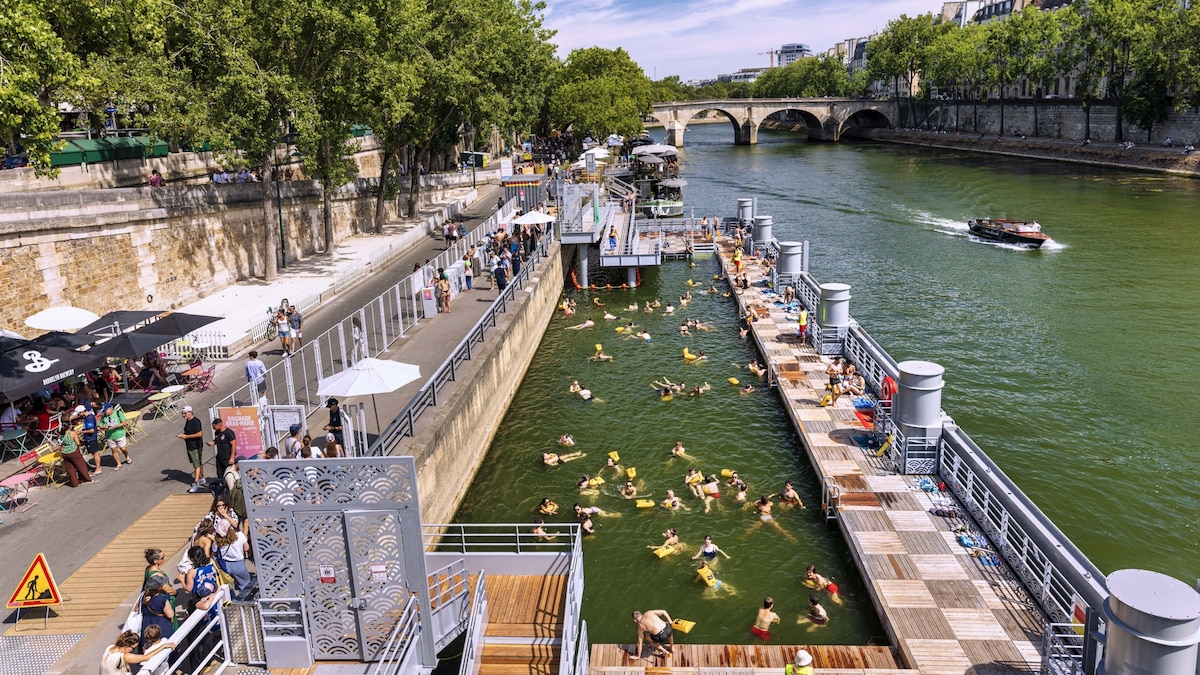
“Until today, I’d never bathed in my own city before,” Janbon said as she wrung river water out of her hair. “It feels like I’m on holiday.”
Paris is just one of many cities in Europe that has fought to make their waterways swimmable again. Copenhagen, Basel, Zurich, Bern, and Oslo have all spent years improving their sewage management systems, creating stormwater infrastructure, and implementing policies to better control water pollution. Their efforts have been largely successful, with city-dwellers across the continent returning to their waters in throes. And as climate change creates more intense and frequent heat waves, city planners and residents are also turning to these waterways to cope with hotter days.
“In these cities, we are seeing people renegotiate their social contracts with water,” said Matthew Sykes, the co-founder and program director for Swimmable Cities, an alliance of organizations championing the right to use urban waterways. “People are starting to understand that a swimmable city is a better one.”
A historic return to the waters
Until the early 20th century, bathing in urban rivers was a common activity in western Europe and parts of North America. Bathhouses were built directly on rivers and were places where people went for leisure as well as to get clean. Lack of private plumbing in people’s homes meant that these river bathhouses—popular in cities like New York, London, Boston, Philadelphia, and Paris—were often the only place where people could wash themselves.
As industrialization expanded and populations sky-rocketed in cities, urban rivers across Europe became unthinkably dirty. In Paris, wastewater, animal parts, and laundry suds were discharged directly into the Seine. As a result, the city banned swimming in 1923, deeming the water unsafe for human health.