
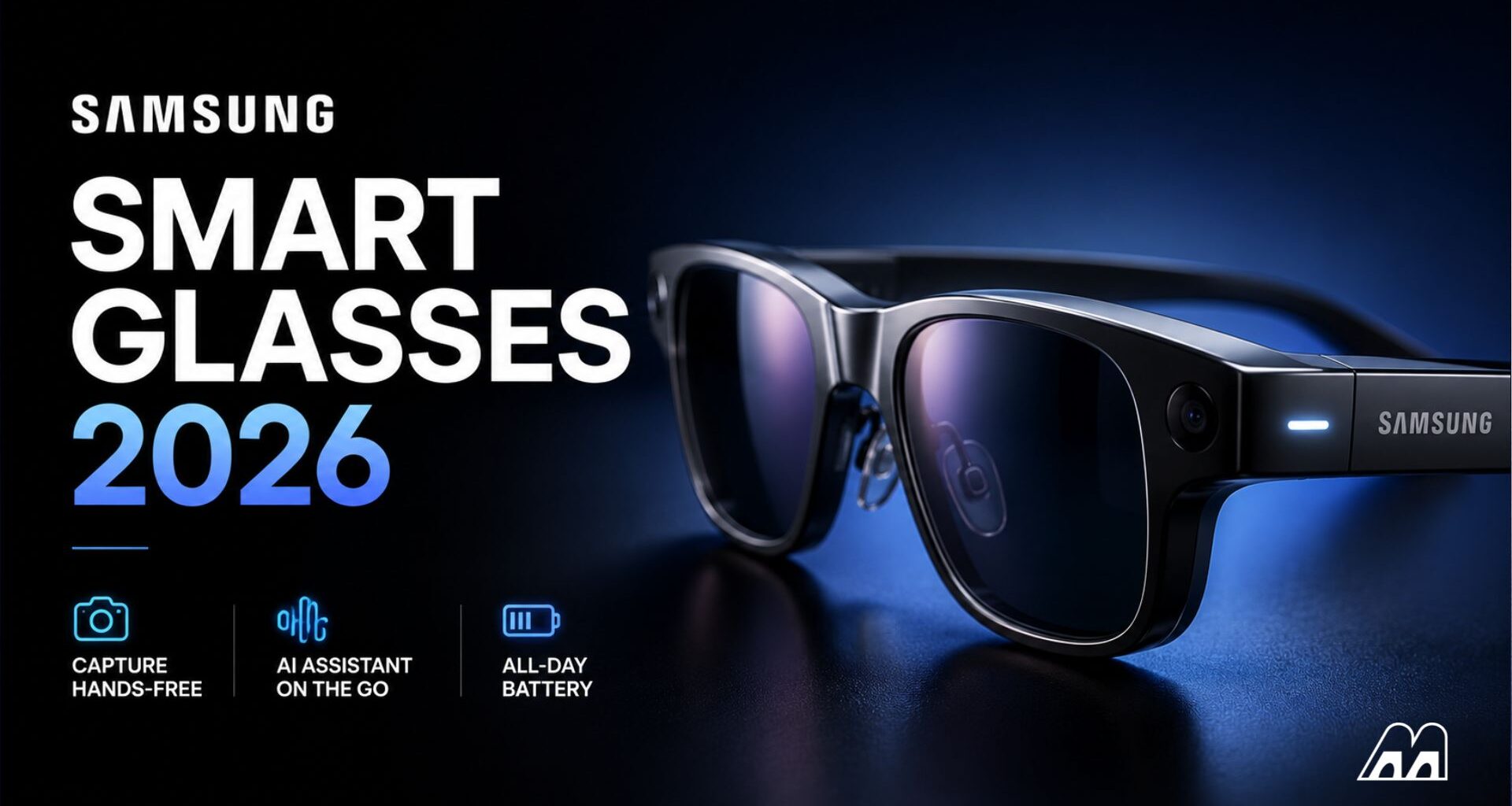
Samsung revealed two new smart glasses designs at Galaxy Unpacked in London on July 22, expanding its Android XR collaboration with Google, Gentle Monster and Warby Parker. The display-free glasses combine Gemini, a built-in camera, open-ear audio and Qualcomm’s Snapdragon AR1 Gen 1 platform, with a fall 2026 launch planned.
The official Samsung announcement confirms up to nine hours of battery life and as many as seven additional full charges from the case. Samsung has yet to disclose the exact release date, camera resolution, weight or price. It has also continued using the term “intelligent eyewear” instead of confirming Galaxy Glasses as the commercial name.
The launch gives Android XR its most credible opportunity to challenge Meta in everyday eyewear. Hardware parity only establishes an entry point, however. Samsung still needs to show that Gemini completes practical tasks reliably, that the final frames justify premium positioning and that the price remains close enough to established Ray-Ban Meta products.
Samsung Smart Glasses Specs Establish a Competitive Baseline
Samsung has now confirmed enough hardware information for an initial comparison, although several details circulating before Unpacked remain unsupported. The frequently reported 12MP camera and proposed $379 to $499 price range were not included in Samsung’s announcement.
FeatureSamsung intelligent eyewearRay-Ban Meta Gen 2AvailabilityFall 2026Available nowDisplayNoneNoneAI assistantGeminiMeta AIProcessorSnapdragon AR1 Gen 1Snapdragon AR1 Gen 1CameraBuilt in, resolution undisclosed3K video recordingBattery lifeUp to 9 hoursUp to 8 hours with moderate useCharging caseUp to 7 additional full chargesUp to 48 additional hoursPhone compatibilityAndroid and iOSAndroid and iOSInteractionVoice, touch and connected Watch9 gesturesVoice and frame controlsStarting priceUnannounced$379
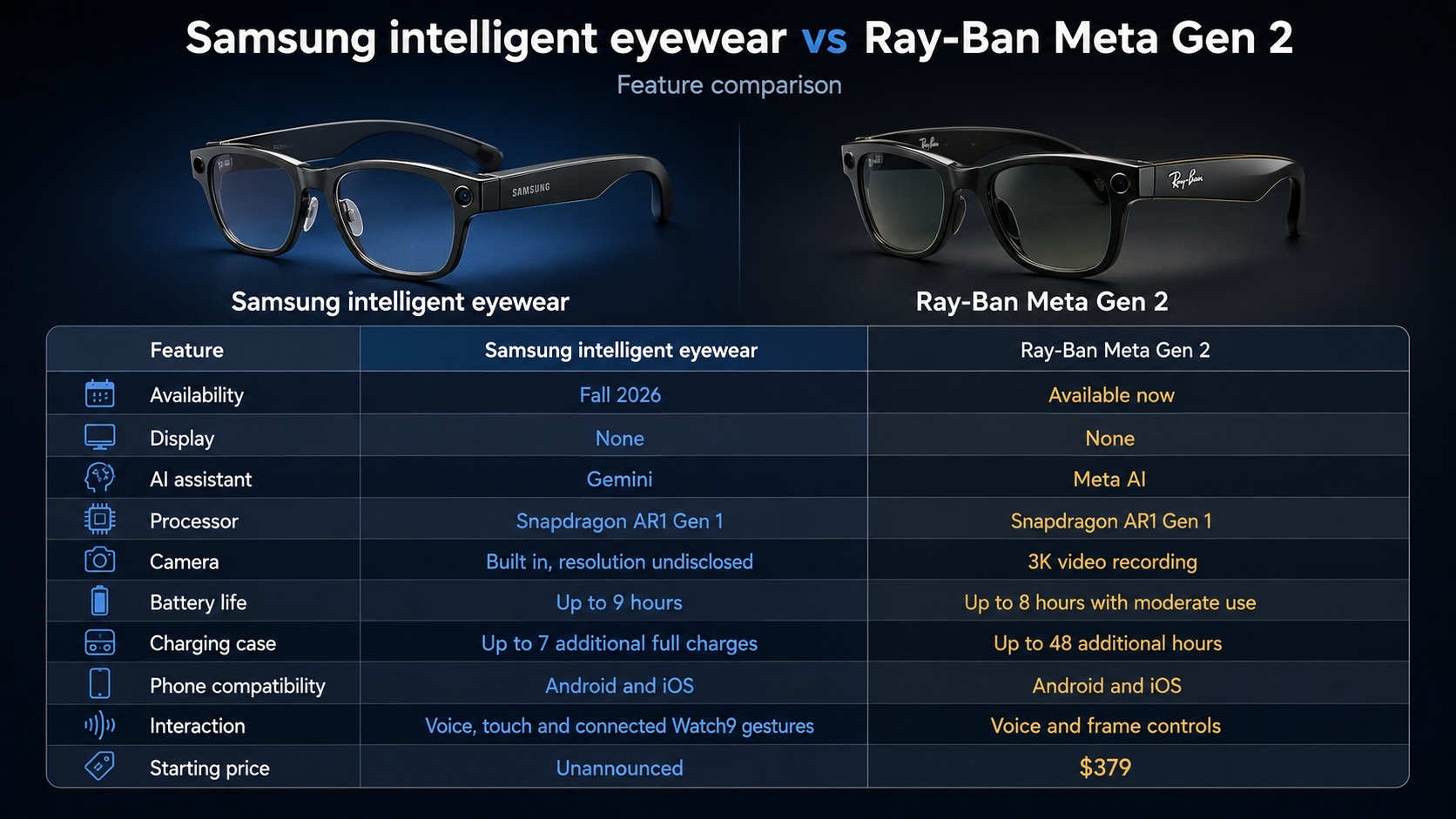
Samsung and Meta use the same Snapdragon platform, while both products rely on cameras, microphones and speakers rather than an in-lens display. Samsung’s main confirmed hardware lead is its nine-hour battery claim. The Ray-Ban Meta Gen 2 specifications list up to eight hours under moderate use.
Those figures are not directly comparable. Samsung has not published a standardized test workload, while Ray-Ban separates moderate use from continuous audio and voice assistance. The two companies also describe their charging cases differently, with Samsung using complete charge cycles and Ray-Ban using additional operating hours.
Independent testing under the same mix of camera capture, audio and AI queries will therefore matter more than the one-hour headline difference.
Gemini Shifts the Comparison Toward Completed Tasks
Gemini provides Samsung with its clearest potential advantage. Google says users will be able to ask about visible objects, receive turn-by-turn navigation, summarize missed messages, translate speech and written text, capture photos and execute supported tasks through connected phone apps.
The Android XR feature announcement also describes tone-matched translation, photo editing through Nano Banana and multi-step actions such as preparing an order before asking the user for final confirmation.
Samsung adds several Galaxy-specific workflows. The glasses can capture information from a whiteboard or meeting, organize it in Samsung Notes and accept gesture input through a connected Galaxy Watch9. This extends the same platform strategy already visible in the Samsung Galaxy XR headset, where Gemini uses visual context to assist with tasks.
The mechanism matters more than the assistant’s model name. A camera supplies visual context, Gemini interprets the scene and the connected phone provides applications, data and processing for the requested action. Watch and voice controls reduce the need to retrieve the phone during each step.
The economic and practical value depends on how often that chain works without correction. Neither Samsung nor Google has published comparative data covering task completion rates, latency, mistaken actions or the amount of phone confirmation required. Translation, navigation and app support may also vary by language, region, network and connected device.
Gemini therefore gives Samsung a wider set of proposed workflows. Current evidence does not yet show that it produces a more reliable glasses experience than Meta AI.
Samsung Versus Meta Depends Heavily on Distribution
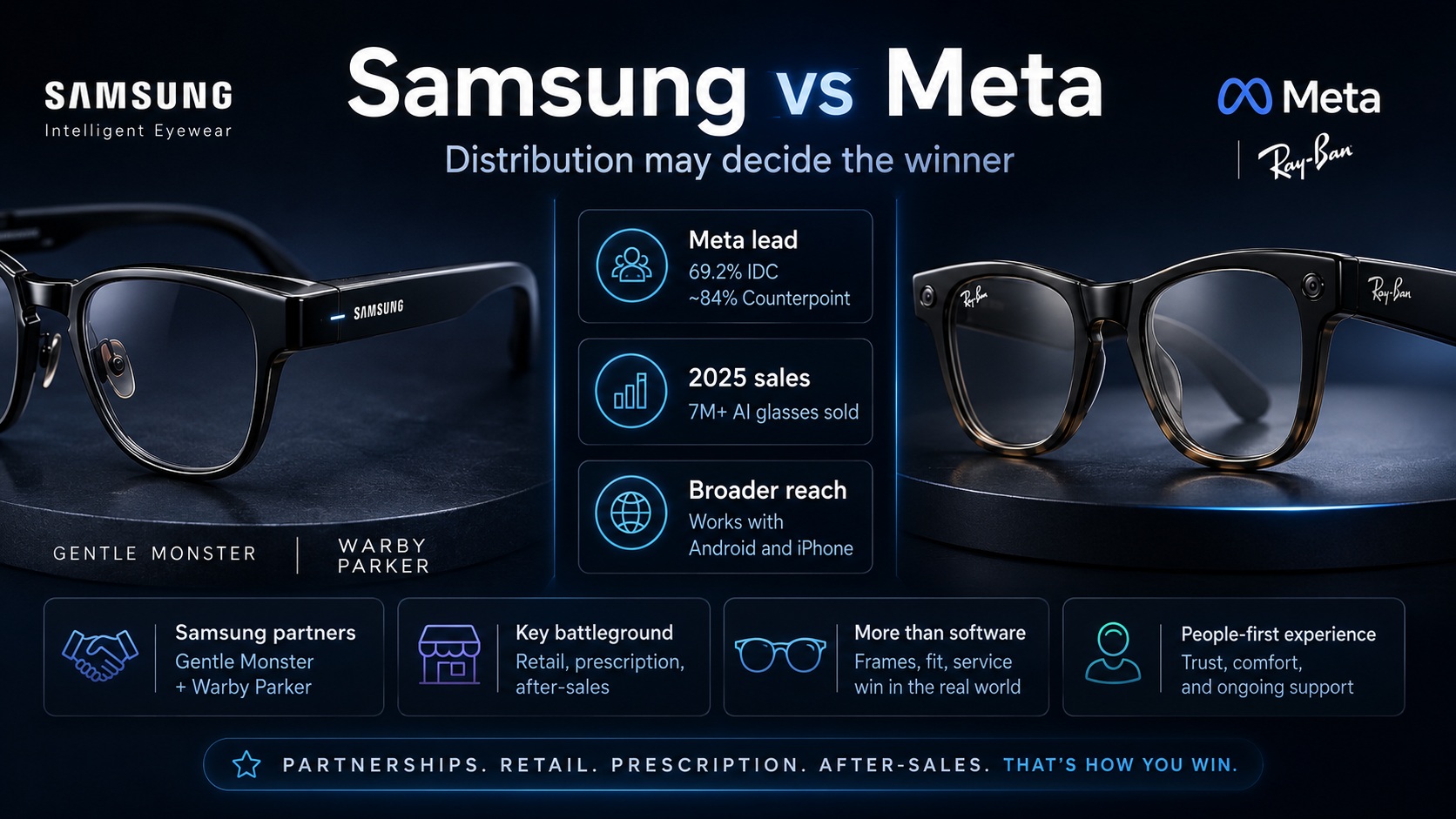
Gentle Monster and Warby Parker give Samsung access to design knowledge that conventional electronics companies often lack. Samsung says the partners helped refine fit around the forehead and ears, while the two Unpacked models target different buyers through a slim black Gentle Monster frame and a more conventional brown Warby Parker design.
That approach follows the category’s clearest commercial lesson. Consumers need to accept the product as eyewear before its software becomes relevant. Meta built its lead through Ray-Ban and EssilorLuxottica, combining recognizable frames with prescription options, physical fittings and an established retail network.
The scale difference remains substantial. IDC recorded Meta with 69.2 percent of the market during the first quarter of 2026. Counterpoint Research estimated nearly 84 percent for the same period. The gap likely reflects differences in category definitions and tracker coverage, although both datasets show Meta far ahead of individual competitors.
EssilorLuxottica also reported that its AI glasses portfolio sold more than seven million units in 2025. Samsung enters with recognised partners and a large smartphone ecosystem, yet it still needs comparable retail availability, prescription support and after-sales service.
Compatibility with iPhones broadens the potential audience. Google explicitly says the first audio glasses will work with Android and iOS, meaning the product is not restricted to Galaxy phone owners. Some functions can remain tied to Samsung hardware, including Watch9 gesture controls and certain Samsung Notes workflows.
This makes the wider 2026 AI smart glasses comparison less about choosing a phone operating system and more about preferred services, frame availability and which assistant performs useful tasks consistently.
Hands-On Restrictions Leave Price and Finish Unresolved
Samsung allowed selected media to inspect the frames but prevented them from wearing the glasses. That limitation leaves comfort, audio leakage, camera positioning and extended-use heat largely untested.
Gizmodo’s early hands-on assessment found both designs extremely light and evenly balanced. The publication also reported that the demonstration frames felt cheaper than expected, scratched easily and collected fingerprints. Those units may not represent the final production materials, which limits the conclusion.
Price now becomes the most important missing commercial detail. Ray-Ban Meta Gen 2 starts at $379 and already offers 3K video, an eight-hour battery claim and access to an established support network. Samsung needs either competitive pricing or a measurable Gemini advantage to justify asking buyers to adopt an untested first-generation product.
Privacy presents another adoption constraint. Samsung includes a front recording indicator and says its controls and safeguards support responsible use. Those features do not fully resolve the broader privacy concerns around camera-equipped smart glasses, particularly when the products are designed to resemble ordinary eyewear.
Regional acceptance, indicator visibility and data-handling disclosures could influence adoption as much as camera quality. Samsung has not yet released enough detail to compare those safeguards with Meta’s policies.
Buyers Face a Choice Between Potential and Proof
Waiting for Samsung makes sense for users who value Gemini, Google services, Galaxy Watch controls and the additional Gentle Monster or Warby Parker designs. The confirmed iPhone compatibility also means Apple users can consider the glasses without changing phones.
Ray-Ban Meta Gen 2 remains the lower-risk choice for anyone buying immediately. Its retail price, camera capability, battery profile and physical support network are already known. Meta also has several years of product feedback and software refinement behind its current hardware.
Samsung can narrow that advantage if the final product delivers comfortable frames, competitive pricing and reliable Gemini task execution. A higher price, limited regional availability or frequent phone confirmation would weaken the case even if the AI demonstrations appear more capable.
The decisive evidence will come from Samsung’s final price, launch markets and independent testing under matched workloads. Until those details arrive, the glasses represent a credible Android XR platform challenge rather than a proven replacement for Meta Ray-Ban.
FAQsWhen are Samsung smart glasses coming out
Samsung says its intelligent eyewear will launch in fall 2026. The company has not provided an exact release date, preorder schedule or complete list of launch markets, so any more specific date remains unconfirmed.
How much will Samsung smart glasses cost
Samsung has not announced a retail price. Prelaunch reports proposed several ranges, but none came from Samsung or its eyewear partners. The clean comparison is therefore an unknown Samsung price against Ray-Ban Meta Gen 2 starting at $379.
Do Samsung smart glasses have a display
No. The first Samsung smart glasses are audio-first models without an in-lens display. They use a camera, speakers, microphones and Gemini for contextual assistance. Google has separately described display glasses as a later category within Android XR.
Will Samsung smart glasses work with iPhone
Yes. Google says the first audio glasses from Samsung, Gentle Monster and Warby Parker will pair with Android and iOS phones. Some Galaxy-only functions may still apply, including gesture interactions provided through the connected Galaxy Watch9.