
WASHINGTON — Ahead of Prime Minister Benjamin Netanyahu’s meeting with US President Donald Trump on Tuesday, mediators believed they were close to a breakthrough that would revive the memorandum of understanding signed by the US and Iran last month, an Arab official and a second source familiar with the matter told The Times of Israel.
However, the intermediaries were awaiting a final decision from Trump after his meeting with the Israeli leader.
Mediators from Pakistan, Egypt and Qatar have been discussing a proposal that would clarify disagreements regarding operations of the Strait of Hormuz, the two sources said on Monday night. Iran maintains that the MOU granted it a level of control over the strait, while the US has argued otherwise.
The proposal being advanced by the mediators aims to bridge those gaps so that the US and Iran can begin talks through the MOU, whose 60-day timeline is already set to expire next month.
Iran and Oman — which both are situated along the strait — have given a green light to the mediators’ proposal, and it now awaits approval from Trump, the two sources said, adding that the White House was holding off on making a decision until after the president’s meeting with Netanyahu.
Get The Times of Israel’s Daily Edition
by email and never miss our top stories
By signing up, you agree to the terms
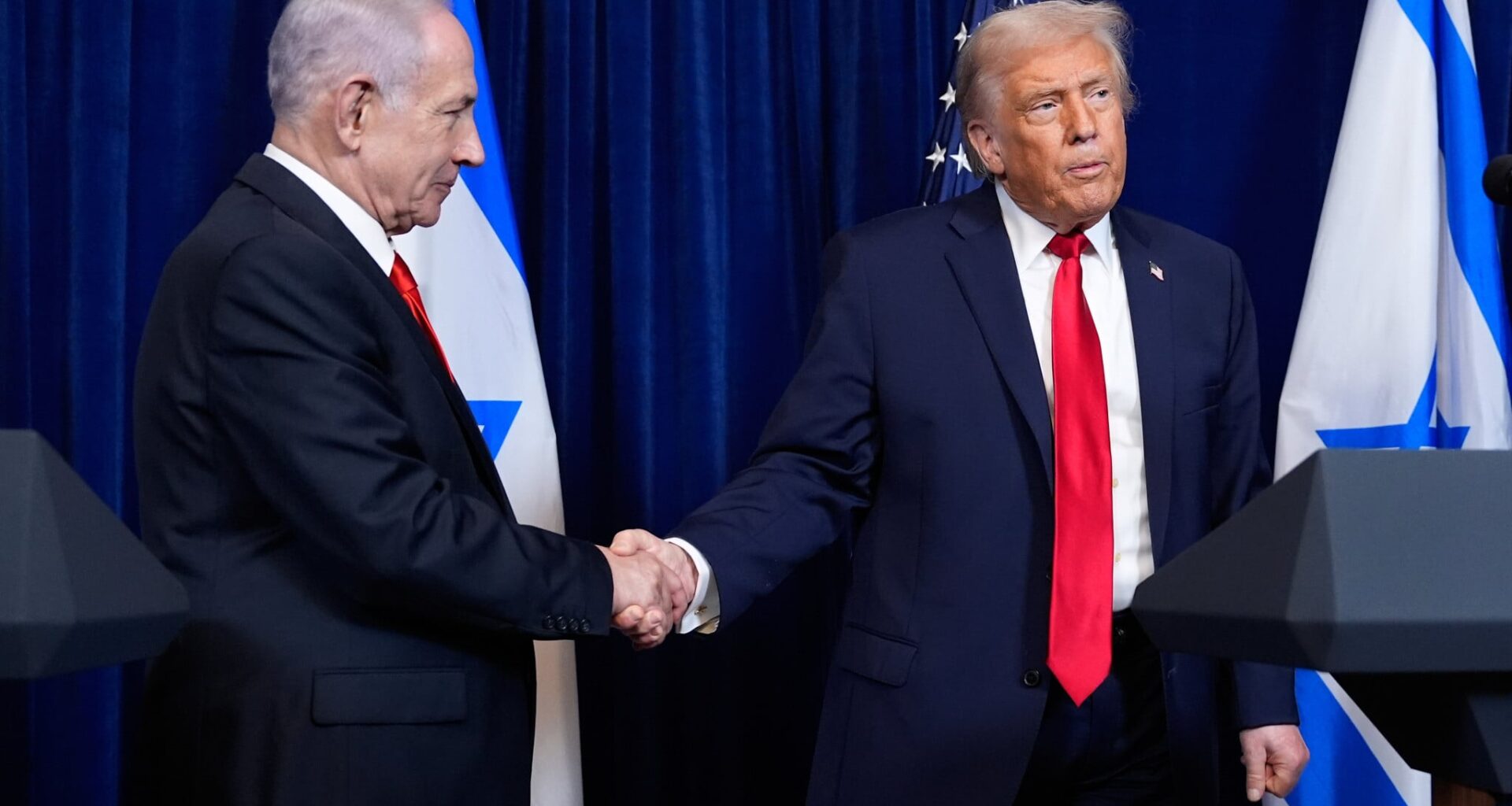
Netanyahu is set to meet Trump on Tuesday at 11 a.m. local time (6 p.m. Israel time), more than five months after their last meeting. His schedule will also include attending a memorial service for the late pro-Israel Republican senator Lindsey Graham.
The White House daily schedule indicated the meeting would be held away from reporters, though Trump has regularly opened such meetings to the press at the last minute.

Reporters crowd the Oval Office as US President Donald Trump, right, hosts Israeli Prime Minister Benjamin Netanyahu in the White House in Washington, DC, on April 7, 2025. (Avi Ohayon / GPO)
It will be Netanyahu’s first sit-down with Trump since before the outbreak of the Iran war on February 28.
The pair last met on February 11 in the White House, where Netanyahu reportedly made a high-stakes pitch for the US to join Israel in another war against Iran, including a series of predictions on the regime’s supposed brittleness that did not pan out.
Netanyahu took off Monday without publicizing his departure in advance, and left from an Air Force base rather than Ben Gurion Airport, reportedly for security reasons.
In a video statement, released after his departure was belatedly confirmed, the premier said he was “embarking on this mission with one clear objective: To ensure the security, strength, and future of our beloved State of Israel.”

Prime Minister Benjamin Netanyahu and his wife Sara board the Wing of Zion plane on their way to Washington, July 27, 2026 (Screenshot/GPO)
His visit to the US comes during a lull in the Middle East war after 13 days of intensifying US airstrikes on Iran and retaliatory attacks across the region by the Islamic Republic.
The Pentagon suspended the bombing campaign late on Friday, with no US attacks reported the next few days.
Iran, which had been following each night of US attacks with its own strikes on neighboring countries that host US bases, has also held its fire, saying it will continue to do so for as long as the US does.
Washington’s decision to halt strikes came, according to widespread reports, due to military officials’ warning that the designated US targets in Hormuz were mostly exhausted, as well as fears that its stores of interceptors to defend from Iran’s attacks in the region were being depleted.
Lazar Berman contributed to this report.
We can’t do this work alone.

The war with Iran has been draining for all of us in Israel. But when I heard about a high casualty incident – ballistic missile impacts in Arad and Dimona that left nearly 200 people wounded – I drank a cup of coffee, packed a bag, and headed south.
There, I spoke with Shilgit, the head of an after-school program for underprivileged youth. Standing outside her destroyed center, Shilgit said it was a miracle that no children were hurt and spoke about the community coming together in the hours since.
As a Times of Israel reporter, I’m committed to telling stories of resilience like Shilgit’s. But my colleagues and I can’t do this alone. If you value work like this, please consider joining our reader support group, The Times of Israel Community. Your financial support is essential to keep real human reporting like this going.
— Stav Levaton, military reporter
Already a member? Sign in to stop seeing this
You’re a dedicated reader

That’s why we started the Times of Israel – to provide discerning readers like you with must-read coverage of Israel and the Jewish world.
So now we have a request. Unlike other news outlets, we haven’t put up a paywall. But as the journalism we do is costly, we invite readers for whom The Times of Israel has become important to help support our work by joining The Times of Israel Community.
For as little as $6 a month you can help support our quality journalism while enjoying The Times of Israel AD-FREE, as well as accessing exclusive content available only to Times of Israel Community members.
Thank you,
David Horovitz, Founding Editor of The Times of Israel