

Inflation figures released on Wednesday might have carried with them a welcome surprise for borrowers, but news of a likely interest rate reprieve will do nothing to ease the price pressures that were already crushing households.
Data from the Australian Bureau of Statistics showed headline inflation eased from 4.0 to 3.8 per cent in the 12 months to June, while the Reserve Bank’s preferred measure of underlying inflation remained steady at 3.6 per cent.

Australians everywhere have been buffeted by a string of price shocks. Luis Enrique Ascui
Both numbers were lower – and therefore better – than economists had forecast and so were almost immediately followed by a suite of welcome developments.
Market pricing for an August rate hike plunged from about 20 per cent to just 3 per cent.
The local share market surged to a five-month-high.
Economists were just about unanimous: better-than-expected inflation means no rate hike in 12 days’ time. Some – those at Westpac and AMP – U-turned on their previous forecasts of an August increase.
So, happy days, right?
Not quite.
Regardless of whether you’re looking at core or headline figures, inflation remains far too high for anyone’s liking, far beyond the RBA’s 2-3 per cent target.
“Keep in mind that inflation is not low, it’s only lower than initially feared,” AMP economists Diana Mousina and My Bui said.
“Inflation is still far from the 2.5 per cent target which is a problem, and there is still a risk that it goes up again.”
Those price hikes might have stopped accelerating, but they’re not disappearing.
Mortgage holders have already absorbed three rate hikes this year into their repayments, and the end of the federal government’s fuel excise discount on Sunday – inconveniently as oil prices have been bubbling up as tensions between the US and Iran escalate – is just another hip-pocket blow.
According to Zyft finance expert Joel Gibson, it’s a combined $4100 blow for the average Australian household.
“Aussies were spending $178 per week on groceries in August 2025, but with [Wednesday’s] CPI figures in mind, inflation equates to another $6 a week to the trolley, or about $305 across the course of the coming year,” he said.
“On top of supermarket inflation, Australian home owners are still absorbing the full impact of this year’s cumulative cash rate increases.
“For a $600,000 mortgage, this year’s three cash rate hikes have added around $272 to monthly repayments – or $3265 over the next year.
“When you combine rising groceries, higher energy bills, insurance increases, and mortgage hikes, the average Australian household is standing to shell out an additional $4110 over the course of this year compared to last.”
That could yet get worse.
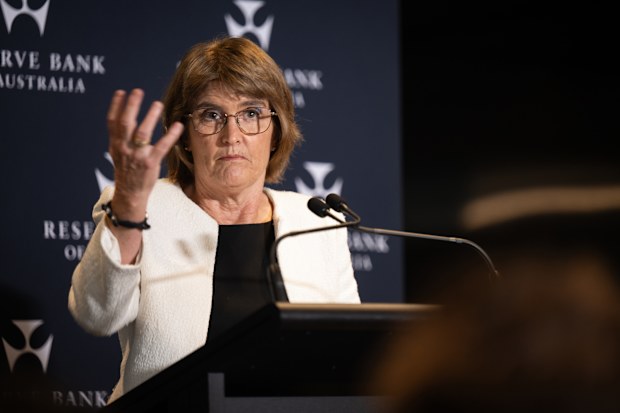
Reserve Bank Governor Michele Bullock may have little choice but to hike interest rates again later this year if Wednesday’s inflation reprieve is only temporary. Louie Douvis
RBA Governor Michele Bullock was abundantly clear on Tuesday she and her monetary policy board won’t shy away from another rate hike if it’s required.
While economists aren’t expecting that, they certainly haven’t discounted it, and financial markets have priced in a better than 80 per cent change of higher interest rates by the end of the year.
Canstar’s Sally Tindall notes the RBA is “walking a tightrope” – and there are serious consequences at play for household budgets.
“The longer the problem persists, the harder it is to shift, with the governor yesterday [on Tuesday] that ‘credibility is hard won and easily lost’,” Tindall said.
“A pause in August looks like the most probable outcome, however, borrowers should keep a buffer in their budgets just in case.
“Another 0.25 percentage-point hike would add $92 a month to a $600,000 mortgage with 25 years remaining.
“The next board meeting will be a line-ball decision, not a slam dunk, and borrowers need to be prepared for a hike just in case the ticking clock wins out.”
The RBA will hand down its next rates decision on August 11.
The information provided on this website is general in nature only and does not constitute personal financial advice. The information has been prepared without taking into account your personal objectives, financial situation or needs. Before acting on any information on this website you should consider the appropriateness of the information having regard to your objectives, financial situation and needs.