
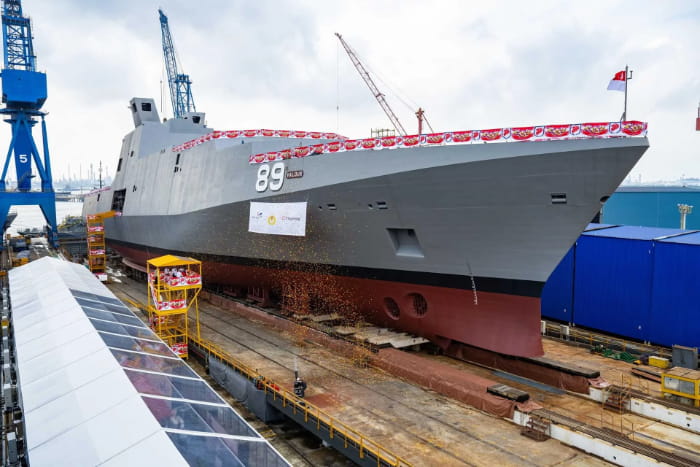
Singapore has launched the second vessel in its new Victory-class multirole combat ship program, featuring key Israeli-developed systems including Blue Spear anti-ship missiles and Rafael’s Typhoon Mk-30C remote weapon system.
The Republic of Singapore Navy launched RSS Valour on July 23, 2026, at ST Engineering’s Benoi shipyard. According to Army Recognition, the 8,000-ton vessel entered the water just four and a half months after keel laying and around three months ahead of schedule.
The Victory-class program includes six advanced combat vessels designed to replace Singapore’s aging 595-ton missile corvettes. Lessons learned from construction of the first ship in the class, RSS Victory, helped accelerate production and improve integration processes.
Israeli technology is central to the ships’ offensive and defensive capabilities. The vessels are expected to carry Blue Spear anti-ship missiles, developed through a partnership between Singapore’s ST Engineering and Israel Aerospace Industries (IAI). The missile system is intended to replace Singapore’s older Harpoon inventory and provide a modern long-range maritime strike capability.
For close-range defense, Singapore selected Rafael’s Typhoon Mk-30C 30mm remotely operated weapon system, providing protection against fast-moving surface and aerial threats.
Beyond their weapons systems, the new vessels represent a major shift in Singapore’s naval capabilities. Measuring 150 meters in length, the ships will have a range of more than 7,000 nautical miles and endurance exceeding 21 days. High levels of automation will allow operation with a crew of fewer than 100 sailors.
The ships are also designed as command-and-control platforms for unmanned operations, supporting unmanned aerial, surface and underwater systems. They feature a helicopter deck and hangar, as well as mission bays capable of carrying up to 20 containers of specialized equipment.
The first Victory-class vessel is expected to enter service in 2028, while RSS Valour is scheduled for operational deployment in 2029.