

A Board of Peace official said Saturday that the US-led panel overseeing the postwar management of Gaza is hoping to commence its Hamas disarmament plan in the coming days after it was approved by the terror group on Thursday.
The official walked back an earlier statement made Thursday that Hamas’s approval of the disarmament plan immediately triggered the first 14 days of the deal — which would see Israeli forces pull back from positions in Gaza as the terror organization lays down its weapons and transfers control of the enclave to a technocratic body — and acknowledged the agreement has yet to enter into force.
The Board of Peace official said the US-backed agency hoped the disarmament plan would begin in the coming days.
Once in place, the deal begins with a two-week period during which the sides will finalize the timeline for the full implementation of Hamas’s disarmament over a period of 200 to 350 days, officials told reporters on a briefing call on Thursday.
But the hold-off on commencing the deal may have to do with Israel’s opposition to it.
Get The Times of Israel’s Daily Edition
by email and never miss our top stories
By signing up, you agree to the terms
Prime Minister Benjamin Netanyahu has yet to publicly comment, but two statements attributed to a “senior Israeli official” since Thursday said that Jerusalem does not approve of the disarmament plan and accordingly will not withdraw, despite statements from American officials that US President Donald Trump would be “very disappointed” if Israel does not move forward with the plan.
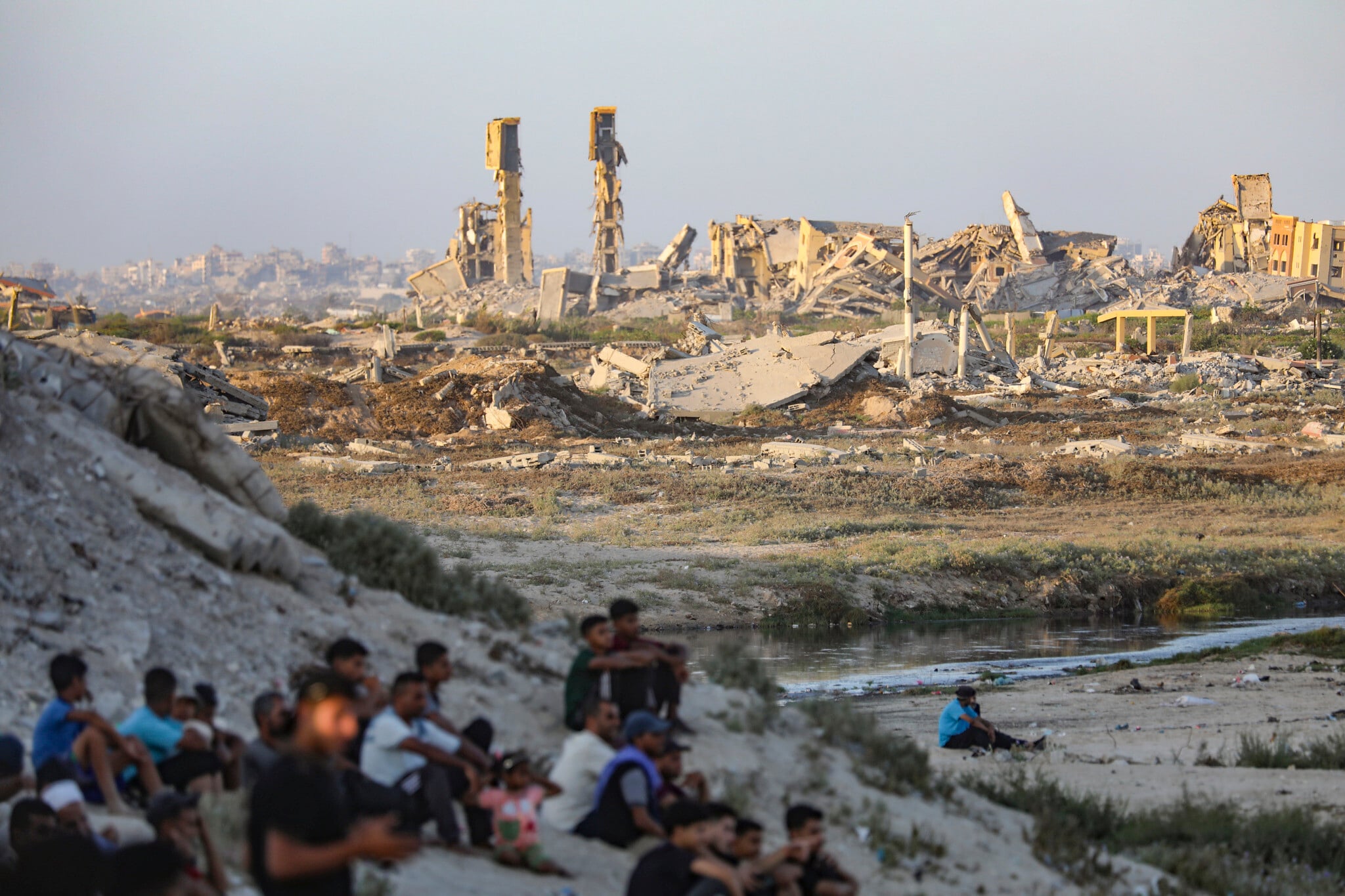
Palestinians sit near rubble in Gaza City, July 31, 2026. (Ali Hassan/Flash90)
Moreover, the Israel Defense Forces announced Saturday that it had conducted a series of strikes against Hamas infrastructure in the Gaza Strip, a further signal that it doesn’t intend to cooperate with the disarmament plan, which would require halting all military operations.
Hamas political bureau member Bassem Naim told AFP on Saturday that “the ball is currently in the Israeli occupation’s court” and called on mediators to “pressure Israel to halt violations and breaches of the ceasefire.”
Palestinian civilians in Gaza have also expressed skepticism, saying they have been repeatedly promised that the war will stop and their lives will improve.
“This is enough. We need improvement in our lives,” said Ayman Ahmed, a displaced Palestinian living in southern Gaza. He said he hopes Hamas gives up its arms, but does not see it happening anytime soon.

A Palestinian boy juggles a ball in front of a destroyed building in Khan Yunis in the southern Gaza Strip on July 31, 2026. (Bashar Taleb/AFP)
“They don’t care about Palestinians’ lives,” he said.
“They can talk about withdrawal and disarmament,” said Abdel Moneim Aboul-Roos, 24, a tuk-tuk driver who lost his leg in an Israeli airstrike. “I don’t care about any of it as long as there is no food or medicine.”
IDF says it hit Hamas arms depots; Gaza hospital said damaged
Five Hamas weapon depots were destroyed in Israeli airstrikes in Gaza overnight, the military and Shin Bet said Saturday afternoon.
The IDF said the sites were used by Hamas to store assault rifles, explosive devices, anti-tank launchers and other military equipment.
One of the weapon depots was located adjacent to Shuhada al-Aqsa Hospital in Deir al-Balah, according to the military.
“This is another example of Hamas’ systematic use of and embedding within civilian infrastructure, including medical facilities, to plan and carry out terrorist activities,” the army said.
The military justified the strikes amid the ceasefire by saying that Hamas intended to use the weapons in attacks on Israeli forces in Gaza and Israeli civilians. The weapon depots were “destroyed to remove the threat,” the IDF added.
צה”ל ושב”כ השמידו חמישה מחסני אמצעי לחימה של ארגון הטרור חמאס ברצועת עזה
צה”ל תקף בהכוונת שב”כ במהלך הלילה במספר מרחבים ברחבי רצועת עזה, והשמיד חמישה מחסני אמצעי לחימה של ארגון הטרור חמאס, בהם אוחסנו כלי נשק מסוג קלאצ’ניקוב, מטעני נפץ, משגרי נ”ט, תחמושת וציוד צבאי נוסף.
אחד… pic.twitter.com/STymI29Ezo
— צבא ההגנה לישראל (@idfonline) August 1, 2026
That strike destroyed two warehouses that were used to store medicine, Hamas’s health ministry said in a statement, adding that two other warehouses storing medicine and the hospital’s outpatient clinic were damaged.
There were no immediate reports of any injuries.
The hospital said the warehouses had stored essential medical supplies used to treat kidney failure patients undergoing dialysis, along with other materials such as gauze used in wound care and routine treatment.
“The Israeli occupation has committed a heinous crime,” Khalil al-Daqran, a doctor at the hospital, said of the strike.
“In the middle of the night, (the military) targeted a warehouse containing medical supplies for the hospital, and the occupation completely destroyed it,” he told Reuters.
Witnesses said the military had issued an evacuation warning for the area before carrying out the strike in Deir al-Balah.
Video from Deir Al-Balah shows the destruction left after an Israeli strike hit a medicine storage warehouse at Al-Aqsa Martyrs Hospital in central Gaza.
The attack displaced dozens of families who had been taking refuge at the site, forcing them to seek shelter elsewhere. pic.twitter.com/2tvVYV6P5h
— Quds News Network (@QudsNen) August 1, 2026
The fragile ceasefire deal reached in October 2025 largely halted a two-year-long war between Israel and Hamas that began with the Hamas-led October 7, 2023, onslaught.
The heaviest fighting has subsided, but at least 1,100 people have been killed in Gaza since the ceasefire took effect, according to the territory’s Hamas-run health ministry. The toll does not differentiate between combatants and civilians and is not verified, though Israel has generally accepted Hamas’s tally. Israel says its strikes respond to violations of the ceasefire or target operatives posing a threat.
Gunmen have continued to carry out shooting attacks on Israeli troops, and Israel says its strikes are in response to those and other violations. Five Israeli soldiers have been killed since the ceasefire began.
We can’t do this work alone.

The war with Iran has been draining for all of us in Israel. But when I heard about a high casualty incident – ballistic missile impacts in Arad and Dimona that left nearly 200 people wounded – I drank a cup of coffee, packed a bag, and headed south.
There, I spoke with Shilgit, the head of an after-school program for underprivileged youth. Standing outside her destroyed center, Shilgit said it was a miracle that no children were hurt and spoke about the community coming together in the hours since.
As a Times of Israel reporter, I’m committed to telling stories of resilience like Shilgit’s. But my colleagues and I can’t do this alone. If you value work like this, please consider joining our reader support group, The Times of Israel Community. Your financial support is essential to keep real human reporting like this going.
— Stav Levaton, military reporter
Already a member? Sign in to stop seeing this
You’re a dedicated reader

That’s why we started the Times of Israel – to provide discerning readers like you with must-read coverage of Israel and the Jewish world.
So now we have a request. Unlike other news outlets, we haven’t put up a paywall. But as the journalism we do is costly, we invite readers for whom The Times of Israel has become important to help support our work by joining The Times of Israel Community.
For as little as $6 a month you can help support our quality journalism while enjoying The Times of Israel AD-FREE, as well as accessing exclusive content available only to Times of Israel Community members.
Thank you,
David Horovitz, Founding Editor of The Times of Israel