
This article first appeared in The Edge Malaysia Weekly on August 3, 2026 – August 9, 2026

The National Automotive Policy (NAP) 2020 and the New Industrial Master Plan (NIMP) 2030 envision Malaysia as an automotive production and export hub for next-generation vehicles, targeting Asean and the wider Asian market. This dovetails with the nation’s broader industrial development plan to raise economic complexity, create high-value job opportunities and deepen domestic linkages.
That the automotive industry is highlighted, alongside priority sectors like aerospace, chemical, electrical and electronics (E&E), pharmaceutical and medical devices is no surprise. Automotive has always been a key pillar in the nation’s economic transformation, initially as the catalyst in the import substitution strategy post-independence (from imports to local assembly), and more prominently, as one of the flagship industries in Malaysia’s pivot towards heavy industrialisation under the First Industrial Master Plan 1986.
The primary strategy back then was to create a national champion: Proton was incorporated in 1983, a 70:30 joint venture (JV) between Hicom (a state-owned entity established in 1980) and Japan’s Mitsubishi Group, and designated as the national car project. Mitsubishi was to transfer technology and manufacturing know-how for Malaysia to develop indigenous design, engineering and manufacturing capabilities over time. Proton became the anchor for Malaysia’s vendor development programme, aggressively enforcing localisation targets to create a local parts and components network for bumiputera-owned small and medium enterprises (SMEs). The ultimate objective was for Malaysia to become a vehicle and component exporting nation, generating foreign exchange.
More than four decades later, it is clear that Malaysia has achieved some but not all of its stated objectives. We have successfully created not one but two national champions — Perodua was established in 1993 as a JV with Daihatsu of the Toyota group — that collectively dominate the domestic market, accounting for six out of every 10 cars sold since 2020. The automotive industry did play a role in accelerating industrialisation, nurtured an industrial workforce and local vendor system, as well as raised bumiputera participation in the economy. There was technology transfer and we did develop engineering capability, just not enough.
But as for the ultimate goal of becoming an automotive export hub, that mission failed — by a huge margin. Vehicles produced in the nation are primarily sold in the domestic market. Case in point: Malaysia’s trade deficit (imports far exceeding exports) for vehicles and related products totals some US$7.7 billion (about RM34 billion). Yes, the sector contributed roughly RM24 billion to gross domestic product (about 1.56%), supported more than 102,000 jobs as well as 150 to 180 Tier 1 vendors and 640 Tiers 2 and 3 components and parts manufacturers in 2022 (per data in NIMP 2030). But could Malaysia have done better?
Not about industrial policy or protectionism but strategic objectives
We cannot turn back the clock and rerun the “experiment”. But the automotive industry development in neighbouring Thailand is instructive.
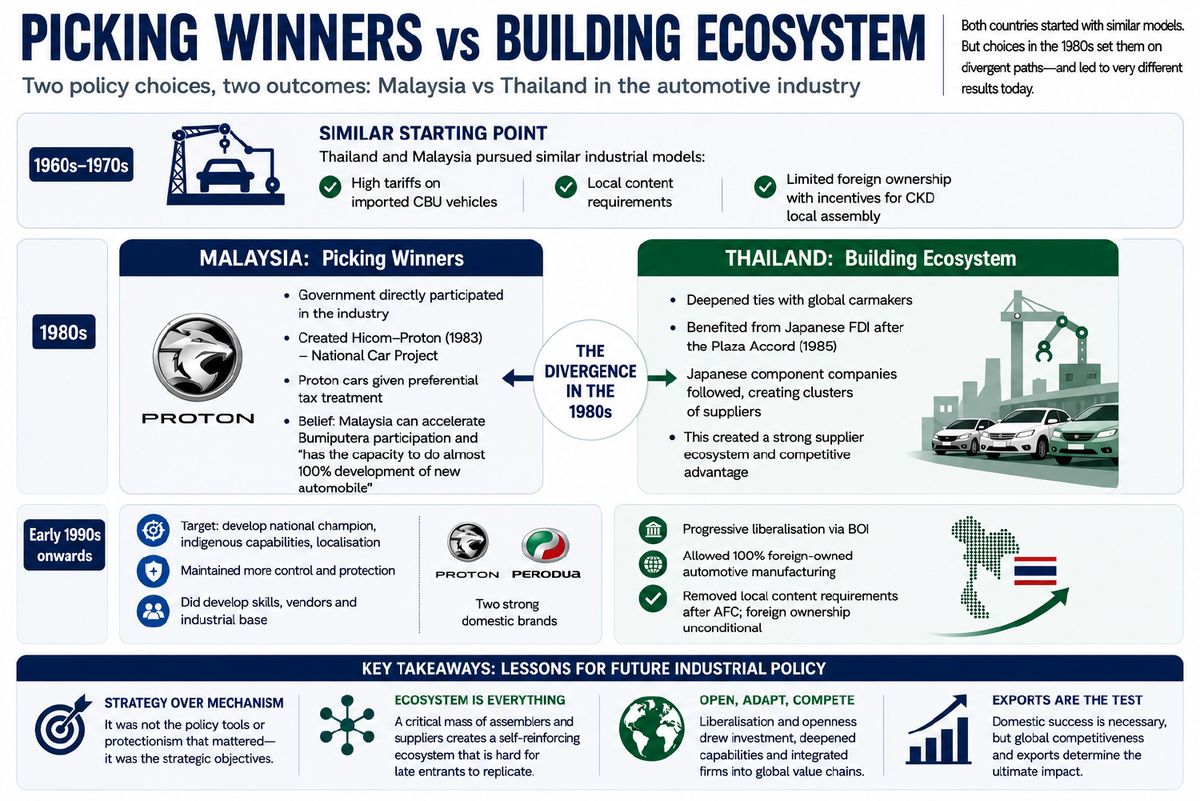
The industry in both countries began evolving around the same time. Through the 1960s to 1970s, Thailand and Malaysia pursued similar industrial models — raising tariffs on imported completely built-up (CBU) vehicles and local content requirements, and limiting foreign ownership while offering investment incentives for local assembly of imported completely knocked down (CKD) kits. The objective: import substitution and localisation.
Then came the divergence in the 1980s. As mentioned, the Malaysian government under then prime minister Mahathir Mohamad decided to move from regulating the industry to directly participating in it — through the creation of Hicom-Proton and the national car project. Proton cars were given preferential tax treatment.
This path was not irrational at the time, given the belief that Malaysia can accelerate bumiputera industrial participation and “has the capacity to do almost 100% development of new automobile”, therefore reducing dependence on foreign technology and carmakers.
Thailand, on the other hand, deepened its relationship with foreign carmakers, and benefited from the influx of Japanese foreign direct investments following the Plaza Accord in 1985 (when yen appreciation made Japanese production more expensive). Toyota, Isuzu, Mitsubishi, Nissan and Honda expanded production in Thailand, and Japanese component companies followed them. This created the clustered supplier ecosystem that became one of Thailand’s most enduring competitive advantages.
Once a critical mass of assemblers and suppliers is established, the ecosystem becomes self-reinforcing. More suppliers attract more carmakers, and more carmakers attract additional suppliers, reducing logistics costs, improving knowledge transfer and deepening labour pools. This creates barriers that become increasingly difficult for late entrants to replicate.
Beginning in the early 1990s, Thailand progressively liberalised foreign investments through the Board of Investment (BoI), allowing 100% foreign-owned automotive manufacturing projects that met investment and export-related conditions. Post-Asian financial crisis (AFC), the sector saw further liberalisation, eventually eliminating local content requirements. Foreign ownership became unconditional.
The outcome: Last year, Thailand produced 1.46 million vehicles, of which 935,750 — or roughly two out of every three vehicles manufactured — were exported. Aside from vehicles, it also exports automotive components, including high-value engines and transmission systems, through its deep integration into regional and global supply chains. The nation recorded an automotive sector trade surplus of US$34.5 billion. This underscores why Thailand is called the “Detroit of Asia”, much like Detroit was the centre of the US auto industry during the 20th century.
Two nations, sharing common beginnings but evolving very differently over the past 4½ decades. It is not about industrial policy, protectionism or even free markets (both nations have implemented protectionist policies over the years).
It is about the strategic objectives. Malaysia wanted to create a national champion. Thailand wanted to create a globally competitive automotive ecosystem.
The results are indisputable — global carmakers see Thailand as a base for supplying Asean and global markets while Malaysia remains a protected domestic market.
Promising reset, then a reversal
Fast-forward to 2020. The aspiration is, once again, for Malaysia to become an automotive production, engineering, technology and export hub for next-generation vehicles, notably electric vehicles (EVs).
The rationale: Malaysia can leverage its semiconductor industry, deepen integration of electronics and systems with the EV segment, push into higher value-added activities in the manufacturing of critical parts and components such as motor, battery management systems, compressor and other intelligent systems.
The draw: foreign carmakers setting up local assembly manufacturing plants for EVs can use Malaysia as a base for exports to Asean — a market of nearly 700 million at zero import tax under the Asean Trade in Goods Agreement (ATIGA).
There appeared to be a ground shift in philosophy. During Budget 2022 and Budget 2023, it was announced that components for locally assembled EVs were fully exempted from import duty and all locally assembled EVs would enjoy full exemption of excise duty and sales tax from January 2022 to December 2027. CBU EVs were granted full import and excise tax exemption until December 2025.
Note that there was no discrimination between national and foreign cars.
Since then, several Chinese carmakers including SAIC Motor, Great Wall Motor and XPeng have set up dealership networks and contracted local partners to assemble their cars. SAIC also revealed plans to collaborate with local suppliers, including for battery pack assembly.
More significantly, Chery announced a substantial RM2.2 billion investment over five years in the Chery Smart Auto Industrial Park in Lembah Beringin, Selangor. In addition to a greenfield manufacturing complex, the project includes plans for supplier parks (including its adjacent Chery Supplier Park), vocational training, tech development, R&D activities and export operations. In 2025, the Malaysian Investment Development Authority and Chery launched the Chery Premier Supply Chain Programme that involves collaboration between the carmaker’s major Chinese suppliers and local vendors.
Geely, which acquired a 49.9% stake in Proton in 2017, has even more ambitious plans to create an auto manufacturing cluster centred in Automotive Hi-Tech Valley (AHTV) in Tanjong Malim, Perak. Its plans include creating an Asean manufacturing hub, supplier and vendor park, R&D facilities, logistics hub, skills development and training and export base.
The AHTV was designated a high-impact major project under the 13th Malaysia Plan — potentially attracting tens of billions of investments over the next decade. Proton opened its first dedicated EV assembly plant there in September 2025, initially with capacity for 20,000 vehicles annually with potential expansion to 45,000.
Of course, contract assembly is far from investing in full-scale manufacturing facilities while Chery’s and Geely’s plans are still at the nascent stage. These are but tentative first steps towards creating an automotive ecosystem.
Same playbook, same results
Unfortunately, the government seems to be reverting to its old playbook of protecting the national carmakers.
The Ministry of Investment, Trade and Industry’s rationale: “To ensure local assembly focuses on higher-value segments, preserving market space for Proton and Perodua. Investments without clear export commitments or localisation plans offer limited benefit to Malaysia’s automotive ecosystem and would constrain manufacturers from achieving the economies of scale necessary for deep and sustainable localisation.”
Following the expiry of tax exemptions in December 2025, CBU EVs are now subject to a 30% import duty (5% for imports from China due to the Asean-China Free Trade Agreement), 10% excise duty and 10% sales tax. Effective July 2026, all imported CBU EVs must have a minimum cost, insurance and freight (CIF) value of RM200,000 and 180kW motor output — that means the on-the-road price including taxes will likely exceed RM300,000.
More critically, new manufacturing licence to establish CKD operations in the country must now export at least 80% of production. This means only 20% of vehicles assembled can be sold in the domestic market. Plus, all locally assembled non-national EVs must be priced above RM100,000.
BYD, arguably the single most important carmaker that Malaysia should attract if it hopes to establish an EV ecosystem and become a significant export hub, has reportedly paused plans to invest RM1.3 billion in a CKD plant in Tanjong Malim. The Chinese carmaker is the world’s largest producer for new energy vehicles, including battery EVs and plug-in hybrids.
Competition strengthens the industry, the lack of which breeds complacency
There is no doubt the latest policy U-turn will set back Malaysia’s EV adoption — EV accounts for just about 3% of new vehicle registrations, far below that of Thailand (18%) — and quite likely derail our ambitions to create an EV ecosystem. The reasons remain the same as with internal combustion engine (ICE) cars — prioritising the national champions over a robust domestic automotive ecosystem.
Growth in the domestic market is limited — Malaysia already has one of the highest car ownership rates in Asean — and our market (34 million population) is simply too small for vendors to scale.
Local component vendors mostly supply to Proton and Perodua, which dominate local vehicle sales. This lack of competition breeds complacency. There is limited exposure to demanding global carmakers and hence, little incentive to innovate, automate or continuously improve the production process, efficiency and manufacturing capabilities.
Many remain relatively small players with no international quality certifications. Few are integrated into the global supply chains, since the national carmakers have limited presence in export markets unlike multinational carmakers like Toyota, Hyundai or BYD. And without sufficiently high production volume and economies of scale, most cannot achieve price competitiveness in the global market.
The economics simply does not work
Make no mistake, Malaysia is playing catch-up. The NAP 2014 liberalised certain aspects of automotive manufacturing, including allowing 100% foreign ownership for new manufacturing licences. Even with investment incentives, there was limited success in attracting greenfield investments from global carmakers. Why?
Thailand had a more than 30-year head start. Despite political instability, its automotive policies have remained remarkably consistent over the decades. It had built a robust ecosystem of competitive supplier network and support industries and many global carmakers had already established full-scale manufacturing facilities in the country. For instance, Malaysia currently has 150 to 180 Tier 1 suppliers (compared to Thailand’s 720) and 640 Tiers 2 and 3 suppliers (compared to Thailand’s more than 1,100).
Regional competition for EV FDI is intense from both Thailand (which already has a mature automotive ecosystem) and Indonesia (whose advantages include natural resources like nickel, cobalt and copper, and a huge domestic market of 285 million population).
The same economics that stunted the growth of Malaysia’s ICE automotive ecosystem also applies to EVs. Scale matters because automotive manufacturing is highly capital-intensive.
Chinese carmakers have chosen to commit billions of US dollars in investments in Thailand since 2020. Great Wall Motor invested US$726 million to take over a former GM plant with a production capacity of 80,000 a year. BYD commissioned its first Asean manufacturing base with a capacity of 150,000 vehicles annually in July 2024. GAC Aion opened its 50,000-capacity plant (with plans to expand to 100,000) in the same year while Changan is investing US$320 million in a greenfield factory with an initial capacity of 100,000 vehicles/year capacity (to expand to 200,000) in Rayong.
Picking winners or building winners?
Can Malaysia become a world-class automotive manufacturing, engineering and export hub? Can the AHTV attract globally competitive Tier-1 manufacturers to establish their plants for batteries, e-drives, power electronics and high-value systems? Can we achieve the NAP 2020 and NIMP 2030 targets? The answers to these questions depend on what is our ultimate objective: is it to create national champions or create a globally competitive ecosystem?
In fact, this question does not apply only to the automotive industry. Malaysia’s industrial policy often focuses on picking (and nurturing) the winners first, in the belief that the few chosen ones will succeed and eventually anchor and grow an ecosystem around them.
Compare this to, say, China. In recent weeks, we have articulated why Chinese companies have enjoyed huge success in global markets. China picks the industries that it views are of national strategic importance, sets the framework, blueprint, targets, regulations and, yes, provides substantial state support for financing, subsidies, incentives and such. But within this framework, instead of betting on one or two or a few companies, the Chinese state supports many competing firms, as long as they meet the necessary criteria. For each success, many others end in failure. China’s objective is to create globally competitive industries by fostering competition, scale and a complete industrial ecosystem.
In other words, Malaysia focuses on ownership. China prioritises capability.
Ultimately, it is about survival of the fittest — not necessarily the one receiving the most state support or whether it is the incumbent or the biggest, but the one that adapts best to rapidly changing market environments. Governments can nurture industries, but only markets impose the relentless discipline — through competition — that cultivates the ability to innovate, reduce costs, respond to consumer demand and adapt to rapid technological change. And produce companies that are truly capable of competing with the world’s best.
The rubber glove industry should serve as a lesson. We did not pick a national champion. We let the local companies compete intensely — and because of that, we now have many globally competitive rubber glove manufacturers. Competition strengthened the industry.
Portfolio commentary
The Malaysian Portfolio traded marginally higher, up 0.1% for the week ended July 29. The biggest gainers were Kim Loong Resources (+1.4%), Hong Leong Industries (+0.6%) and LPI Capital (+0.1%). The two losing stocks were Maybank (-0.7%) and United Plantations (-0.1%). Total portfolio returns now stand at 226% since inception. This portfolio is outperforming the benchmark FBM KLCI, which is down 6.2% over the same period, by a long, long way.
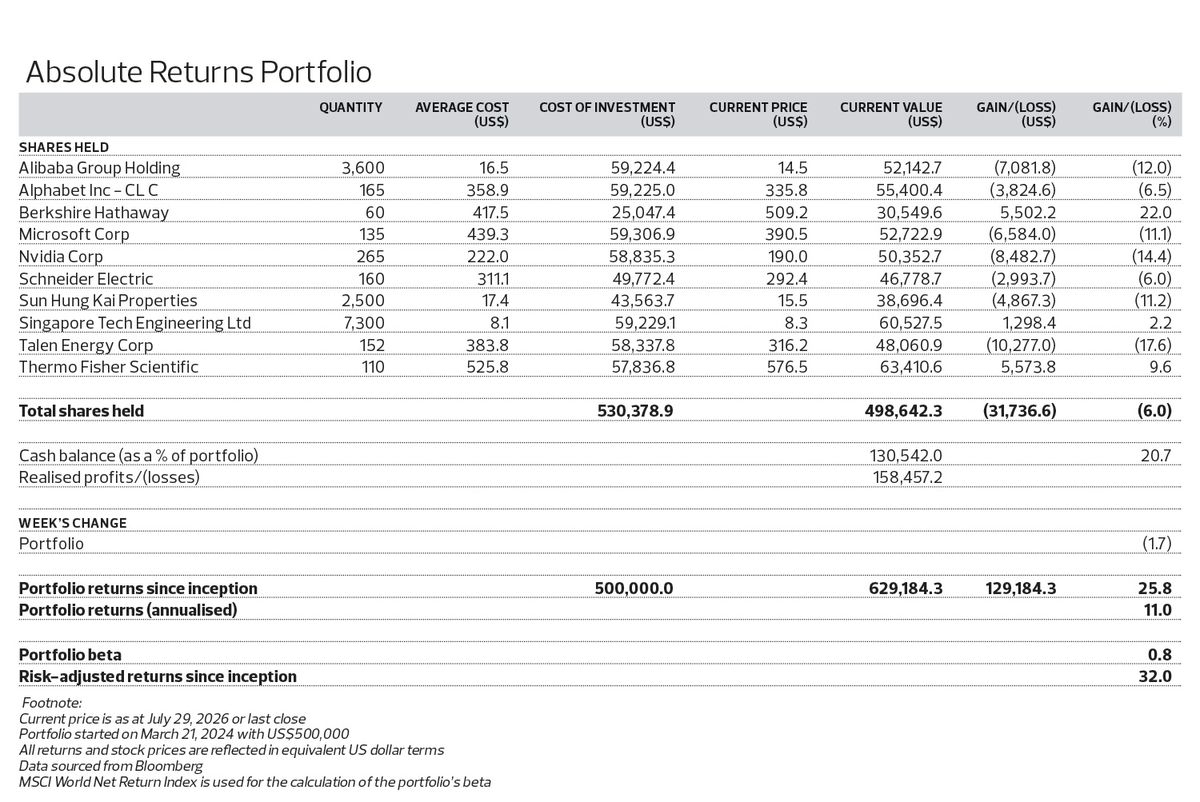
The Absolute Returns Portfolio, on the other hand, fell 1.7% over the same period, paring total portfolio returns to 25.8% since inception. The top gainers were Alphabet Inc – CL C (+9.5%), Sun Hung Kai Properties (+4%) and Microsoft Corp (+2.6%) while the notable losers were Talen Energy Corp (-16.2%), Singapore Tech Engineering Ltd (-10.4%) and Nvidia Corp (-4.7%). Nevertheless, the two latest additions to the portfolio have done quite well in little over one week, with Thermo Fisher Scientific up 9.6% and Singapore Tech Engineering up 2.2%.
The AI Portfolio lost 6.1% last week as the sell-off in chip stocks intensified. Last week’s loss reduced total portfolio returns to 15.7% since inception. Datadog (+7.5%) was the sole gaining stock while Marvell Technology Inc (-22.6%), Roundhill Memory ETF (-22.4%) and Akamai Technologies Inc (-13.6%) led the losers.
Disclaimer: This is a personal portfolio for information purposes only and does not constitute a recommendation or solicitation or expression of views to influence readers to buy/sell stocks. Our shareholders, directors and employees may have positions in or may be materially interested in any of the stocks. We may also have or have had dealings with or may provide or have provided content services to the companies mentioned in the reports.
Save by subscribing to us for
your print and/or
digital copy.
P/S: The Edge is also available on
Apple’s App Store and
Android’s Google Play.