
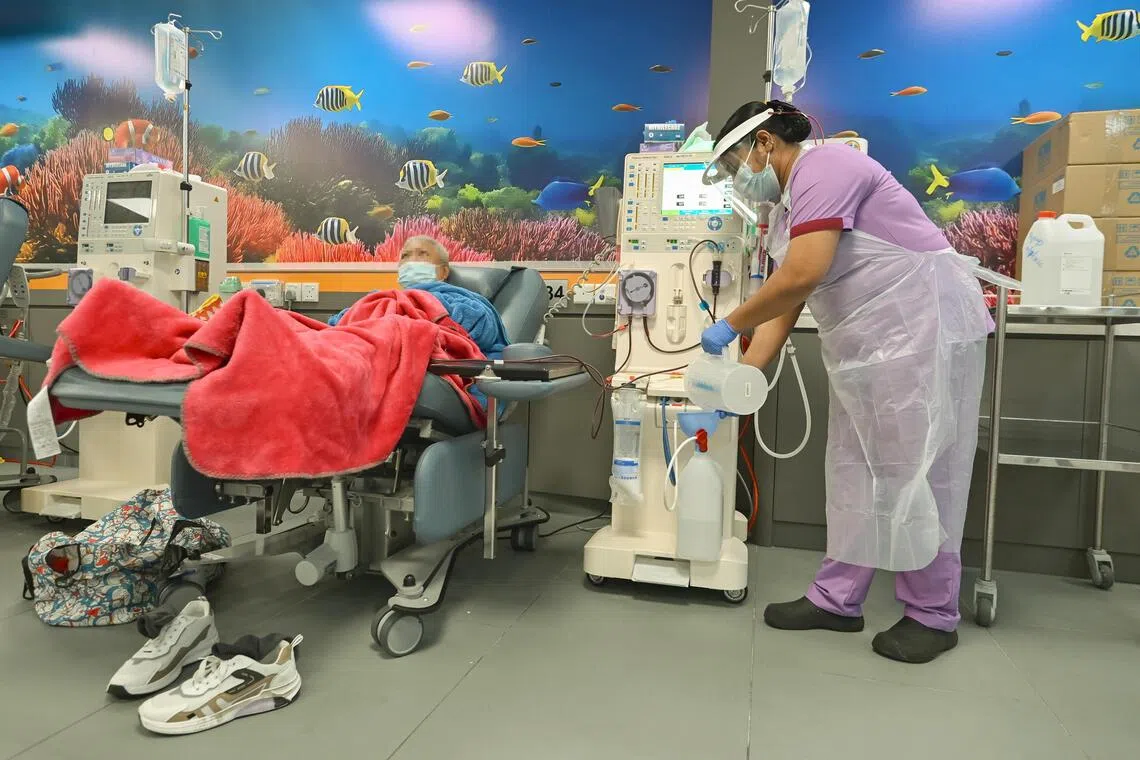
Haemodialysis, a common way to clean the blood when kidneys fail, is one of the most environmentally demanding medical treatments and generates a huge amount of waste.
The National Kidney Foundation (NKF), which cares for two in three of Singapore’s more than 9,000 dialysis patients, generates 285 tonnes of biohazardous waste a year – or 14,268 bins that can each hold 20kg of clinical waste.
This non-recyclable medical waste includes the needles and tubes through which the blood flows, the “artificial kidney” in which blood is cleaned, and the 5-litre plastic containers holding acid concentrate.
It also generates another 940 tonnes of general waste, while recycling more than 25 tonnes of metal, paper, wood and e-waste.
Massive waste footprint
The healthcare sector has a massive ecological footprint, contributing 4 to 5 per cent of global carbon emissions, with kidney dialysis a major contributor.
In line with the national Singapore Green Plan 2030 launched in 2021, NKF, Singapore’s largest dialysis provider, sought ways to reduce its carbon footprint through more sustainable practices.
It includes identifying potential waste reduction as well as reuse and recycling opportunities across the dialysis process, including saline bags, other dialysis consumables and packaging material, subject to infection control requirements.
One measure is that it now refurbishes and upgrades key components of the reverse osmosis systems in its 45 dialysis centres, instead of replacing them every 10 years.
This extends their use by another decade and saves about $2 million over five years. Reverse osmosis produces the ultrapure water needed in dialysis.
It also limits air-conditioning maintenance and cleaning the exterior of the HQ building, reducing its electricity consumption by 5.8 per cent, even though more patients are getting dialysis there now.
In 2026, the NKF HQ became the first in the renal sector to get the BCA Green Mark Gold Plus Certification, given to organisations with high energy efficiency, sustainable design and advanced environmental impact reductions.
Said its chairman Ang Hao Yao: “Sustainability is not separate from healthcare. It is part of delivering better care.
“By reducing waste, improving efficiency and creating safer environments for our staff, we can focus more of our resources on what matters most: our patients.”
One of the biggest environmentally friendly changes came about in 2025, thanks to a $4 million donation from Arthur Tay’s family company, SUTL, to renovate the dialysis centre at the NKF headquarters in Kim Keat Road.
Aside from increasing the number of dialysis stations from 21 to 36, the donation enabled it to set up Singapore’s first Centralised Acid Concentrate Delivery System (CDS). Another centre at One Punggol sponsored by Kwan Im Thong Hood Cho Temple, which opened in 2025 with 40 stations, also has a CDS.
Each system costs $200,000 to $250,000.
The CDS at the two centres _ which can serve 456 patients _ reduces plastic waste and carbon emissions, and has saved the NKF $115,000 a year.
They now use 60,000 fewer 5-litre acid concentrate containers annually.
The NKF said carbon emissions dropped by 70 per cent, acid concentrate solution waste by 10 per cent, and staff injuries caused by lifting the containers by 80 per cent.
Ridding the body of waste
Kidney failure patients cannot urinate and need dialysis to rid their bodies of waste, salt and excess liquid.
In haemodialysis, which takes about four hours and is done thrice weekly at a dialysis centre, blood is removed from the body, cleaned and returned.
The cleaning occurs in an “artificial kidney”, where the blood flows through thousands of tiny semipermeable fibres that let waste pass through their walls, but not blood cells and protein.
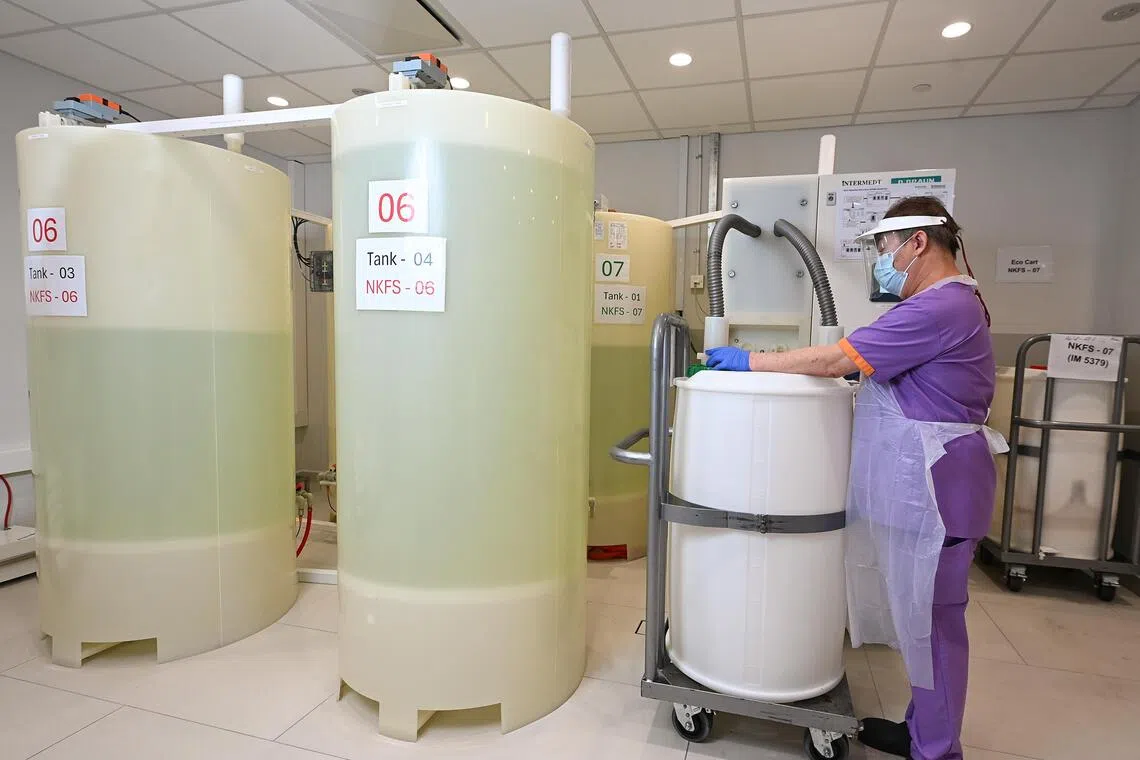
Dialysis care associate Tien Wee Hock transfers the acid concentrate from a bulk drum into the central holding tanks of CDS. The system then automatically pipes the solution directly to every dialysis chair in the centre, through a closed loop.
ST PHOTO: DESMOND WEE
A solution called dialysate flows around the fibres, pulling toxins through the fibre walls by a process called diffusion, while excess water in the blood is drawn out through osmosis.
The dialysis stations create the dialysate by combining purified water, acid concentrate and bicarbonate concentrate. NKF uses four types of acid concentrates, depending on patient needs.
Nurses have to take containers of acid concentrate from the storeroom to each dialysis station. Some patients need more than 5 litres, so another container has to be brought for a top-up during the process.
As each station serves three patients a day, the 20 nurses at the HQ centre, which has 36 stations, need to carry more than 100 such containers each day.
Reducing the load for nurses
Dialysis care associate Tien Wee Hock said the frequent lifting and bending aggravate his old back injury, and he sometimes needs to go for acupuncture to relieve the pain.
Enrolled nurse Dhanyamol Chembali Ambujakshan said lifting so many containers is physically demanding.
With the CDS, the solution is tubed directly to each station, instead of being carried manually in containers.
About one in five patients still needs the containers delivered to their station as the CDS supplies only the two more commonly used of the four solutions.
Dhanyamol said work processes have become smoother and less physically demanding, while Tien is glad he can now focus on other clinical duties.
Though new to Singapore, the CDS system is widely used in Japan, the US, South Korea, China and Europe. The NKF hopes to roll out CDS to four other centres that have at least 30 stations over the next three to five years when they undergo renovation.
The NKF is also pushing for greater use of home-based peritoneal dialysis, which is better for most patients, is less costly and more environmentally friendly. This is supported by the Health Ministry and public hospitals.
Currently, fewer than one in 10 of its more than 6,000 patients is on peritoneal dialysis, as some patients fear doing the process by themselves.
According to an article in the American Journal of Kidney Diseases in January by researchers from the University of British Columbia, the environmental impact of haemodialysis is 46 per cent higher than peritoneal dialysis.
This special report is supported by The National Kidney Foundation.