

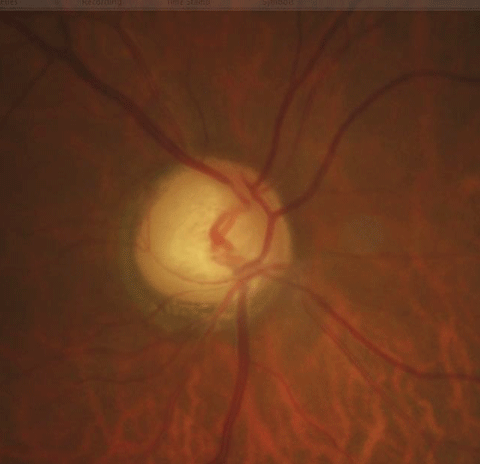
Researchers believe that estrogen may lower IOP in patients with glaucoma by counteracting TGF-β2-driven fibrosis in the trabecular meshwork and Schlemm’s canal, which may improve aqueous humor outflow. Photo: Justin Cole, OD, and Jarett Mazzarella, OD. Click image to enlarge.
A new Korean population study suggests that the relationship between a woman’s lifetime estrogen exposure and intraocular pressure (IOP) may depend on whether the patient has glaucoma. Longer estrogen exposure was associated with higher IOP in women without the condition but lower IOP in those with glaucoma, pointing to a context-dependent role of estrogen in ocular physiology.
The study, published in PLOS One, examined 1,823 postmenopausal women aged 50 and older from the Korea National Health and Nutrition Examination Survey. Researchers used age at menarche, age at menopause, reproductive span and time since menopause as markers of lifetime estrogen exposure. Participants were stratified into glaucoma (n=111) and non-glaucoma (n=1,712) groups. The analysis was adjusted for confounding factors including age, diabetes, blood pressure, BMI, triglycerides and LDL cholesterol.
Overall, 6.1% of the study population met International Society of Geographical and Epidemiological Ophthalmology criteria for open-angle glaucoma. Compared to the non-glaucoma group, women with the condition were older on average (62.3 vs. 58.9 years), had later menarche (16.3 vs. 15.8 years) and had a higher rate of hypertension (46.8% vs. 41.8%). Mean IOP was similar between groups (14.27mm Hg in the glaucoma group vs. 13.88mm Hg in the non-glaucoma group).
Among women without glaucoma, later menopause and longer reproductive span—indicators of longer lifetime estrogen exposure—were linked to higher IOP. Specifically, menopause at age ≥49 and a reproductive span of ≥33 years were each associated with IOP increases of 0.79mm Hg and 0.88mm Hg, respectively.
Interestingly, in women with glaucoma, the direction of association shifted. Later menarche, defined as age 16 or older, was associated with a 2.23mm Hg lower IOP in the fully adjusted model. A longer reproductive span was also associated with lower IOP (1.29mm Hg). By contrast, age at menopause, reproductive span and years after menopause were not consistently associated with IOP reduction in this subgroup.
“These observations underscore disease-specific hormonal responsiveness,” the authors explained in their paper, adding that this suggests “the ocular response to estrogen may shift from robust activity in earlier life to reduced receptor sensitivity or altered tissue compliance with aging.”
The finding that greater estrogen exposure was linked to lower IOP specifically in the glaucoma group “may be explained by the antagonistic effects of estrogen on transforming growth factor-beta (TGF-β) signaling,” the authors noted. They explained that in glaucoma, estrogen may lower IOP because it appears to counteract fibrosis in the trabecular meshwork and Schlemm’s canal—an effect mediated by cytokine TGF-β2—allowing fluid to drain more easily.
Despite this study’s strengths, including the use of a large, nationally representative dataset that supports high external validity, the authors highlight several limitations. These include the study’s cross-sectional design, which prevents causal conclusions, and reliance on self-reported reproductive history, which may be affected by recall bias. It also did not distinguish glaucoma subtype or severity, and residual confounding from factors such as socioeconomic status or medication use cannot be ruled out.
“These findings suggest that a patient’s reproductive history may be a relevant factor to consider along with traditional clinical parameters,” the authors concluded, “potentially offering deeper insights into the individual variability of glaucoma progression profiles.”
Click here for the journal source.
This article was developed by the editorial staff in conjunction with experts in the field. In the process, AI may have been among the editorial tools used to meet the goals of human editors, who approved all content.