
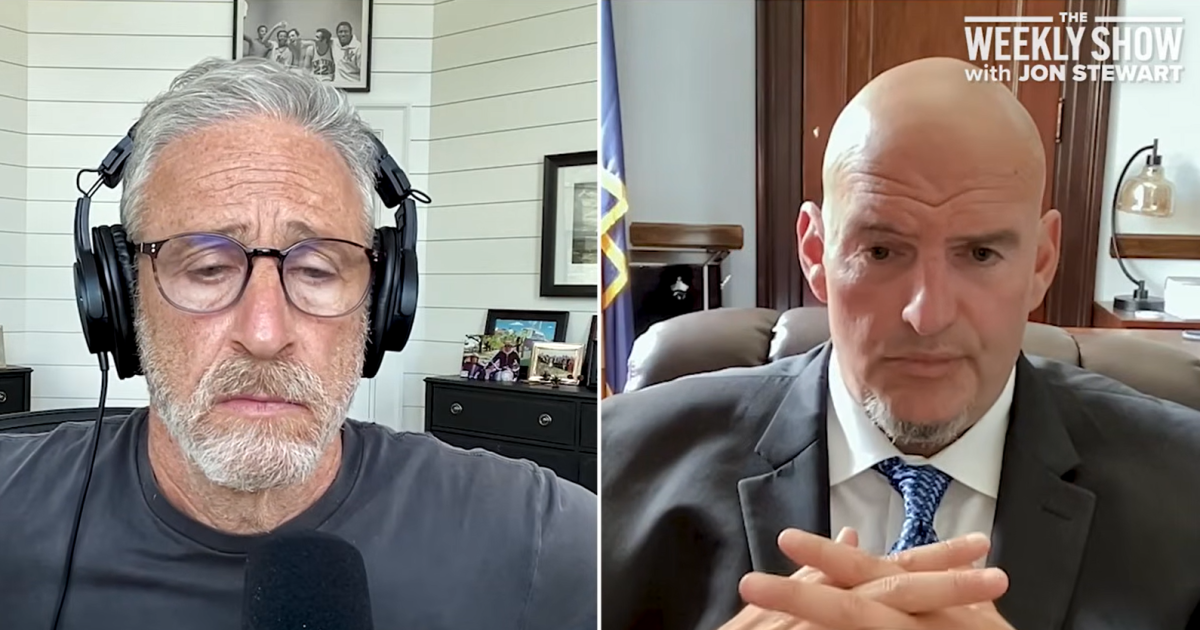
It’s not exactly unusual to see U.S. Sen. John Fetterman being interviewed by the national media: By one reckoning, he is Fox News’ favorite Democrat, presumably for his game willingness to criticize members of his own party for a conservative audience.
But his appearance on The Weekly Show with humorist Jon Stewart marked a departure: a nearly hour-and-a-half interview with a host who repeatedly challenged him with the concerns Democrats have about him.
The conversation did, however, begin on familiar territory: with a discussion of Fetterman’s wardrobe.
Fetterman, known for a casual dress style, appeared in a suit, prompting Stewart to ask, “Where’s Senator Fetterman? All I see is a guy wearing a suit and tie. … You have a job interview today?”
“I thought, ‘Hey, I’m already in it, so maybe I could just be a treat for everybody,’” Fetterman responded.
But the joke reflected Fetterman’s uncertain job prospects. While he doesn’t face reelection until 2028, his approval ratings among Pennsylvania Democrats are dismal, with a strong majority disapproving. (Thanks to his popularity among Republicans, his overall favorability hovers slightly below 50 percent.) There has been speculation — which Fetterman’s own remarks seems to alternately encourage and reject — that he may leave the party entirely.
Stewart did not question Fetterman directly on such plans. But the former Braddock mayor’s chilly relationship with Democratic voters and officeholders was front and center from early on in the conversation, with Stewart asking “How at odds are you with the party?” and likening him to former U.S. Sens. Joe Manchin of Virginia and Krysten Sinema of Arizona — both often seen as Democratic apostates.
“It’s not that at all,” protested Fetterman. While “it’s like an easy take to assume that,” he added, “if you look at my voting record, I’m in 90-some percent voting the Democrat line.” And he noted that he’d been a strong voice on LGBTQ rights: “I haven’t changed these core things like pro-choice. I don’t pick on, turn our back on the gay or trans community in America”
Still, he acknowledged sharp differences with the party, and many of his subsequent remarks — which have become familiar through countless other media appearances — seem unlikely to assuage Democrats.
While the conversation with Stewart was cordial — “You’ve been very fair here,” Fetterman told him at one point — it did include some sharp exchanges, most notably a discussion of Israel that the show’s PR team previewed on social media a day before the interview.
Fetterman has put support for Israel at the heart of his agenda, previously saying that turning on the country would be “my red line” for leaving: “If [the] Democratic Party becomes official anti-Israel, then that’s when I would — force me out.”
Stewart, who is Jewish, pressed him on the decision to weigh Israel’s interests so heavily when “I mean no disrespect on this, but that is not our country.”
Other Democrats “may have great ideas for our economy. They may want to do the exact same things you want to do in terms of getting money out of politics. They may want to increase the social safety net.” Stewart said. “But if they don’t agree with you on Israel, you don’t want them in your party.”
After a few exchanges, Fetterman said that “what history demonstrates is … when people or a government or people turn their back to, to the Jewish community, things end really badly.”
“Jewish community and Israel are not the same thing, brother man,” said Stewart.
And when he asked Fetterman, “is there anything you would criticize Israel about?” Fetterman did not address the question head on but said, “I have not a single Democrat that’s willing to go on record saying, I’m cool, it’s okay if Iran builds a nuclear bomb.”
Fetterman also said that “Trump Derangement Syndrome” — a Republican catchphrase for the belief that criticism of President Trump reflects only hatred for the President — is “a real thing. And that makes it more difficult to call balls and strikes.”
He called himself “very pro-immigration” but said little to address Stewart’s observation that he had backed the nomination of some key Trump Administration cabinet members, including those involved in immigration policy such as former Attorney General Pam Bondi and former Homeland Security head Kristi Noem.
Fetterman later called for Noem’s removal, and he praised her replacement Markwayne Mullin for calling off a plan to warehouse immigrants in former big-box retail spaces around the state. But he said Democrats had been wrong to seek reforms by seeking to use government spending shutdowns as leverage.
Concerns about executive overreach were “reasonable kinds of concerns” but shutdowns were “the wrong tool,” he said. “Win elections and then that puts you in the better position.”
The problem, Fetterman said, was that Democratic voters were doing it wrong by nominating candidates with “extreme views … from the kind of people that have never won a real competitive election “
The interview with Stewart was taped before results in Tuesday-night primaries, including a closely watched U.S. Senate race in Michigan won by progressive Abdul El-Sayed. Fetterman predicted El-Sayed would win by double-digits — the race actually appears to be decided by a single percentage point. But he said if Democrats wanted to avoid being stuck in the minority in the years to come, “I think the responsibility is to police your own ranks. … We can’t go back to the same extreme views because we have to win actual battleground states.”
At various points in the interview, Stewart seemed to be pressing Fetterman on why “it seems like you’re more comfortable angrily denigrating … what you consider the extreme on the left than the right.” Repeatedly he asked why Fetterman wasn’t “using the energy from the left for ideas like banning corporate money and strengthening labor unions — all stuff that I imagine you support — rather than denigrating them and caricaturing them.”
Fetterman did not directly answer such questions, which Stewart sometimes stepped on by asking a follow-up query before Fetterman could address the first one. Fetterman’s auditory-processing issues, the legacy of a stroke he suffered during a 2022 campaign, also sometimes tangle up real-time exchanges with reporters. And at times, his answers could have been drawn from a rank-and-file Senate Republican.
When Stewart observed that the New Deal programs advanced by Franklin Roosevelt borrowed from leftist ideas, for example, Fetterman said “we’re not in the Great Depression.
“The economy continues to grow overall and without a doubt,” he said. And while he allowed that “some things are too expensive,” he said, “Eventually, I think the market will address that.” While the soaring cost of eggs was much discussed last year, he said, those prices attract less discussion now that they are down.
Stewart, like many Democratic voters, seemed flummoxed at how Fetterman had gone from a Democratic firebrand to someone who often seemed intent on tamping down such concerns.
“You called President Trump a ‘jagoff’ in 2016,” the host noted.
“I put it on a shirt,” Fetterman boasted, referring to campaign merchandise from earlier runs.
“You put it on a shirt. And now you’ve been very complimentary to him,” Stewart replied.
And while Fetterman had denounced former Maine Senate candidate Graham Platner over a Nazi-inspired tattoo and allegations of assaulting women, he said, “you’re ignoring an awful lot of evidence for the current president about his relationship with women.” And rather than try to harness the energy of the progressive movement to a shared agenda, he said, “this feels like it’s playing into the hands of Republican caricatures.”
“Hmmm,” said Fetterman, before shifting the focus away from his own record. “Why can’t people on the Democratic side finally figure out why Trump was so competitive and winning two out of the three last cycles? Why is he still here? Why are we still doing it? Because we keep losing.”
Fetterman also reprised his attacks on the Democratic Socialists of America, a progressive group that has lately seen like-minded candidates win primary contests on the Democratic ballot. Fetterman said the group was “colonizing the Democratic Party.”
“If you are a DSA member, if you are a member of a specific political party, run under your own banner,” he said.
Stewart countered that the DSA was similar to the Republican Freedom Caucus, made up of conservative hardliners in Congress. The analogy was imprecise: The caucus is a group of elected lawmakers with a shared legislative agenda, but DSA is made up of voters and activists engaged in electoral politics at the grassroots level.
Despite his professed disdain for the group, in fact, Fetterman himself sought its endorsement during his 2018 run for lieutenant governor. The Pittsburgh DSA rejected him, in large part because he supported incoming state Rep. Paul Costa over rising progressive star Summer Lee.
Early returns of Fetterman’s performance on Stewart’s show were also downbeat, at least on social media — a forum where Fetterman was once a Democratic favorite but is now regularly excoriated.
Former Congressman Conor Lamb, who lost to Fetterman in the 2022 Democratic primary and is a potential challenger to Fetterman’s 2028 reelection bid, said in a social media post that the exchange was “a great demonstration of how when Fetterman is not on Fox he gets thrown off by the most obvious questions and is revealed to be completely vapid.”
The Pittsburgh branch of the Democratic Socialists of America offered a more succinct response: a link to the group’s sign-up page for those interested in joining.