
Few motifs in 20th-century art carry the emotional resonance and symbolic longevity of Marc Chagall’s lovers. Throughout a career spanning over seven decades, Chagall returned obsessively to paired figures, suspended in gravity-defying embraces above rooftops, floating across dreamlike skies, or framed by exuberant floral arrangements. Far from a mere romantic trope, the motif functioned as Chagall’s primary aesthetic vehicle for examining identity, spiritual transcendence, personal displacement, and memory.
Rooted initially in his fiery devotion to his first wife and muse, Bella Rosenfeld, the couple became Chagall’s visual sanctuary against the tumultuous currents of the 20th century. As he navigated exile, world wars, loss, and creative shifts, his depiction of lovers evolved from intimate, folklore-infused domestic visions to grand, mythic allegories of universal peace. By examining key works across his career, one traces how Chagall transformed personal affection into a timeless painterly language.
Les Mariés de la Tour Eiffel (1928)
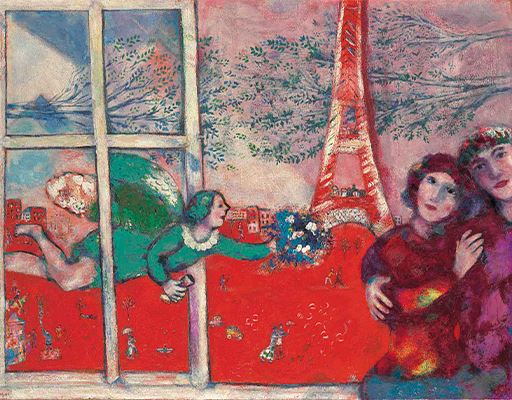
 Marc Chagall, Les Mariés de la Tour Eiffel, 1928, Oil on canvas. Courtesy of Christie’s.
In Les mariés de la Tour Eiffel, Chagall constructs a complex double portrait of himself and Bella embracing against a panoramic view of Paris. Framed by an open window pane – an architectural device that separates interior devotion from the bustling city – an angelic figure bearing the likeness of their daughter, Ida, floats inside to present a bouquet. Surrounding the couple, a cityscape hums with circus performers, strollers, and tiny automobiles beneath a multi-colored sky, merging family portraiture with the energy of the metropolis.
While structurally referencing his 1913 masterpiece Paris par la fenêtre, this 1928 canvas replaces earlier psychological tension with spatial fluidity and narrative warmth. Supported by a steady contract with the Bernheim-Jeune Gallery beginning in 1926, Chagall’s work from this period achieved high commercial acclaim.
CHECK AVAILABLE ARTWORKS BY MARC CHAGALL
Le baiser or Les amoureux en bleu (1930)
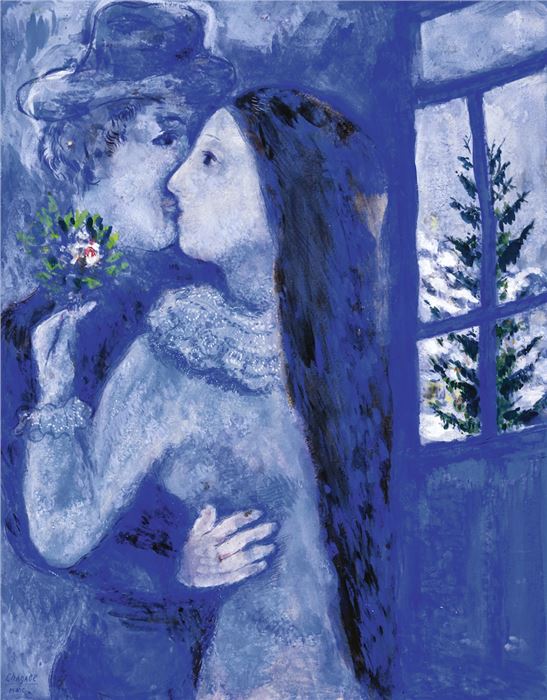
Marc Chagall, Le baiser or Les amoureux en bleu, 1930, Gouache, pastel, and black crayon on paper. Courtesy of Sotheby’s.
In Le baiser or Les amoureux en bleu, Chagall uses a rich combination of gouache, powdery pastel, and dense black crayon to plunge two embraced figures into an intoxicating sapphire space. Rather than signaling melancholy, the dominant cool blue tones create an ethereal nocturnal sanctuary where physical gravity gives way to fluid emotional connection. The tactile quality of pastel combined with opaque gouache allows the artist to build luminosity directly out of deep color fields.
Works from this series demonstrate how Chagall’s large-scale paper compositions rival his oil canvases in market standing and visual weight. Collectors particularly value his 1930s blue-palette works for their vibrant preservation of medium and intimate connection to his ongoing series of romantic duos.
Les Fiancés (1932)
.Jpeg)
Marc Chagall, Les Fiancés, 1932, Gouache, ink, charcoal, and pencil on paper. Courtesy of Christie’s.
In Les Fiancés, Chagall presents a compact, highly focused canvas dedicated to the eternal symbolism of the bridal duo. Rendered with crisp oil strokes in vertical alignment, two closely intertwined figures stand enveloped in bridal white and rich, warm background tones. The bride’s veil cascades softly down the length of the composition, blending seamlessly into her partner’s dark suit. Rather than placing the couple within an expansive landscape, Chagall tightens the perspective to emphasize emotional unity and domestic devotion.