
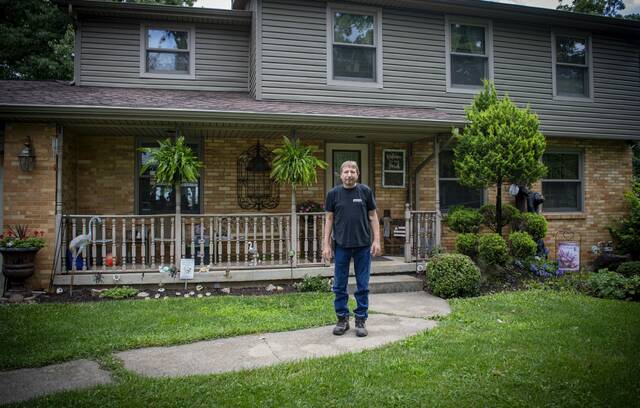
When James Polka learned a donor kidney was available to replace his failing organ, he never dreamed a robot would help perform the transplant.
“My surgeon chose me to be the guinea pig,” said Polka, 52, of Kittanning. “I wasn’t nervous. The only real question I had was how confident she felt.
“I knew someone had to be the first.”
Polka is the first patient at Allegheny Health Network to undergo the groundbreaking procedure for kidney recipients, while AHN became the only health system in Western Pennsylvania to perform both donor and recipient surgeries robotically.
It marks a significant advancement in regional transplant care, according to surgeon Jennifer Carpenter, who serves as director of the living donor kidney transplant program at AHN.
“The future is exciting,” Carpenter said. “We’re not going to immediately offer this to everyone, but we feel it will become a routine part of transplant care by early 2027.”
AHN has routinely performed robotic nephrectomies, or kidney removals, from living donors since 2018. But Polka’s surgery was the first time the technology was used to assist in the implantation of a donor kidney into a recipient.
Kidney failure occurs when the organ can no longer work efficiently to filter waste and excess fluids from the bloodstream, according to the National Kidney Foundation. It can lead to a dangerous buildup of toxins in the body.
Common causes include diabetes, high blood pressure and certain medications.
When 85% to 90% of kidney function is gone, dialysis or a transplant is necessary.
More than 90,000 people in the U.S. are awaiting a kidney transplant, making it the most in-demand organ and emphasizing the need for innovative approaches to expand access and reduce wait times, Carpenter said.
“For many of our patients, a kidney transplant isn’t just a procedure,” Carpenter said. “It’s the culmination of years of waiting and is a true gift of life that transforms their future.”
For Polka, the call took three years to arrive. He received a kidney through the National Kidney Registry paired kidney exchange program.
“I waited a long time, but it’s like I bounced back in no time,” he said. “The day after surgery, they came and got me out of bed, I went for a walk and they sat me up in a chair. It was pretty quick.”
Carpenter performed the procedure using the da Vinci Surgical System. She was assisted by Sarah Skeba.
Unlike a traditional kidney transplant, which requires an incision across the abdomen, robotic-assisted procedures create a tiny incision with high-precision instruments and enhanced 3D visuals.
Carpenter said the minimally invasive option can reduce wound complications and support faster recovery.
“Because the placement of the incision changes, it’s much easier to heal and less painful,” she said.
Polka said his incision is just above his belly button, which he believes allowed him more mobility during recovery.
“The incision, being kind of mid-area versus lower, has less pain,” he said. “I think it will be a game changer, especially for people who need to get back to work.”
A heavy equipment mechanic, Polka is participating in rehab to rebuild his muscle strength.
The robotic procedure, Carpenter said, can expand accessibility for patients who are older or morbidly obese, or who have complex medical conditions that might carry higher complication risks from a traditional open procedure.
Polka didn’t fit into any of those descriptions. He’s a self-described “thinner man who is on the younger side and otherwise healthy.” His diabetes led to scleredema, a rare skin condition that can affect kidney disease.
“I just lucked into this,” he said. “It’s really a plus.”
AHN joins an exclusive number of transplant centers nationwide in performing robotic kidney transplants for recipients. There are about 30 centers across the country, Carpenter said.
She is grateful that Polka agreed to the landmark procedure, saying “without the bravery and willingness, we would never be able to do new things.”
“It was stressful and exciting,” Carpenter said. “Any time you start something new, you can’t predict how it’s going to go. We have a whole team that put in hundreds of hours of preparation.
“Now that we’ve proven that it can be done and done well, the exciting thing is what we can do in the future. We can expand who we offer transplants to, especially those patients who would’ve previously been turned down.”