
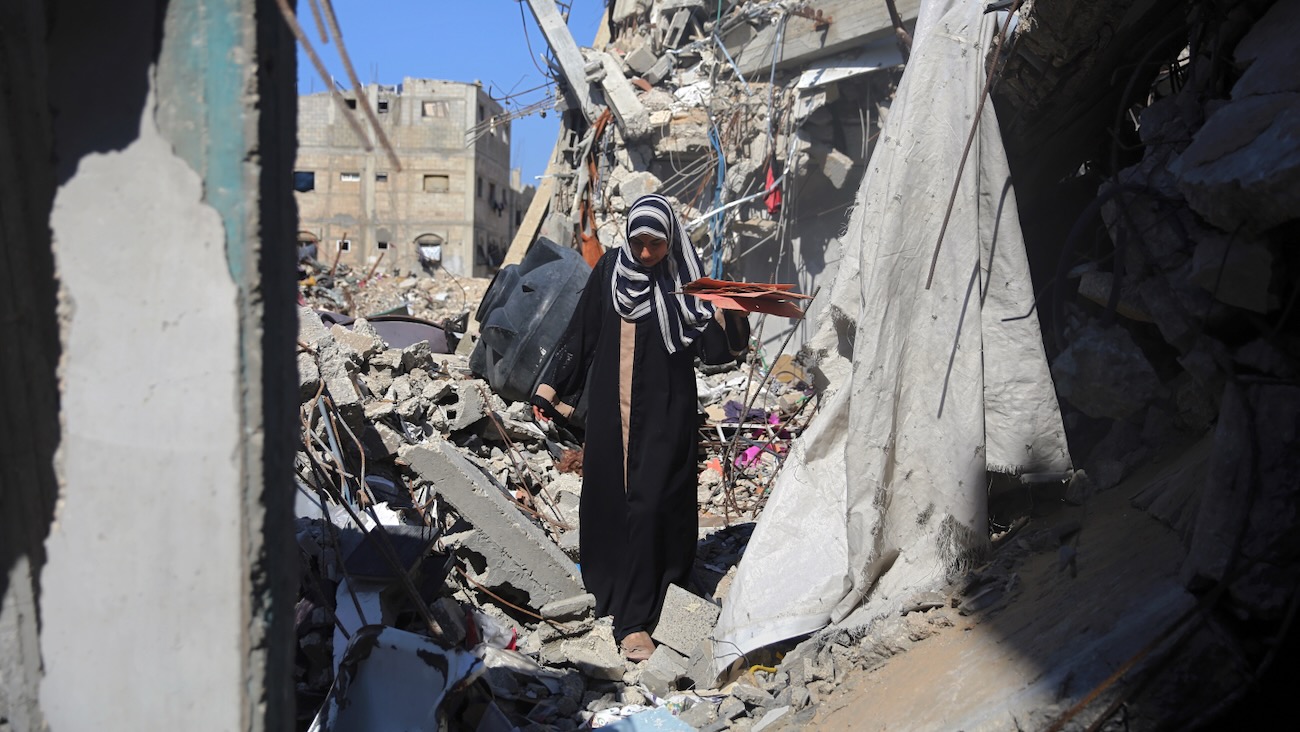
A woman in Gaza who told her story to UN Women, September 24, 2024. UN Women/Suleiman Hajji.
On July 30th, the US-led Board of Peace announced a potential breakthrough in efforts to implement the roadmap for Gaza’s political and security transition. Under the proposed arrangement, the National Committee for the Administration of Gaza (NCAG) would assume responsibility for civilian governance and security; Hamas and other Palestinian armed groups would place weapons under Palestinian custody; an international committee would verify compliance; an International Stabilization Force (ISF) would support security and humanitarian operations; and Israeli forces would withdraw in phases.
The announcement, however, did not resolve the central dispute. Hamas has accepted the roadmap while maintaining that it will not turn over its weapons to the NCAG before Israel ends military operations, withdraws its forces, increases humanitarian access, and fulfills earlier ceasefire commitments. On August 9th, the Israeli Prime minister rejected the roadmap, insisting that Israel would not withdraw until Hamas was fully disarmed. Israeli strikes have also continued, underscoring the fragility of the proposed transition. Despite this uncertainty, it is not too early to ask who will govern Gaza once a transition does get underway. The NCAG has been designated as the Palestinian technocratic body responsible for public administration and, under the roadmap, would become the sole transitional authority for civilian governance and internal security. It is preparing to oversee public services, Palestinian police, economic recovery, and reconstruction in areas certified as having completed the weapons-decommissioning process.
Any transitional arrangement for Gaza should nonetheless remain connected to a broader Palestinian political framework rather than institutionalize Gaza’s separation from the West Bank, including East Jerusalem. That broader context is increasingly urgent: in its July 2026 statement on escalating violence in the West Bank, the Carter Center warned that settler violence, displacement, settlement expansion, and official and de facto annexation are further undermining Palestinian rights and the prospects for a just and lasting peace. Gaza’s transitional arrangements should therefore be designed in a way that preserves Palestinian territorial and political unity rather than deepening fragmentation. Within that framework, the immediate design of Gaza’s transitional institutions matters because decisions taken now could shape governance, security, land, and reconstruction well beyond the transitional period.
Yet women are almost absent from the institution being prepared to exercise these powers. The NCAG’s official website lists 13 commissioners. Only one is a woman. This imbalance matters. The institutions established during the transition will determine how police are vetted, how violations are investigated, which property claims are recognized, where reconstruction begins, which companies receive contracts, how former combatants are reintegrated, and who can obtain compensation or legal remedy. The near absence of women from these decisions will influence the substance of Gaza’s emerging political and economic order.
The women, peace, and security (WPS) agenda provides a practical framework for assessing the role of women in Gaza. UN Security Council Resolution 1325 and subsequent WPS resolutions emphasize women’s participation, protection of women and girls, conflict prevention, and inclusion of women in relief and recovery. The CEDAW Committee’s General Recommendation No. 30 further establishes that obligations to prevent discrimination and protect women’s rights continue during armed conflict, occupation, political transition, and post-conflict recovery.
Applied to Gaza, these commitments require more than consulting women after governance, security, and reconstruction arrangements have been negotiated. They require examining who holds authority within the NCAG and related institutions, how decisions are made, and whether women can shape the rules governing policing, disarmament, property, public finance, reconstruction, and accountability from the outset. Against this backdrop, five priorities should guide the NCAG, other Palestinian institutions, the Board of Peace, the United Nations, donors, and other international actors as they design and implement Gaza’s transitional governance, security, and recovery arrangements.
Give Women Authority inside the NCAG
The NCAG’s composition illustrates the dire state of women’s inclusion in Gaza’s governance. Not only is there only one woman commissioner, but that commissioner is assigned to the social protection portfolio. This risks reinforcing the assumption that women’s contributions belong primarily in care-related sectors, while men retain control of policing, justice, land, finance, infrastructure, and reconstruction. The issue is therefore not simply how many women are represented but whether they hold authority where Gaza’s political, security, and economic arrangements are being determined.
The NCAG includes Gaza-based technocrats who were approved by consensus among Palestinian factions. The same process should be used to fill any remaining positions and appoint additional women commissioners and deputy commissioners before the committee becomes fully operational inside Gaza. The factions involved, working with the guarantors and the Office of the High Representative for Gaza, should solicit nominations from Gaza-based women’s organizations, professional and business associations, municipalities, universities, legal and academic institutions, and organizations representing displaced women and persons with disabilities. Additional appointments should place women beyond social protection, including in portfolios shaping security, justice, land, finance, and reconstruction, while reflecting the diversity of women in Gaza.
Yet appointments alone will not guarantee women’s meaningful participation. The harder question is whether women can shape agendas, budget priorities, and informal decision making rather than simply occupy formal positions. A 2025 study of Palestinian women’s political participation found that formal measures, including reserved seats, had expanded women’s representation without necessarily shifting decision-making power away from entrenched patriarchal and elite networks. As one participant observed, “There are now some seats reserved for women in the [Palestinian legislative] council.… Real influence is still out of reach.” Although the study did not examine the NCAG specifically, the committee’s current composition risks reproducing this broader pattern.
Women’s participation must also not be limited to representation in the NCAG. The NCAG could establish a standing consultative mechanism to allow women-led and women’s rights organizations, persons with disabilities, and affected communities to submit proposals, review policies and budgets, participate in hearings, and receive written responses. Such a mechanism should go beyond symbolic consultation after decisions have been made, allowing these groups to participate in governance, planning, budgeting, implementation, and oversight.
Put Women inside the Verification, Disarmament, and Civilian-Protection Architecture
The July roadmap establishes a linked security and governance architecture for Gaza. An Implementation Verification Committee, composed of representatives of the guarantors, the ISF, and the Board of Peace, would determine whether the parties had fulfilled their obligations before moving to the next phase. The Security Council–authorized International Stabilization Force would serve as a buffer, support the chain of custody and decommissioning of weapons, protect humanitarian operations, and assist in training vetted Palestinian police. As the transition advances, the NCAG would assume responsibility for civilian administration and internal security in areas placed under its authority.
Women should hold operational positions throughout this architecture. The Implementation Verification Committee should include senior gender and civilian-protection experts with access to its evidence, deliberations, and findings. The ISF should include women monitors, investigators, police advisers, interpreters, protection specialists, and community liaison officers. Women should also hold decision-making roles within the NCAG’s interior, justice, and civil peace portfolios and in the leadership of the new Palestinian police.
Beyond including women, these security institutions will need to take a gender-responsive approach. Monitoring should extend beyond weapons transfers and exchanges of fire. It should also assess whether civilians can move safely, obtain humanitarian assistance without discrimination, reach healthcare and other essential services, and report violations without retaliation. This requires understanding differences in how women and men are experiencing the ceasefire.
These institutions should also include mechanisms to address the protection risks facing both men and women. Before Palestinian police are deployed at scale, the NCAG’s should establish an independent civilian police-complaints mechanism to receive and address allegations of violence, abuse, discrimination, arbitrary detention, corruption, and other misconduct by Palestinian police and other NCAG security personnel. The mechanism should operate outside the police chain of command and include women investigators, lawyers, interpreters, and protection specialists trained in trauma-informed and gender-responsive approaches. Police should also be screened for credible allegations of past abuse, and women police officers should be recruited, including for community policing, detention monitoring, family-protection units, complaints investigation, and senior command positions.
A gender-responsive approach will be critical for the decommissioning framework, which anticipates conditional amnesty, weapons buy-back, reintegration assistance, and protection for individuals who comply with the transition. These measures should not be designed solely around male combatants. They will affect families, widows, dependents, survivors of violence, and communities receiving former fighters. Women’s organizations, affected families, and community representatives should participate in determining eligibility, monitoring reintegration, preventing reprisals, and addressing the economic and protection consequences for families.
Create a Gaza Property and Documentation Mechanism
A major challenge with Gaza’s reconstruction will be the lack a system for determining household ownership, occupancy, inheritance, restitution, and compensation. Repeated displacement and the destruction of homes and public institutions have led to the loss of identification cards, birth and death certificates, marriage records, guardianship documents, leases, land deeds, and other evidence. With 60% of Gaza’s population having lost their homes, this evidentiary gap risks excluding large parts of the population from the reconstruction process. At greatest risk are the most vulnerable, including widows, orphans, and displaced households. Unless property protections precede land clearance, rezoning, contracting, and redevelopment, wartime displacement could become permanent dispossession.
The NCAG should therefore establish a joint civil documentation and housing, land, and property mechanism in coordination with municipal authorities, the Palestinian judiciary, legal aid organizations, professional associations, women lawyers, and representatives of displaced communities. The mechanism could provide mobile civil-registration and legal-aid teams; accelerate the replacement of birth, death, marriage, guardianship, educational, identity, and property records; and accept alternative evidence such as copies, electronic records, leases, utility records, tax records, photographs, testimony, and community verification.
Such a mechanism must account for the particular needs of women. Women submitting claims involving missing or deceased relatives, unregistered marriages, informal occupancy, inheritance, and guardianship should receive specialized legal assistance. Women should also be permitted to submit claims, receive compensation, and register property in their own names without requiring the presence or authorization of a male head of household. Adjudication and appeal bodies should include women judges, lawyers, and property specialists.
Pending claims should not expose women, particularly widows or those relying on informal, inherited, or disputed tenure, to eviction or irreversible loss of property before their claims have been reviewed.
Give Women Decision-Making Power over Reconstruction Finance and Contracts
A joint World Bank, United Nations, and European Union assessment estimates that Gaza’s recovery and reconstruction needs amount to approximately $71.4 billion. The financing architecture is already taking shape. In July, the NCAG presented its Gaza Reconstruction Program in Brussels. The meeting launched the Gaza Team, involving more than 12 donor countries, the European Investment Bank, and the World Bank, with the stated goal of mobilizing nearly $1 billion.
How these resources are allocated will determine who controls capital, employment, land, public services, and commercial opportunity for years. This is particularly important for women: UN Women reported in June 2026 that 95% of businesses employing women in Gaza had shut down or been destroyed.. Some financing mechanisms have already incorporated gender commitments to this end. For example, the United Nations Horizon Fund provides that at least 15% of project resources should support gender equality and women’s empowerment.
That allocation target is useful, but it does not ensure women are included in deciding how funds are spent. A project can be classified as benefiting women while women remain absent from project selection, budgeting, procurement, and oversight. Women should therefore have voting seats on bodies that approve projects and allocate resources under the Gaza Team, Horizon Fund, NCAG reconstruction structures, and related donor platforms. Gaza-based women’s organizations, professional associations, women-owned businesses, and disability organizations should be represented through transparent selection procedures rather than periodic consultations alone.
The NCAG and donors should also publish criteria for deciding which communities, sectors, and projects are prioritized; the composition and voting rules of project-selection bodies; approved budgets and contracts; beneficial ownership of contractors; gender, age, disability, and location-disaggregated data on employment, compensation, business support, and service access. In addition, procurement frameworks should establish measurable targets for women-owned and women-led Palestinian businesses, including subcontracting opportunities and simplified registration and bidding procedures. Women entrepreneurs will also need direct grants, credit guarantees, technical assistance, and access to banking and digital payment systems.
Women-led organizations have also continued to deliver legal aid, protection services, emergency cash, livelihood support, safe spaces, and other essential assistance throughout the conflict. They possess community networks, operational knowledge, legal and protection expertise, and relationships of trust that can help identify where services are needed and which groups are being excluded. Donors should therefore provide direct, flexible, and multi-year financing to Gaza-based women-led and women’s rights organizations.
Care infrastructure must also be treated as economic infrastructure. Women cannot participate fully in public life or the reconstruction economy while carrying disproportionate responsibility for securing basic needs and caring children, injured or disabled relatives, and other family members amid the collapse of schools, healthcare, transportation, and childcare. Investment in this care infrastructure should be treated as a priority, not as a secondary social expenditure.
A Practical Test for Gaza’s Transition
While the path toward a transition in Gaza remains uncertain and difficult, steps are already being taken to prepare for future security and governance arrangements. A ceasefire and weapons-decommissioning agreement would be essential, but neither constitutes a complete design for peace. The institutions now being developed will help determine who governs Gaza, who exercises security authority, where reconstruction begins, who holds legal title, who receives contracts and compensation, and who can obtain a remedy when rights are violated.
The NCAG is preparing to assume responsibilities inside Gaza, verification and stabilization mechanisms are being designed, and donors are organizing reconstruction financing. Yet the role of women in these emerging arrangements remains an open question.
The question is not whether women will be consulted; it is whether they will exercise authority while these institutions and rules are being constructed. The practical test will be whether women have meaningful influence over the decisions that matter most—from security and property rights to reconstruction priorities, public resources, and accountability.
If women remain nearly absent from these institutions, Gaza’s transition risks reproducing existing patterns of exclusion at precisely the moment when its political, security, and economic order is being rebuilt. Meaningful participation is not an additional demand placed on a complex transition; it is a condition for its legitimacy, effectiveness, and durability.