

METEOR 1-21 is a Soviet weather satellite that has been circling Earth for over 51 years. Launched on April 1, 1975, from the Plesetsk Cosmodrome aboard a Vostok 8A92M rocket, it was the 21st operational spacecraft in the first-generation Meteor program. As of August 2026, it remains in a stable sun-synchronous orbit near 870 km, still tracked under NORAD catalog number 7714.
The satellite was built to provide television imagery, infrared radiometry, and actinometric measurements of Earth’s atmosphere and surface. That instrument suite fed data to the Soviet Hydrometeorological Service for weather forecasting and climate monitoring. While long since retired from active operations, METEOR 1-21 continues to orbit with minimal decay, a product of its relatively high altitude and low drag profile.
Mission and History
The Meteor-1 series was the Soviet Union’s first operational polar-orbiting weather satellite constellation. Developed by VNIEM (the All-Union Scientific Research Institute of Electromechanics), the program ran from 1969 through the late 1970s, with each spacecraft carrying a standardized set of meteorological instruments. METEOR 1-21, designated Meteor (M) No. 31L, was one of the later first-generation units and carried the standard TV, infrared, and actinometric payload package.
The spacecraft uses a cylindrical bus with two deployable solar panel wings, giving it a total span of roughly 4.5 meters. Dry mass at launch was approximately 1,280 kg. Power came from the twin solar arrays backed by onboard batteries. The Meteor bus shape (cylinder plus two panels) is immediately recognizable in the catalog as a distinctive radar cross-section signature, and METEOR 1-21’s RCS of about 3.87 square meters is consistent with the deployed configuration.
By the time METEOR 1-21 launched, the Soviet meteorological program was already transitioning toward the second-generation Meteor-2 series, which began flying in 1975 as well. The first-generation spacecraft were workhorses rather than technology demonstrators, and their longevity in orbit has outlasted their operational relevance by decades.
Orbit Analysis
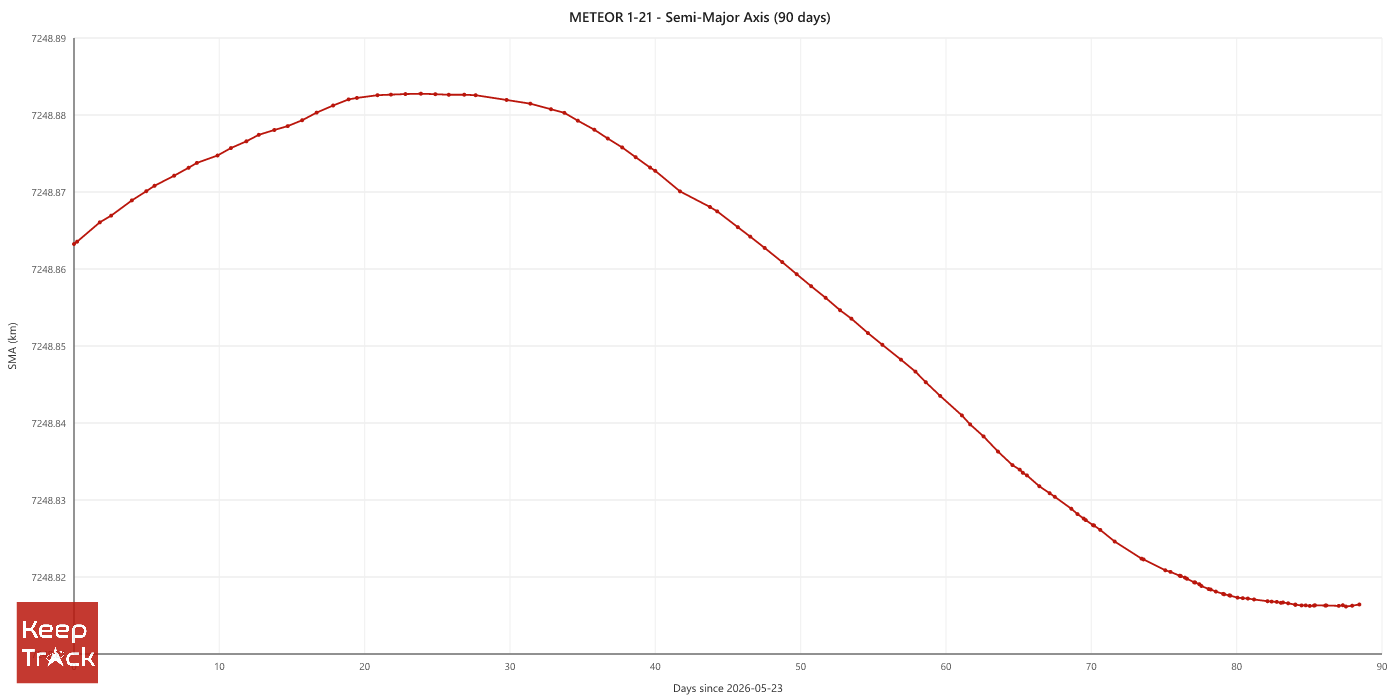
METEOR 1-21 occupies a near-circular sun-synchronous orbit at approximately 850 x 892 km altitude with an inclination of 81.20 degrees. Over the past 88 days of tracking data (120 element sets), the semi-major axis has been essentially flat, dropping just 47 meters total. At this altitude, atmospheric drag is negligible, and the satellite’s orbit will persist for centuries without any intervention. The mean motion of 14.08 revolutions per day and the near-zero first derivative confirm the orbit is in long-term equilibrium.
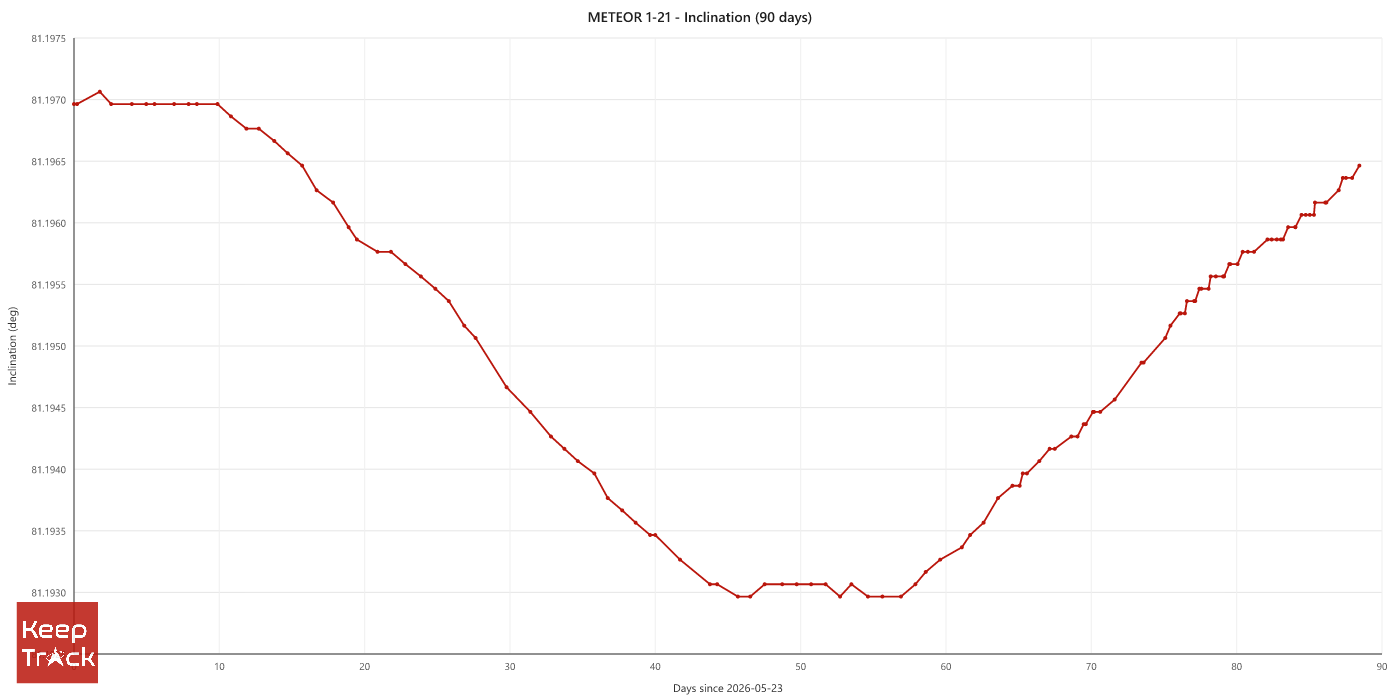
The inclination has been rock-steady at 81.19 degrees with less than 0.005 degrees of variation across the observation window. This is characteristic of a high-altitude sun-synchronous orbit where gravitational perturbations from Earth’s oblateness (J2) dominate but produce predictable nodal regression rather than inclination drift.
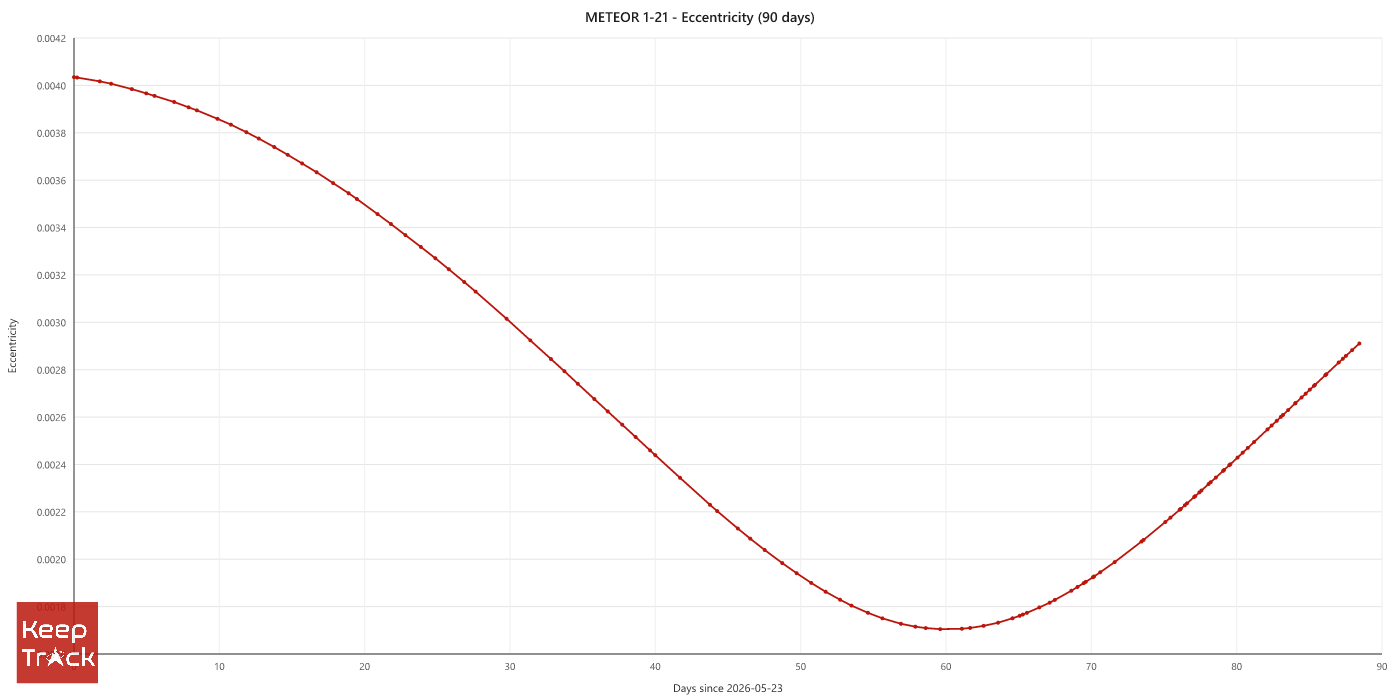
The eccentricity shows a clear downward trend, dropping from 0.00403 to 0.00291 over the 88-day span. This periodic oscillation is driven by solar radiation pressure and third-body perturbations cycling the eccentricity vector. The orbit is becoming more circular in this phase, though it will oscillate back. At its lowest, eccentricity dipped to 0.0017, bringing apogee and perigee within about 25 km of each other.
Quick Facts
Detail
Value
NORAD ID
7714
COSPAR ID
1975-023A
Operator
GUKOSR/GMS
Country
Soviet Union
Launch Date
April 1, 1975
Launch Site
Plesetsk (LC41/1)
Launch Vehicle
Vostok 8A92M
Mass
1,280 kg
Orbit
850 x 892 km, 81.19°
Purpose
Meteorology
Track METEOR 1-21 in real-time: Track METEOR 1-21 | Full record