
Beneath the sun-baked sands of Egypt’s Abu-Tartur Plateau, paleontologists have unearthed fourteen fossilized shark teeth belonging to five previously unrecorded species. The discovery, buried in a layer of the Duwi Formation, pushes the known shark diversity at the site to at least seven species and offers a rare window into a marine ecosystem that vanished tens of millions of years ago.
It’s hard to imagine now, but the desert stretching across northern Africa was once submerged beneath a warm, nutrient-rich sea. During the Cretaceous period, roughly 145 to 66 million years ago, higher sea levels and a greenhouse climate meant much of the land we walk on today sat underwater, part of the ancient Tethys Ocean.
That submerged world left behind more than just sand and rock. Phosphate deposits, the kind that tend to form where marine life and nutrient cycling run high, preserved not only the seafloor itself but clues about how productive those waters once were. It’s within one of these phosphate beds that researchers, led by paleontologist Tarek Yassin of Cairo University, went looking for answers.
A Second Trip Back to Abu-Tartur
This isn’t the team’s first visit to the site. In earlier research, Tarek Yassin and colleagues had identified two shark species from a handful of teeth found in the fossil bed, a modest but telling signal, since supporting multiple large predators requires a food web with real depth beneath it. That hint was enough to send the researchers back for a closer look.
The return trip paid off. The black and yellow layers of the Duwi phosphate yielded fourteen more shark teeth, representing five species never before identified at Abu-Tartur. Two of them, Serratolamna cf. serrata and Squalicorax bassanii, turned out to be entirely new records for Egypt.
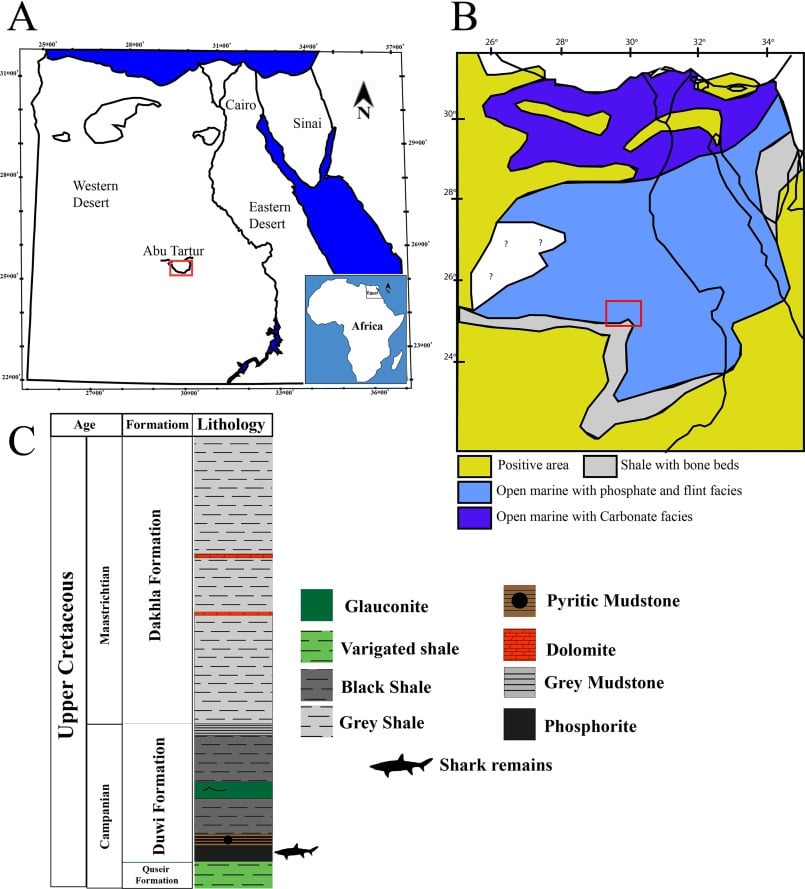 Maps show the study area and Late Cretaceous marine environments, with the stratigraphic position of shark remains in the Duwi Formation. Credit: Cretaceous Research
According to the study, published in Cretaceous Research, one specimen stood out even further: Scapanorhynchus cf. raphiodon, distinguished by its needle-like teeth, may represent the first known occurrence of the species in Africa, and possibly the most recent example in the fossil record overall, with other known specimens being notably older.
“Collectively, this assemblage highlights a nutrient-enriched, high-productivity marine ecosystem along a phosphogenic shelf margin,” the researchers wrote.
Reading a Lost Ecosystem in Tooth Shapes
With ancient sharks, teeth are often all that remain, and subtle differences in shape can be the only basis for telling species apart. In this case, the differences were not so subtle. Some teeth were long and slender, needle-like; others broad and serrated, apparently built for slicing rather than piercing. One was curved sharply, resembling a karambit blade. Some carried small fang-like projections called cusplets, while others lacked them entirely.
Those variations, the researchers argue, point to sharks occupying different ecological niches rather than competing directly for the same prey.
“The presence of Squalicorax could suggest an input from nearshore/inner shelf settings, while the occurrence of Scapanorhynchus reflects deeper-water conditions on the outer shelf and slope,” the researchers write. “Lamniform taxa such as Cretalamna and Serratolamna further support stable open-shelf conditions” as evidence, taken together, of a layered marine environment rather than a single uniform habitat.
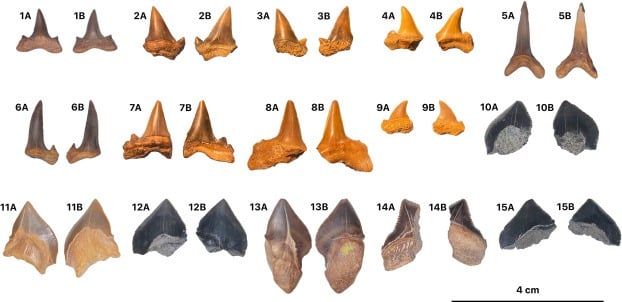 Fossil shark teeth recovered from the Duwi Formation at Egypt’s Abu-Tartur Plateau. Credit: Cretaceous Research
A Graveyard Built Over Time, Not in a Day
The researchers are careful to note what the fossil bed does and doesn’t show. Because so little sediment accumulated during the period the sharks lived, the phosphate layer represents a condensed span of time rather than a single moment frozen in the rock. That means the teeth reflect a time-averaged accumulation drawn from multiple ecological niches, not proof that seven species of shark lived, and died, together at once.
Still, the findings fit into a broader pattern. Similar phosphate deposits in Morocco and Syria have also recorded large numbers of shark species, suggesting that this stretch of the ancient Tethys, along the northern edge of Africa, was a great place for the marine predator to thrive during the Late Cretaceous.