
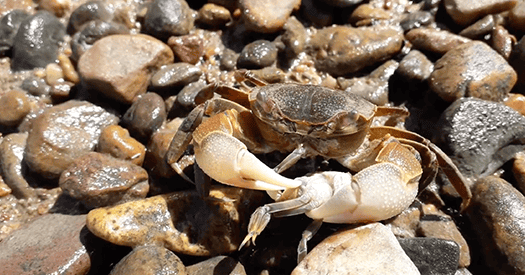
Intracellular recordings revealed the circuits that connect visual input to motor output. The decision to flee is triggered once the apparent size of an approaching object has grown to a certain size, according to work by Tomsic and his colleagues. The crab continuously adjusts its running speed as the threat expands, slowing immediately if the stimulus stops growing. A single giant neuron, the MLG2 neuron, encodes how fast the threat is expanding and drives that speed adjustment in real time, and another neuron, MLG1, controls a crab’s freezing response.
Field studies in collaboration with Jan Hemmi, professor of biological sciences at the University of Western Australia, revealed that crabs behave differently in the lab than in the wild. In the lab, crabs consistently flee in the opposite direction from an approaching stimulus, and they wait until the looming object is fairly large before moving. In the field, however, crabs bolt in response to smaller stimuli and run toward their burrows to hide, even if it’s in the same direction as a predator. Without a place to hide, lab animals freeze to avoid detection. “That was a big lesson for me,” Tomsic says. The mismatch showed that laboratory conclusions about natural behavior carry real risk without field checks, he says.
More recently, Tomsic’s focus has shifted to the decision-making behind the escape behavior, and how being surrounded by other crabs changes when and how an individual crab chooses to flee. And, because Neohelice prey upon each other, the model enables researchers to study predatory behavior as well.