
EDITOR’S NOTE: Call to Earth is a CNN editorial series committed to reporting on the environmental challenges facing our planet, together with the solutions. Rolex’s Perpetual Planet Initiative has partnered with CNN to drive awareness and education around key sustainability issues and to inspire positive action.
Every day, the Amazon releases billions of tons of water into the atmosphere that are carried by winds toward other regions of South America. These vast flows of moisture, known as “flying rivers,” deliver the rains that supply forests, cities, crops and power generation far beyond the rainforest.
But for the process to keep working, the Amazon ecosystem must stay connected, and the forest that produces and transports that moisture must be protected.
For decades, the Gaia Amazonas Foundation has worked with Indigenous communities and governments to strengthen the management of their territories, give them a greater say in decision making about the forest, and bring their traditional knowledge into conservation policies and strategies. The idea is that preserving the flying rivers also means preserving the conditions that allow the Amazon to keep pumping water to the rest of the continent.
For Francisco von Hildebrand, director of Gaia Amazonas, conserving the forest requires maintaining a connectivity that is not only biological but also cultural and social — one in which Indigenous peoples lead the way.
“That role of Indigenous peoples as bearers of ancestral knowledge for the care of ecosystems and territory is what underlies the historic stewardship they have had with the Amazon,” he told CNN. That cultural connectivity also means aligning the stakeholders that have an impact on the territory, including the economic and financial sectors.
In practice, Gaia’s mission includes working with Indigenous leaders to strengthen their governments and advance the recognition of their territories as political-administrative entities. Gaia Amazonas also supports forums to strengthen the political participation of Indigenous women in decisions about managing and protecting the forest.
The Amazon’s capacity to move water across the region begins with a process happening in the forest every day.
“For years it’s been said that the Amazon is the lungs of the planet … but it is also the heart of the planet, because it pumps the rains that irrigate much of the continent,” von Hildebrand said.
Behind that image is a physical process that Germán Poveda, a hydrologist at the National University of Colombia, describes as “a daily heartbeat of the Amazon’s hydroclimate.”
Poveda said that during the day, plants “eat sunlight to photosynthesize” and, as a result, release enormous quantities of water vapor through “evapotranspiration.” That moisture, added to the vapor arriving from the Atlantic Ocean, is carried by winds into the interior of the continent and feeds rainfall over the Amazon, the Orinoco basin, the Andes and even regions farther away.
That process allows cities such as Quito, Ecuador; Lima, Peru; and La Paz, Bolivia, to receive water from the high Andes — “water that is carried by the winds from the Amazon.”
But the reach of these flying rivers goes far beyond the forest.
Von Hildebrand estimates around 670 million people in Latin America depend directly or indirectly “on the water cycle sustained by these rivers.”
That estimate matches the conclusions of the Amazon Assessment Report 2025 by the Science Panel for the Amazon (SPA) warning about the Amazon’s role in the continent’s water balance. The same finding appears in an analysis by the World Economic Forum, which notes that each day the Amazon’s roughly 400 billion trees release approximately 20 billion tons of water into the atmosphere — a flow that then becomes rainfall essential to water supply, agriculture and climate stability across Latin America.
Quantifying the economic and social value of the flying rivers is one of the projects led by Gaia Amazonas.
Ideally, von Hildebrand explained, the Amazon should be understood as a “natural infrastructure” that sustains the economic and social activity of the region’s countries. Essential activities and services — agriculture, hydroelectric power generation, drinking water supply, transport and supply chains — depend, directly or indirectly, on the rain this atmospheric system generates.
Disruption of that system would have consequences far beyond the forest. For von Hildebrand, reaching that point would mean the start of an irreversible process of “savannization”: it would stop being a rainforest, release most of the carbon it currently stores, and accelerate climate change. But in his view, the greatest impact would be on people. “Food production across all of South America would collapse or enter a total crisis. Every sector would be affected,” he said.
Water supply, energy generation and public health would also suffer, with a possible “economic, social and political collapse at a global level.” That could trigger mass population displacement toward regions with better living conditions. “The question is not what it’s worth to preserve the flying rivers; the question is whether we can afford to lose them,” he added.
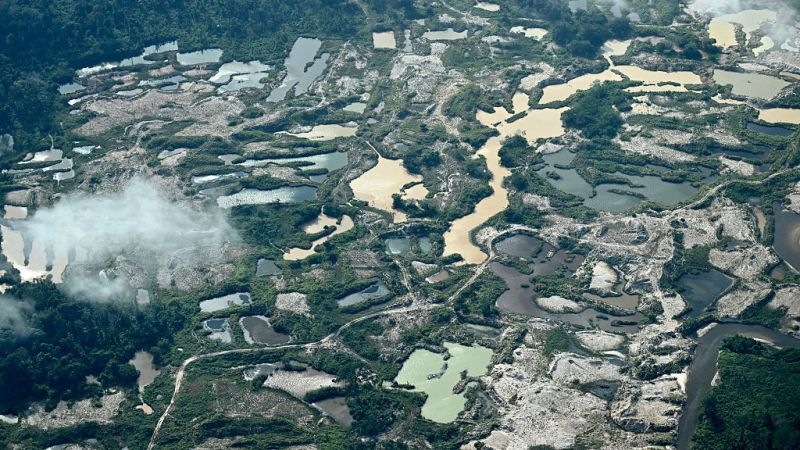
The scientific evidence points in the same direction. In the report “The Future Climate of Amazonia,” Brazilian scientist Antonio Donato Nobre argues that deforestation is already altering the regional climate by reducing the forest’s transpiration — the movement of water through plants, from the soil into the air — and by changing rainfall patterns and extending dry seasons — changes already observable in different areas of the Amazon.
The report adds that many of those effects were anticipated by climate models more than two decades ago and have now been confirmed through scientific observation, while new projections warn of an even more severe scenario.
Poveda also quantifies that risk. He told CNN the forest could collapse if deforestation exceeds 25% and global warming reaches 1.5 degrees Celsius above pre-industrial levels.
“We are very close to that point of no return. Today, around 20% of the Amazon rainforest has already been deforested. If we reach 25%, it would be very difficult to go back,” he warned. For experts, the point of no return no longer belongs only to climate models: it is a risk that is starting to be measured in the present.
Avoiding that point of no return also requires involving the different sectors that have an impact on the Amazon. To that end, the Gaia Amazonas Foundation is working to bring conservation into decision-making spaces and to get political, economic and financial stakeholders to introduce land protection.
“How the economic sectors, the financial sectors, the political sectors align is an important part of the work,” von Hildebrand said. The aim is to build strategies that allow conserving the Amazon beyond the territories where the foundation works directly.
That also demands changing how we understand our relationship with nature. “We have to remember again that we are part of nature, and plan with life at the center. That is something we can learn from Indigenous peoples,” von Hildebrand said.
That shift also means no longer seeing water, air, forests and oceans as mere resources. “We should call them life support systems,” he added, because without them “neither we nor any of the other beings we share this planet with can live.”
Translation by Daniel Olivares Gallego.