
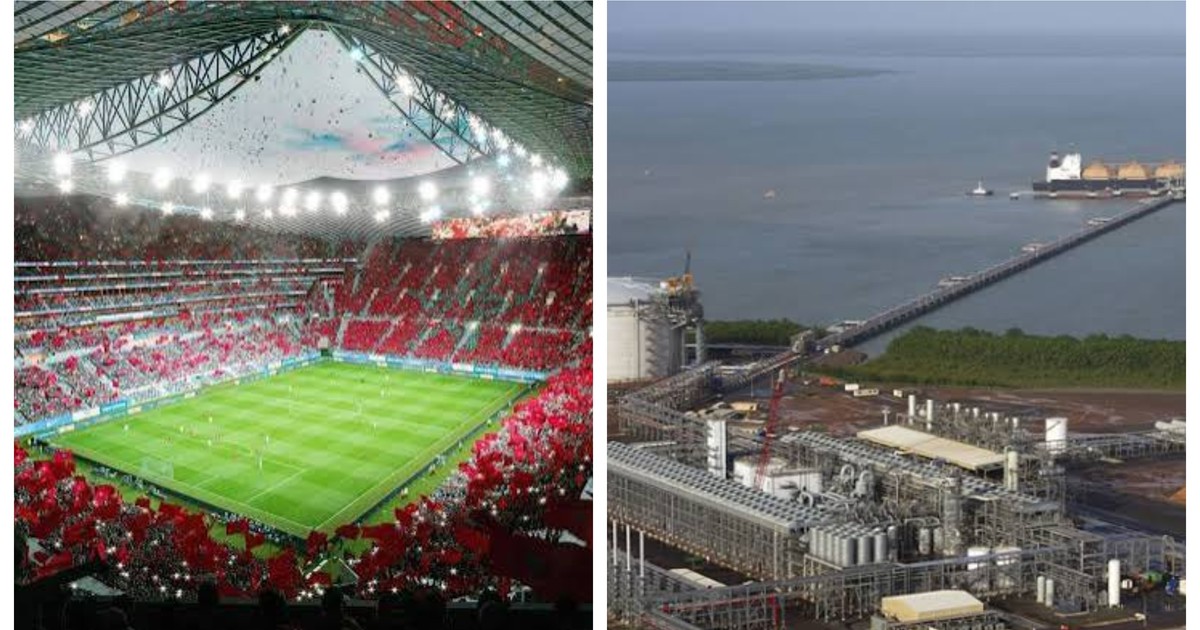
The projects range from a $42 billion LNG development in Tanzania and a $17 billion refinery in Kenya to a new Ethiopian airport designed to rank among the world’s biggest aviation centres.
Others target Africa’s long-standing problems, from unreliable power and costly transport to dependence on imported fuel.
Together, they could reshape energy, aviation, trade and critical mineral supply chains, while also intensifying competition between China, the United States and Europe for influence across Africa.

$17 billion Dangote East Africa Refinery — Kenya
Dangote Industries plans to build a 700,000-barrel-per-day refinery in Lamu, Kenya, in what could become its biggest refining investment outside Nigeria.
The project is estimated at about $17 billion, with site selection, soil testing and engineering work already under way. It could reduce East Africa’s dependence on imported petroleum products and serve markets including Uganda, Rwanda, Tanzania and South Sudan.
For Kenya, the refinery could also revive the long-running LAPSSET corridor and turn Lamu into a major industrial and energy centre.
Its scale is also likely to attract interest from major Chinese, American, European and other international engineering, construction and technology companies competing for contracts.
That would make the project important not only to East Africa’s energy security, but also to the wider global contest for infrastructure business and influence across the continent.

$12.5 billion Bishoftu International Airport — Ethiopia
Ethiopia broke ground on the $12.5 billion Bishoftu International Airport in January 2026, led by Prime Minister Abiy Ahmed and Ethiopian Airlines chief executive Mesfin Tasew.
The project has already attracted world-class designers and engineers. Dar Al-Handasah is leading a consortium that includes Zaha Hadid Architects, Pascall+Watson, Landrum & Brown and TYLin, while major construction groups from China, France, Italy, South Korea and Turkey are competing for contracts.
The first phase is designed to handle 60 million passengers a year, rising to 110 million at full capacity, with four runways and space for about 270 aircraft.
At that scale, Bishoftu would compete with global aviation centres such as Dubai International, London Heathrow, Istanbul Airport and Singapore Changi Airport.

Grand Stade Hassan II — Morocco
Morocco is pouring about 5 billion dirhams, roughly $500 million, into the 115,000-seat Grand Stade Hassan II near Casablanca as it races to prepare for the 2030 FIFA World Cup, which it will co-host with Spain and Portugal.
Backed by the Moroccan government and the Caisse de Dépôt et de Gestion, the stadium is expected to be completed by 2028.
Once finished, it would become the world’s largest football stadium by capacity and is being designed with the World Cup final in mind.
Beyond football, the project is part of Morocco’s wider infrastructure push across airports, railways, tourism and urban development ahead of 2030, giving the country a global platform to showcase its ambitions.

Nigeria–Algeria Trans-Saharan Gas Pipeline — Nigeria, Niger and Algeria
The Trans-Saharan Gas Pipeline, estimated to cost about $13 billion, is designed to carry Nigerian gas more than 4,000 kilometres through Niger to Algeria, where it could connect with existing infrastructure supplying Europe.
The pipeline could transport up to 30 billion cubic metres of gas annually. In 2026, Nigeria, Niger and Algeria approved an updated feasibility study as Algeria advanced work on its section.
Its global importance is growing as the European Union moves to phase out Russian energy imports by late 2027 and searches for alternative suppliers.
By linking Nigeria’s vast gas reserves to Algeria’s established Mediterranean export infrastructure, the project could become both a major African integration corridor and a strategic energy lifeline to Europe.

Grand Inga Hydropower Project — DR Congo
Grand Inga is one of Africa’s oldest and most ambitious infrastructure dreams. The full scheme has been estimated at as much as $100 billion, while Inga 3, its next major phase, is expected to cost more than $10 billion.
Built around the enormous hydropower potential of the Congo River, Grand Inga could eventually generate about 39,000 MW on average, putting it among the largest power-generating projects in the world.
The World Bank has already approved the first $250 million of a planned $1 billion programme to prepare Inga 3 and strengthen the institutions needed to move the project forward.
If realised, Grand Inga could transform electricity access in the DRC, supply power across African markets and provide the energy needed to expand mining, manufacturing and industrialisation.
Lobito Corridor — Angola, DRC and Zambia
The roughly $6 billion Lobito Corridor is turning an old railway into one of the most strategically important transport routes in Africa.
Backed by the United States, European Union and African partners, the project links Angola’s Atlantic coast with the mineral-rich regions of the DRC and Zambia.
Its importance lies in copper and cobalt, two minerals essential to electric vehicles, batteries and modern power grids.
The bigger African opportunity, however, is to use the corridor to build industries around those minerals rather than simply export them faster.
$42 billion Tanzania LNG Project
Tanzania’s proposed LNG project is the biggest on this list by estimated cost.
The roughly $42 billion development is intended to commercialise huge offshore gas discoveries made between 2010 and 2015. Shell, Equinor, ExxonMobil and Tanzanian state partners are among those involved.
Although negotiations have delayed the project, changing global energy dynamics are renewing interest in Tanzania’s gas.
Equinor has said disruptions to energy flows through the Strait of Hormuz are making the project more attractive as buyers look for alternative sources.
If it proceeds, the development could turn Tanzania into a major LNG exporter and strengthen East Africa’s position as an alternative energy supplier to global markets.