
An Experiment in Art Education
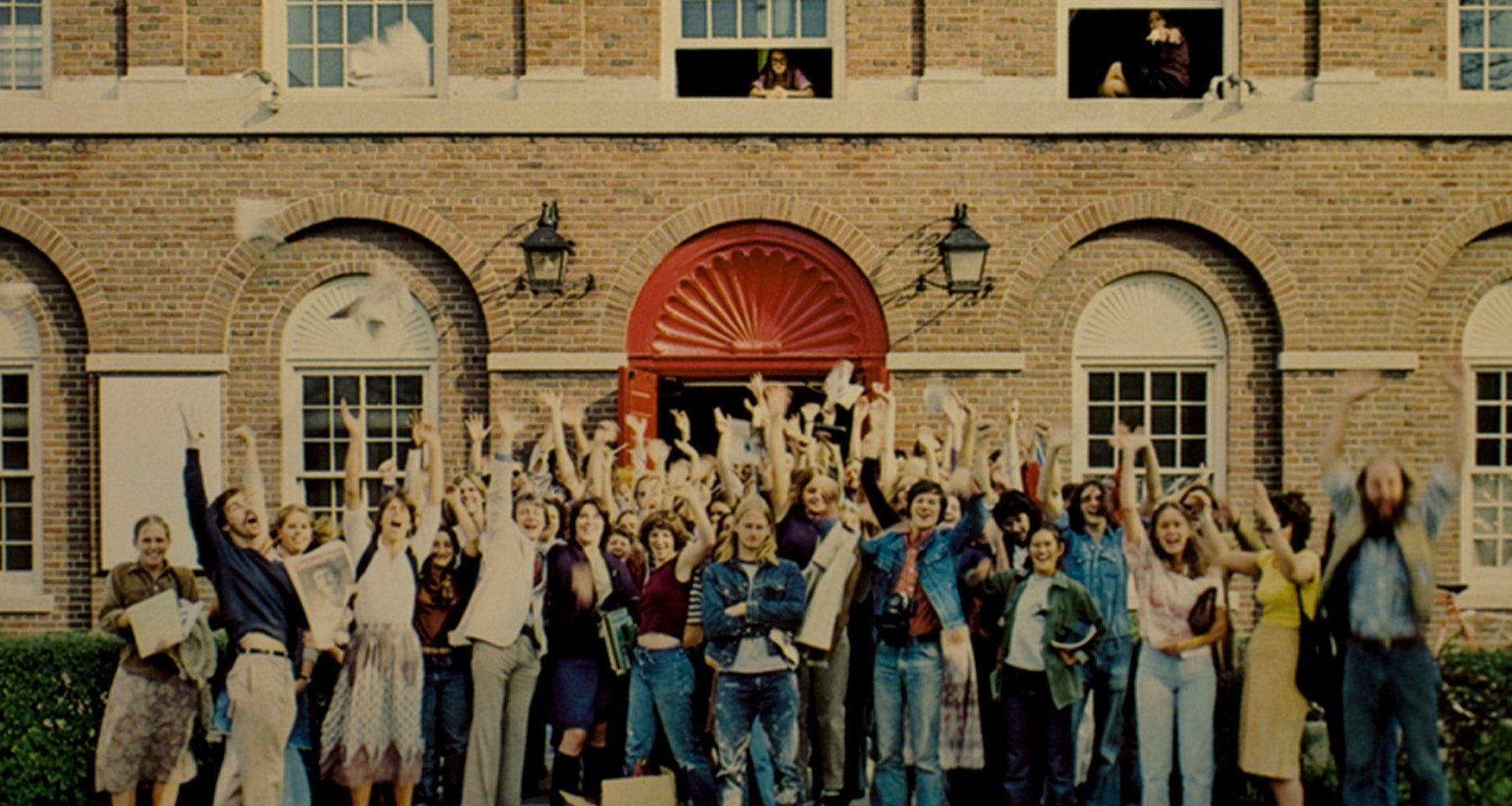
Perhaps the biggest pedagogical shift for the school came in 1968, when Dean Bill Bagnall ushered in an experimental curriculum. He encouraged students to explore a variety of media, removed prerequisites to studio access, and advocated skill-building rather than technical proficiency. Bagnall “kept a low profile and let the creators create the school they wanted,” Murphy writes.
The game changer was doing away with the traditional grading system in favor of review board evaluations. A film running at the entrance to the exhibit shows one of these early review sessions. Aside from the tinted glasses and leisure suits that mark the era, it’s not unlike the candid, collaborative review boards that still happen today.
Murphy writes that the changes were a response to the cultural and political climate of the times, a climate that would soon heat up the campus as protests against the Vietnam War and the Kent State Shooting roiled the country.
“One could hear the store windows smashing near Harvard all the way to Putnam Square during the multi-night riots in 1970, and the entire city was on high alert,” Avram Finkelstein, A73 (BFA), writes in the exhibit. “Across town the student body at SMFA contributed what they were best at: fight the military war with an equally powerful information war.”
To that end, students took over the first-floor studios at SMFA to print resistance posters that they shared with protestors at other schools.
In the early 1970s, students took over the first-floor studios at SMFA to print protest posters.
Photo: Tim Correira
Beauty and Chaos
Part of Bagnall’s legacy was adding film, video, and photography to the school’s curriculum. At first, photography “was the suspect child relegated to the darkest corners,” write emeritus professors of the practice Bill Burke (who taught from 1970 to 2025) and Jim Dow (who taught from 1973 to 2016).
But, they write, artists with cameras were soon welcomed in, thanks in part to the new spirit of interdisciplinary exploration: “Potters taught and reviewed photographers, sculptors evaluated sound artists, and so on. This integrated approach overcame the silos of departments, and it produced photographic artists of every persuasion.”
1980s black and white portraits by Shellburne Thurber.
Photo: Tim Correira
Among those darkroom denizens of the ’70s and ’80s who would go on to fame were David Armstrong, Phillip-Lorca diCorcia, Nan Goldin, Christian Walker, brothers Doug and Mike Starn, and Shellburne Thurber.
In the exhibit, Thurber describes “being overwhelmed by how chaotic and crazy it was” when she first arrived at the school: “There were dogs everywhere, drag queens everywhere. I mean, it was just a free-for-all. And I thought to myself, ‘Ah, okay. Yeah, I could probably do this.’”
The chaos of the times may have felt something like a photo Dow took of the school’s spray room in the 1990s: colorful and wild.
Jim Dow’s photo of the SMFA spray room from the 1990s was transferred to a gallery door for the exhibit, giving the illusion that you can step into the past.
Photo: Tim Correira
That healthy pandemonium laid the foundation for the boundary-breaking work to come from performance and interdisciplinary artists. Among them was Kaiju Big Battel, which brought intergalactic wrestling to the school’s atrium in the late ’90s. Students Rand Borden, A95 (BFA), and Jeff Warmouth, AG97 (MFA), inspired by Japanese sci-fi and pro wrestling, crafted monster suits and staged “battels” (a typo that stuck) among increasingly bizarre contenders, including a pair of tag-teaming plantains and a club-wielding club sandwich.
Rand Borden’s “Sky Deviler” was one of the monster costumes he created for Kaiju Big Battel performances in the SMFA atrium in the 1990s.
Photo: Tim Correira
Collapse modal
Rand Borden’s “Sky Deviler” was one of the monster costumes he created for Kaiju Big Battel performances in the SMFA atrium in the 1990s.
Photo: Tim Correira
A sister exhibit, which will continue the SMFA story through its official incorporation into Tufts University in 2016 and into the future, will open in the spring. It’s a reminder that in the hands of today’s students and teachers, SMFA is still taking shape.
“This milestone is both a celebration of the past,” said Fultineer, “and a call to build a future for the school as a place where boundaries continue to be broken.”