
Researchers at the University of Manchester’s National Graphene Institute, led by lead author Julien Barrier and corresponding authors Professor Sir Andre Geim and Professor Alexey Berdyugin of the National University of Singapore, together with contributing researchers from the Henry Royce Institute, Washington University in St. Louis, the University of Pennsylvania, the University of Antwerp, and Japan’s National Institute for Materials Science, have shown that superconductivity in magic-angle twisted bilayer graphene can be completely suppressed by screening the electrical interactions between its electrons.
The result provides strong experimental evidence that electron-electron interactions, rather than atomic vibrations, drive the pairing behind the material’s superconductivity, addressing a question that has remained open since magic-angle graphene’s superconductivity was first discovered.
Magic-angle twisted bilayer graphene, made by stacking two graphene sheets with a rotational offset of about 1.1 degrees, has become one of the most intensely studied quantum materials of the past decade, but the origin of its superconductivity has remained disputed. One camp of theories holds that the pairing is driven by electron-electron interactions, in a manner that could be analogous to high-temperature cuprate superconductors, while another camp favors a more conventional phonon-mediated mechanism, in which lattice vibrations couple electrons into pairs. Previous experiments attempted to settle the question by placing a screening layer near the magic-angle graphene to weaken Coulomb interactions, but those screening layers sat several nanometers away, separated by a dielectric spacer, and only managed to suppress the material’s correlated-insulator states while leaving superconductivity largely intact, or shifting its critical temperature by just 2-3%.
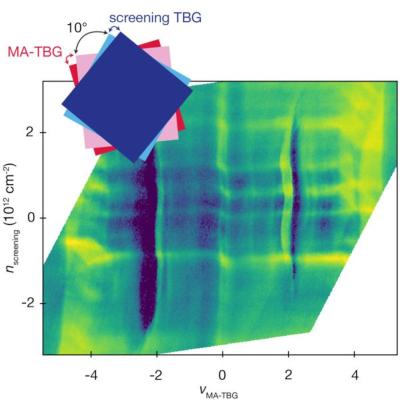
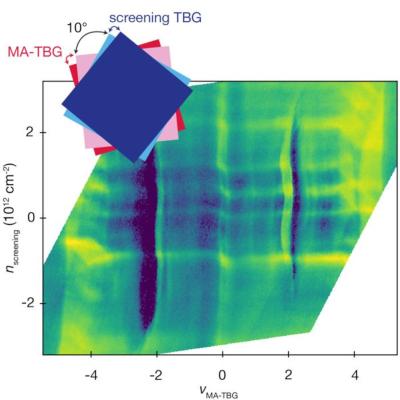
The team’s device instead placed two twisted graphene bilayers directly on top of each other, separated by less than a nanometer, while keeping them electronically decoupled by giving them a large relative twist angle rather than inserting a dielectric spacer. That geometry let the researchers use one bilayer, tuned to a small twist angle for a high density of states, as an unusually effective and electrically tunable screening layer positioned immediately next to a second, magic-angle bilayer. As the researchers increased the carrier density in the screening layer, both superconductivity and the correlated-insulator states in the adjacent magic-angle graphene were progressively suppressed, with the superconducting critical temperature falling by more than an order of magnitude and superconductivity vanishing entirely at sufficiently high screening carrier densities, a far larger effect than in earlier screening experiments.
That behavior runs opposite to what conventional phonon-mediated superconductivity would predict, since screening Coulomb repulsion between electrons should leave phonon-coupled pairing unchanged or even slightly enhance it. The researchers compared their results against theoretical modeling of several candidate mechanisms and found the observed suppression consistent with pairing driven by electron-electron interactions, such as electron-plasmon coupling, rather than by phonons, though the authors are careful to note that the work does not single out one definitive unconventional mechanism among several that remain consistent with the data.
“To make a difference, we had to solve two issues. First, to build a device in which the screening layer sits extremely close, a fraction of a nanometer, to the superconducting graphene while remaining electronically separate. Second, we had to make that screening layer tunable. To this effect, we used a twisted graphene bilayer in atomic contact to the magic-angle graphene,” said Barrier.
Berdyugin added: “When we switched on the screening, we were surprised to find that superconductivity was completely suppressed. This provides clear experimental evidence that superconductivity in this system originates from strong electron-electron interactions. This behavior offers a new opportunity to better understand the mechanisms underlying superconductivity in other materials with strong electronic interactions, including high-temperature superconductors.” He noted that the sub-nanometer screening technique, working over distances as short as 0.3 nm, “could also help clarify many other debated phenomena.”
Geim, reflecting on the broader motivation, said: “Personally, I am interested only in high-temperature superconductivity – preferably at room temperature or above. This study was done at temperatures so low that even helium turns liquid. But unless we understand what makes superconductivity work, we are unlikely ever to reach room-temperature superconductivity, let alone make this remarkable phenomenon commercially useful. Our study takes only a tiny step – but still a step – in that direction, helping to nail down the mechanism of exotic superconductivity in graphene. Rome was not built in a day.”