
In areas where malaria is very frequent, children can experience five or more infections a year.
I’ve never had malaria, but I know several people who have. They describe it as one of the worst experiences of their life.
What starts out feeling like the flu — which is bad enough — can quickly progress into something far worse. The body swings from intense fever and sweats to chills deep enough to make you shake uncontrollably. Everything aches, from your muscles and joints to the pounding headache that makes it impossible to think clearly. Your body is so fatigued that it’s a battle to make it to the bathroom when the nausea and vomiting arrive.
That’s what a pretty standard infection feels like. For some, it goes much further. Here is how one account describes it:
“I awoke to what felt like lightning going through my legs, and then spreading through my body and in my head. Probably the worst headache, body aches, and chills you could possibly imagine. It felt like I was being stung repeatedly by an electric shock gun and could barely control my movements. The pain was so intense; I actually believed I was dying, literally crying out in pain so bad that I was taken to a 24-hour clinic that night at 3am.”
Imagine (or remember) what a bout of this pain feels like. Then imagine having to suffer through that more than 100 times. That’s the reality for some children in the world.
Here is another account, from a Peace Corps volunteer: “I had never felt like this before. I wasn’t just sick… I was dying.”
I often donate to the Against Malaria Foundation. When I do so, I become obsessed with one single metric: the number of lives my money might save. That’s because malaria kills a lot of people: over 600,000 every year, and most of them are children.
While focusing on deaths, I gloss over the number of infections that donated bed nets might prevent. Donating £10,000 saves around four lives and prevents 2,500 infections.1 Saving four lives is great. But so, too, is sparing 2,500 people from the awful experiences described above. That suffering is what these donations are protecting against.
Before digging into the data, I didn’t quite grasp how brutal the non-fatal side of this illness is. It’s estimated that there are around 280 million cases of malaria every year. That means one case for roughly every 30 people.
In some parts of the world, though, those rates are much, much higher.
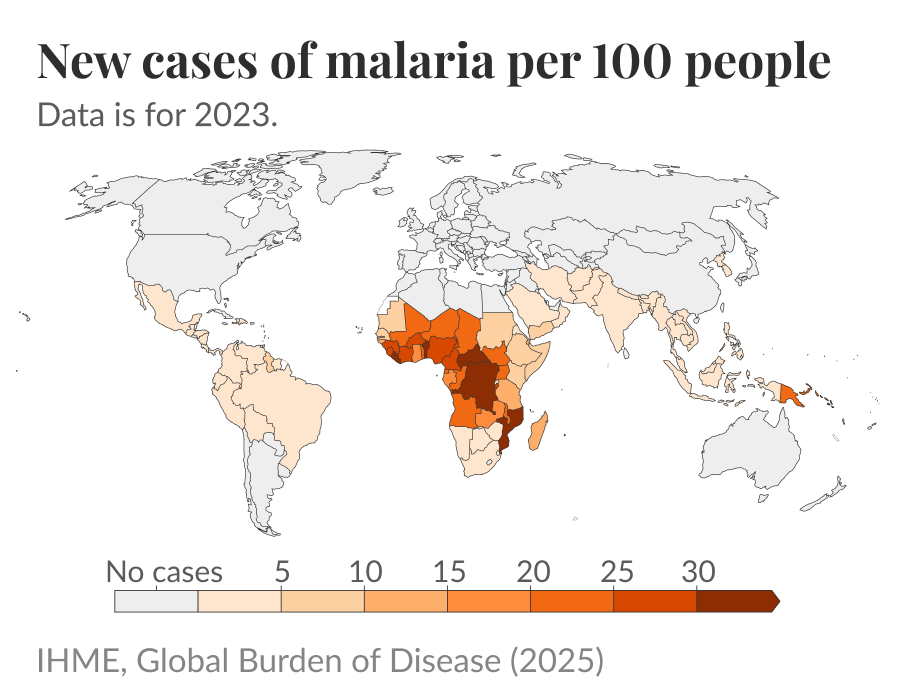
The map shows how concentrated malaria is. It is still a significant problem across much of the tropics — including South and Southeast Asia, and South America — but its focal point is Africa.
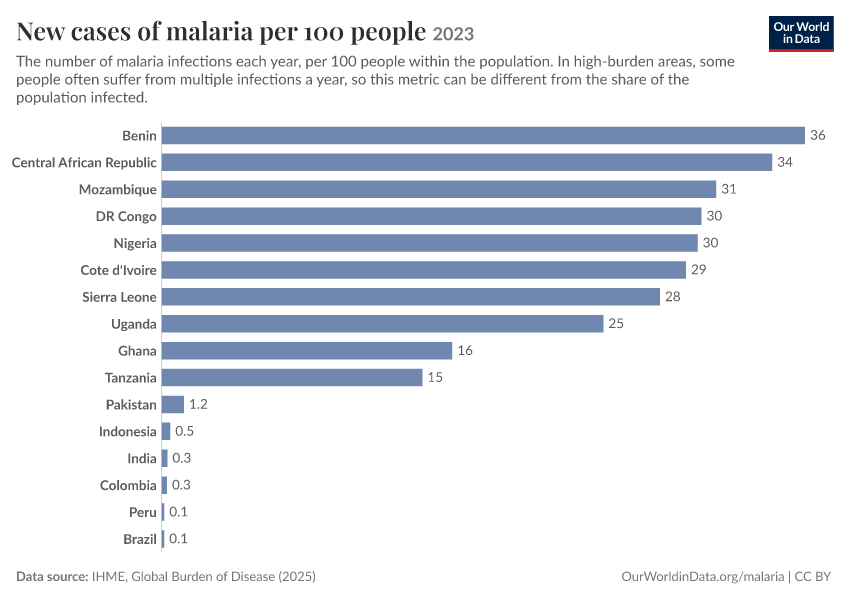
We also get this perspective from the chart below. In countries like Benin, Mozambique, Nigeria, and Sierra Leone, there are roughly 30 new cases of malaria for every 100 people, every year.
That’s around 100 times higher than in high-burden countries in other regions, such as India or Colombia.
When I first saw this data, my initial thought was: if there are 30 cases per 100 people, that means around one-third of Nigerians or Beninese must be infected every year. That in itself is quite staggering.
Yet that is quite far from the truth. Looking at this data by age group, we see that malaria infections are incredibly common among children; much less so among adults, who have built up immunity.
In Benin, there are 98 cases for every 100 children under five years old. In Nigeria, 79 cases. Almost one case for every child.
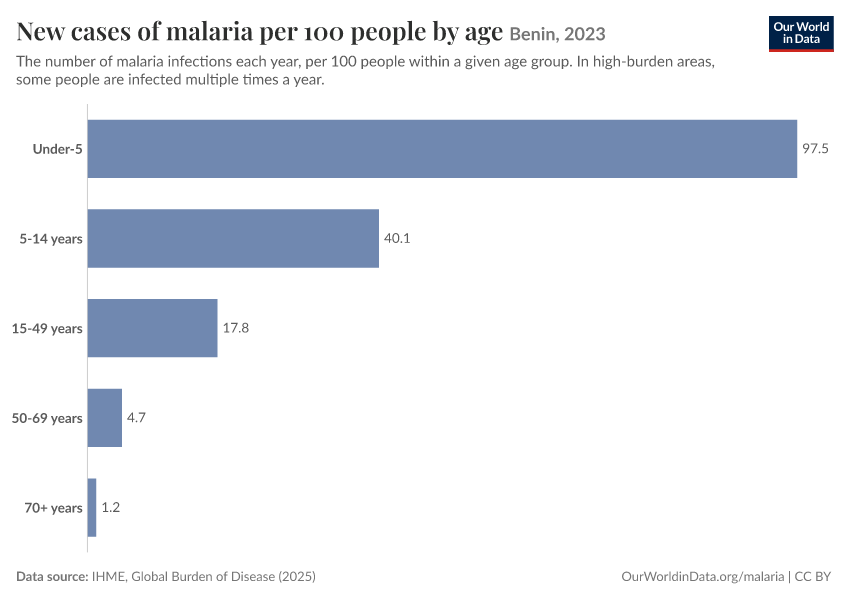
But again, this doesn’t mean that every child in Benin gets malaria once a year. It’s an average: some regions see much less transmission of the disease, while children living in very high-burden areas will often be infected five or six times over.
Studies in high-transmission areas of Burkina Faso find that the number of episodes among children reaches up to six per year.2 In parts of Uganda, the median was more than 5 infections per year.3 That’s roughly once every two months. You’ve barely recovered from the previous infection before you’re floored with another one.
In Benin, there are 98 cases for every 100 children under five years old.
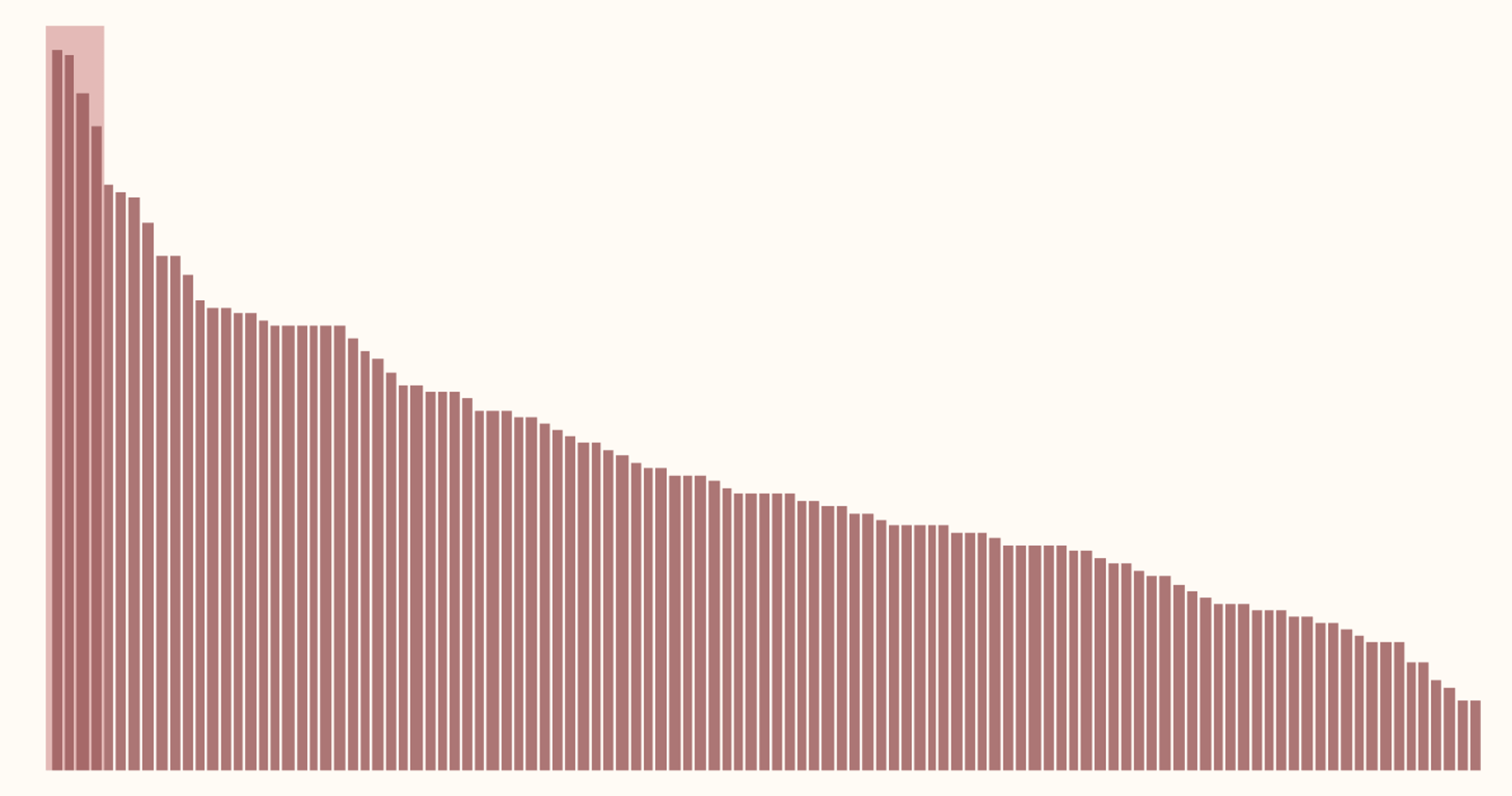
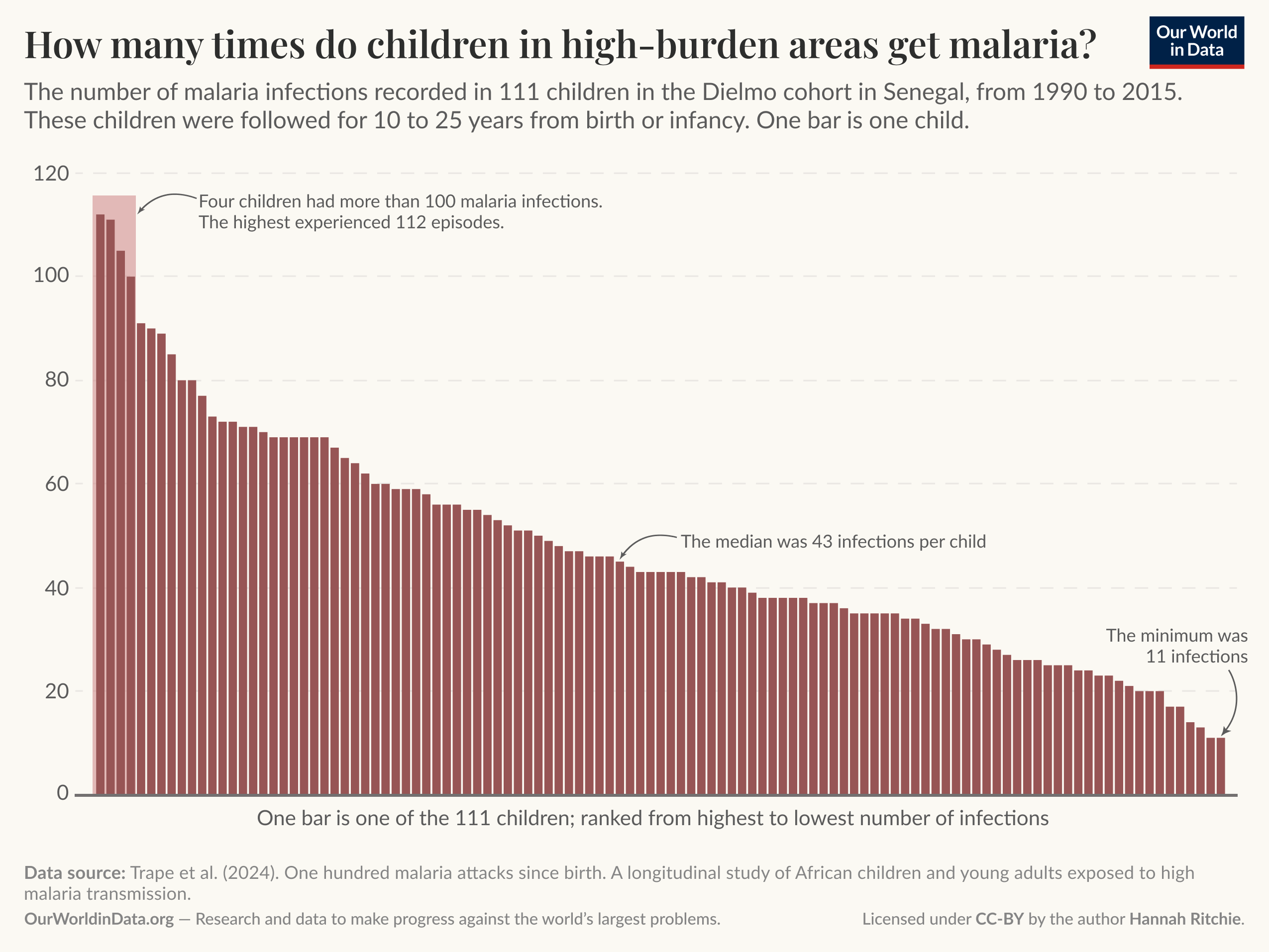
One of the most extensive (and tragic) studies I’ve seen followed 111 children in Senegal over an average span of 17 years.4 The children were monitored almost daily for malaria infection. The median child experienced 43 attacks of malaria over the course of their childhood.5
In the chart, you can see the number of malaria infections each child experienced over that period, with one bar representing one child.
What’s staggering is that four children were infected 100 times or more. The highest suffered through 112 episodes. Even the boy who experienced the fewest was still infected 11 times.
This level of suffering is hard for me to get my head around. For most children growing up in areas with very high rates of malaria, their childhood is a constant and relentless series of malaria episodes. The symptoms themselves must be hard to deal with. But the toll this takes on the body is extreme, too. It is not surprising that so many become malnourished and have their development hindered.
The median child experienced 43 attacks of malaria over the course of their childhood.
This extensive study spanned decades, from 1990 to 2015. Many living there didn’t have access to insecticide-treated bed nets or other preventive measures. Over the course of those 25 years, people did start to get them. Infection rates fell 25-fold as a result. Clearly, this is a problem we can do something about. As it turns out, it can be done fairly cheaply, too. An insecticide-treated bed net costs just $2.
Many children and families in the world still lack this basic tool. That is why I’m happy to donate to organizations trying to change that.
I would love to see humanity beat malaria in my lifetime. Not just to stop the 600,000 deaths that happen every year, but to give millions of kids something back that no chart can capture: their childhood.
Acknowledgments
Many thanks to Edouard Mathieu for comments and feedback on this article.
Continue reading on Our World in DataCite this work
Our articles and data visualizations rely on work from many different people and organizations. When citing this article, please also cite the underlying data sources. This article can be cited as:
Hannah Ritchie (2026) – “A never-ending childhood of malaria” Published online at OurWorldinData.org. Retrieved from: ‘https://archive.ourworldindata.org/20260907-000131/a-never-ending-childhood-of-malaria.html’ [Online Resource] (archived on September 7, 2026).
BibTeX citation
@article{owid-a-never-ending-childhood-of-malaria,
author = {Hannah Ritchie},
title = {A never-ending childhood of malaria},
journal = {Our World in Data},
year = {2026},
note = {https://archive.ourworldindata.org/20260907-000131/a-never-ending-childhood-of-malaria.html}
} Reuse this work freely
All visualizations, data, and articles produced by Our World in Data are completely open access under the Creative Commons BY license. You have the permission to use, distribute, and reproduce these in any medium, provided the source and authors are credited.
The data produced by third parties and made available by Our World in Data is subject to the license terms from the original third-party authors. We will always indicate the original source of the data in our documentation, so you should always check the license of any such third-party data before use and redistribution.
All of our charts can be embedded in any site.