

The United States is preparing to sell 40,000 bombs weighing 2,000 pounds (nearly a ton) each in a $2.8 billion sale funded by U.S. taxpayer money, The Washington Post reported, citing a U.S. official.
According to The Post, half of the bombs are MK-84 “hammer” bombs – among the most destructive in Western arsenals – while the other half are its BLU-117 “bunker buster” variant. The sale reportedly includes 20,000 penetrator warheads used for bunker busters.
The sale reportedly in planning overshadows previous deals – such as the $2 billion deal that bypassed Congress in 2025 – and is set to become the single largest U.S. arms deal in recent years.

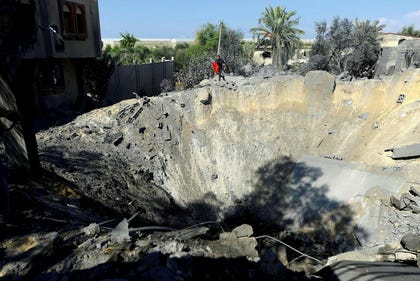
In 2023, Israel reportedly used the bombs in areas of the Gaza Strip designated as safe for civilians, each creating a crater measuring at least 40 feet (12 meters) across or larger.
 Close
A view of a crater at the site of a deadly Israeli airstrike on a house in Khan Yunis, southern Gaza Strip, 2023. Credit: Ibraheem Abu Mustafa/Reuters
A view of a crater at the site of a deadly Israeli airstrike on a house in Khan Yunis, southern Gaza Strip, 2023. Credit: Ibraheem Abu Mustafa/Reuters
Former U.S. Army explosive-ordnance-disposal technician Trevor Ball reportedly told The Post that Israeli forces “do like to use them a lot when they’re trying to target any building,” adding that “If Hezbollah or whoever is in a building, an MK-84 will bring down the whole building.”
On Sunday, the Israeli military denied an allegation in the investigative documentary “NAZA” – in which IDF soldiers spoke about killing civilians in Gaza – that it had planned and approved a strike in Gaza in which 500 civilian deaths were expected.
Related Articles
“The IDF has never planned, approved, or carried out a strike in Gaza in which 500 civilians or anything near that number were anticipated to be killed,” the military said. “Nor was any credible claim raised throughout the war suggesting that an IDF strike had caused anything near that number of fatalities.”
In an exposé published in 2024 on +972 Magazine and its Hebrew-language sister site Local Call, “NAZA” co-director Yuval Avraham reported, citing Israeli military sources, that the IDF used unguided MK-84 bombs in strikes on junior Hamas combatants, authorizing collateral damage of 15-20 civilians.
An unnamed intelligence officer reportedly told the magazine, “You don’t want to waste expensive bombs on unimportant people – it’s very expensive for the country, and there’s a shortage.”
The Biden administration held off on supplies of MK-84 and MK-82 bombs, made by American defense contractor General Dynamics, due to fears that the army would use them in the Palestinian city of Rafah in the southern Gaza Strip and cause mass civilian casualties there.
Months later, Israeli military contractor Elbit Systems received a 1.5 billion shekel ($492 million) order to build a munitions plant for the Israel Air Force to solve issues with the supply of arms.
Yoram Gabison and Noa Limone contributed to this report.