
Artificial Intelligence & Machine Learning
,
Data Loss Prevention (DLP)
,
Data Security
AI Agents Could Help Analysts Separate Meaningful Data Events From Routine Activity
Michael Novinson (MichaelNovinson) •
September 17, 2026
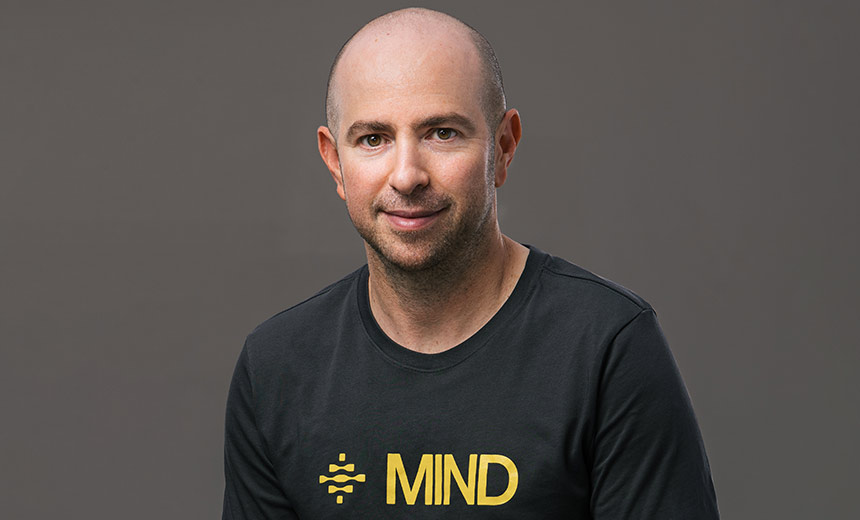
Eran Barak, co-founder and CEO, Mind (Image: Mind)
A startup led by the ex-CEO of Hexadite raised $72 million to rebuild data loss prevention for artificial intelligence-heavy enterprise environments.
See Also: A Darkening Landscape: AI, Friend and Foe of Cyber Resilience
The Crosspoint Capital Partners-led Series B round will allow Seattle-based Mind to transform DLP from a static system of classification, policies and blocking into something agentic and interactive, said CEO Eran Barak. Traditional endpoint controls will handle the technical work of preventing data movement; while AI agents will analyze enormous volumes of lineage and activity to determine what matters.
“We develop very deep tech when it comes to DLP,” Barak told ISMG. “We have four different products in one product, and we just added what we call an AI governance model. We unify this DLP that you have on endpoint, SaaS, generative AI, on-premises, email and now agentic AI into one platform, and this requires resources.”
Mind, founded in 2023, employs 85 people and has raised $112 million, having last completed a $30 million Series A round in June 2025 led by Paladin Capital Group and Crosspoint Capital Partners. The company has been led since inception by Barak, who previously started SOAR vendor Hexadite in 2014, sold it to Microsoft in June 2017 and spent four years as Microsoft’s principal program manager (see: Mind Gets $30M to Boost AI for Endpoint Data Loss Prevention).
How AI Agents Can Help With Data Lineage
Traditional DLP can consume significant endpoint resources because of constant scanning, while MIND instead tries to determine when information actually needs to be scanned and reuse classifications already established elsewhere. If Mind has already classified information residing in SaaS storage such as Google Drive or OneDrive, it can retain that labeling when the information reaches the endpoint.
“The problem with DLP is that it creates a lot of overhead and friction with the user,” Barak said. “Our main focus when we developed it was the simplicity of this agent – very lightweight in terms of resources and able to cover a variety of operating systems.”
Mind already provides data lineage showing when someone downloads a file, modifies it, compresses it, masks PII or accesses it, but Barak said presenting all of that activity can overwhelm DLP analysts. Mind plans to have AI agents analyze the lineage themselves and present the analyst with the essential conclusion about what happened, allowing AI to determine the significance of user behavior, Barak said.
“So far, what we have done is more data lineage, which shows you how someone downloaded the file, changed it, zipped it, changed specific PII, masked it or accessed it,” Barak said. “But now we also want to show it in terms of evidence – to take a recording of that.”
Rather than merely alerting that a user attempted to move sensitive information, Mind wants to capture evidence showing what the user actually did such as sending PII to a personal Gmail. Mind wants to be able to record relevant activity and retain enough high-resolution evidence for investigators while dealing with the storage and compression challenges created by collecting large volumes of information.
“The challenge is how much data you collect and show,” Barak said. “We developed this balance between enough data that can tell the story and not overwhelming the user. With the new AI agents, you can have the AI agents themselves reviewing that for you.”
Why Mind Allows Clients to Configure Each Endpoint Differently
Mind can configure endpoints differently depending on the user and their role, which Barak said helps users understand what sensitive information they can share and where they can share it. Mind’s DLP system doesn’t simply allow or block an action, instead empowering AI agents to explain to an employee that an attempted action violates company policy and interact with the worker about what to do next.
“The agent will help you more with guidance of the end user and interacting with the end user,” Barak said. “For example, it can tell you, ‘This is a speed bump because you violated the company policy. What would you like to do?’ Then it creates this chat between you and the system.”
Barak said customers can deploy Mind’s endpoint technology within hours and begin blocking data movement using preconfigured policies rather than performing extensive configuration first. Mind built discovery, classification, policy, detection, response and prevention capabilities together rather than adding DSPM or other functionality later, according to Barak.
“Once you deploy Mind, in a few hours, you can deploy the endpoint and start blocking data from going either to GenAI, native apps, Teams, Slack – already out of the box with policy configured,” Barak said. “You don’t need to do this heavy lifting that you need to do with other competitors.”
Windows and macOS remain Mind’s priorities, but Linux is next on the roadmap while mobile is being considered for later. Barak sees mobile DLP as increasingly relevant because sales and other go-to-market employees conduct substantial amounts of business from their phones, but he said mobile presents technical challenges because devices offer less memory and compute capacity than PCs.
“We just crossed eight-digit revenue, and for us it’s been amazing,” Barak said. “But we need to keep executing on this trajectory. My plan is to reach $100 million in ARR in two years from now. It won’t be an easy task, but we do believe we can do that.”