
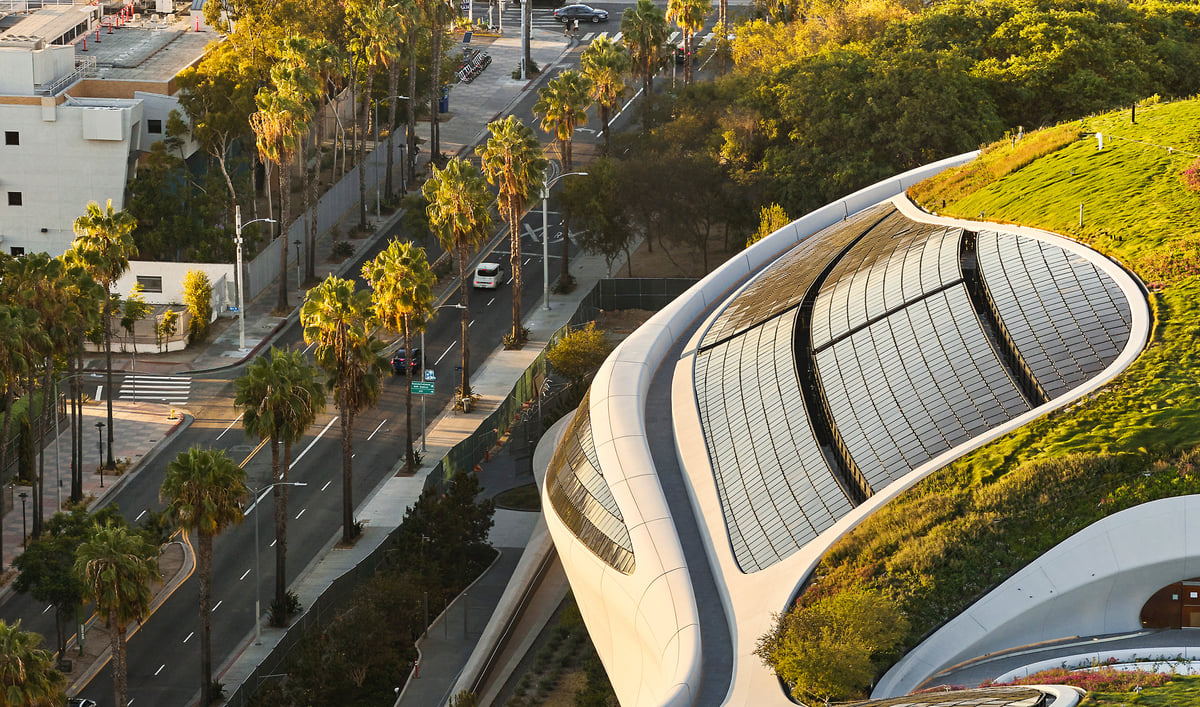
In less than a week, the Lucas Museum of Narrative Art will open in Los Angeles after more than a decade of debate, design, and construction.
Ahead of the opening, critics and media outlets across the United States and beyond have weighed in on the project, expressing mixtures of excitement and skepticism.
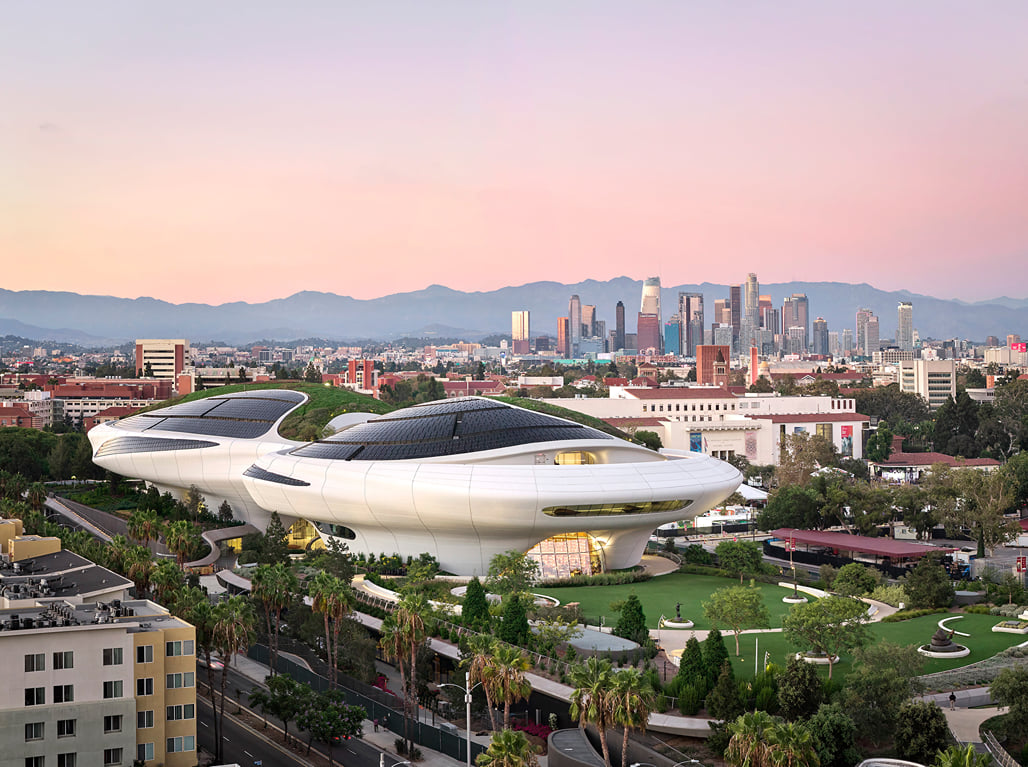 Image credit: Hufton+Crow, courtesy of Lucas Museum of Narrative Art
Writing for The Los Angeles Times, Sab Lubell described the design as a “contradiction-filled landmark.” Behind the dramatic architectural expression, Lubell argues, the scheme’s populist message is undercut by conventional galleries and fenced-off rooftops.
“It’s synthetic yet organic, monumental yet welcoming, populist yet elitist,” Lubell notes. “Its architecture conjures freedom and motion, but its galleries retreat into conventional rooms. It creates an extraordinary park, but fences and inaccessible surfaces weaken that generosity. It feels utterly foreign to its context, yet somehow it fits right in.”
 Image credit: Hufton+Crow, courtesy of Lucas Museum of Narrative Art
For The Los Angeles Times’ culture critic Mary McNamara, the museum is “a win for ‘the people’s art.’” McNamara argues that the “gleaming spacecraft” upends conventional expectations of a museum, instead offering an eclectic, nostalgia-rich journey for visitors.
“A captivating, welcoming and family-friendly space, with some jaw-dropping views, a cafe and a gorgeous rooftop fine-dining restaurant, not to mention an 11-acre garden, dotted with statuary and fountains,” McNamara notes. “It is, in fact, on its own diplomatic mission: To make people think about art, and the world, a little differently than they did before they arrived.”
 Image credit: Hufton+Crow, courtesy of Lucas Museum of Narrative Art
At The Guardian, meanwhile, Matthew Cantor took a wider view at the museum’s timeline, tracing its genesis to failed attempts at the museum’s construction in San Francisco and Chicago. Continuing the popular comparison of the museum to a spaceship, Cantor remarks, “With its sleek, flying-saucer-like design, it’s impossible not to think of Star Wars, though the museum’s architect, Ma Yansong, says he was inspired more by tree canopies and clouds.”
 Image credit: Hufton+Crow, courtesy of Lucas Museum of Narrative Art
For The Hollywood Reporter’s Gary Baum, the museum is a “temple,” rather than a museum. Baum describes the museum as “a final-act provocation which only someone with fuck-you money can realize at such colossal scale and scope. A museum as Megalopolis. The approach taken by Lucas, 82, is a striking throwback to the rich, eccentric autodidact’s cabinet-of-curiosities concept associated with Gilded Age figures like Henry Clay Frick, Henry Huntington and P.T. Barnum. But it’s also a distinct expression of Lucas’ own artistic influences and impacts.”
 Image credit: Hufton+Crow, courtesy of Lucas Museum of Narrative Art
Finally, James Parker in The Atlantic gives perhaps the most dramatic account of the scheme’s architecture, describing it as “ swooping, brain-beggaring, super-sexy, twin-bodied leviathan of a megastructure, white as the gown of Princess Leia, half spaceship, half cetacean, all curves, Shangri-la for skateboarders if they could ever get inside.”
Archinectors, what’s your take? Share in the comments.