

Micron’s latest breakout reflects tight memory supply and strong semiconductor demand, but elevated earnings expectations and heavy capital spending could leave the rally vulnerable to disappointment.
Written by:
Skerdian Meta
•
Tuesday, September 22, 2026
•
4 min read
•
Last updated: Tuesday, September 22, 2026
Add an article to your Reading List
Register now to be able to add articles to your reading list.
” aria-hidden=”true”>

Quick overview
Micron’s stock has rebounded above $1,085, reflecting strong semiconductor demand and tight memory supply.The upcoming earnings report is highly anticipated, with expectations of a significant increase in adjusted earnings compared to last year.Despite strong fundamentals, Micron’s low forward valuation highlights the cyclical risks associated with the memory industry.Investors remain cautious due to potential fluctuations in memory pricing and the impact of broader technology infrastructure spending.
Micron’s latest breakout reflects tight memory supply and strong semiconductor demand, but elevated earnings expectations and heavy capital spending could leave the rally vulnerable to disappointment.
Micron Stock Rebounds Above $1,085
Micron Technology shares regained significant momentum on Tuesday, climbing above $1,085 after closing above the psychological $1,000 level last Friday. The move pushed the stock to its highest level since early July and cleared the important $1,040 resistance zone, strengthening the recent technical recovery.
The rally comes as semiconductor stocks regain momentum, with investors focusing on constrained memory supply, strong demand and expectations ahead of Micron’s upcoming earnings report. Improving sentiment across the chip sector has also provided support.
However, Micron has previously struggled to sustain moves around major resistance levels. The latest breakout could therefore remain sensitive to any signs that memory demand is weakening or that the enormous spending required to support the technology infrastructure cycle is becoming harder to justify.
Micron is scheduled to report fiscal fourth-quarter results next Wednesday, September 30, after the market closes. Wall Street expects adjusted earnings of $31.43 per share, compared with $3.03 per share in the same quarter last year. That would represent an increase of roughly 940%.
Over the next 12 months, analysts expect Micron to generate earnings of approximately $144.94 per share. At a share price around $1,060, the stock trades at roughly 7.3 times those expected profits, giving it one of the lowest forward price-to-earnings ratios among companies in the Technology Select Sector SPDR Fund.
Earnings Growth Has Accelerated
Micron’s recent financial performance has provided substantial support for the rally.
In June, the company reported fiscal third-quarter revenue of $41.46 billion, compared with $9.30 billion a year earlier. Adjusted earnings reached $25.11 per share, beating the consensus estimate of $20.71.
Management subsequently guided for fourth-quarter revenue of approximately $50 billion, plus or minus $1 billion. Adjusted earnings were guided to $31.00 per share at the midpoint, while gross margin was expected to reach approximately 86%.
The scale of the margin expansion highlights the strength of the current memory cycle. Micron’s gross margin was only 39% one year earlier, meaning higher memory prices and stronger demand have dramatically improved profitability.
For the full fiscal year, consensus estimates point to earnings of approximately $73.44 per share, nearly nine times the previous year’s result.
Memory Chips Remain Critical to Data-Center Growth
Micron produces several types of memory, including DRAM and NAND flash. DRAM temporarily stores data being actively processed, while NAND provides persistent storage for products such as smartphones and solid-state drives.
High-bandwidth memory, or HBM, has become particularly important as advanced processors require significantly greater memory capacity and bandwidth.
Micron competes with SK hynix and Samsung Electronics in this market, with demand for advanced memory growing rapidly as data-center operators expand high-performance computing infrastructure.
When supply remains constrained, manufacturers can command higher prices. That can significantly increase profitability because the additional revenue flows through a business with substantial operating leverage.
This dynamic has been an important factor behind Micron’s sharp improvement in margins and earnings.
The Memory Cycle Remains a Major Risk
Despite the strong fundamentals, Micron’s low forward valuation reflects the cyclical nature of the memory industry.
Memory products are relatively standardized, meaning supply and demand play a major role in determining prices. When prices rise and profitability improves, manufacturers typically have greater incentives to expand production.
The problem can emerge when new capacity arrives simultaneously. If supply eventually exceeds demand, memory prices can fall rapidly, putting pressure on revenue, margins and earnings.
Micron has experienced this cycle repeatedly. Previous memory downturns have shown how quickly strong profits can deteriorate when pricing conditions reverse.
That history helps explain why investors may remain cautious about assigning a much higher valuation multiple to Micron, even when near-term earnings growth is exceptionally strong.
Technical Strength Meets Near-Term Valuation Questions
From a technical perspective, Micron’s fall below $311 in March and the quick rebound off the 100 daily SMA (green) was symbolically important. Buyers came back as broader stock market sentiment improved. But, we saw a pullback under $1,000 and MU stock slipped to $800 lows in early August, where it rebounded from. But the price was rejected just above $1,000 and Micron dipped below $800 but found support at the 100 SMA in green. MU stock rebounded above $1,000 again but sellers keep returning.
MU Chart Daily – Micron Breaks Above the 50 SMA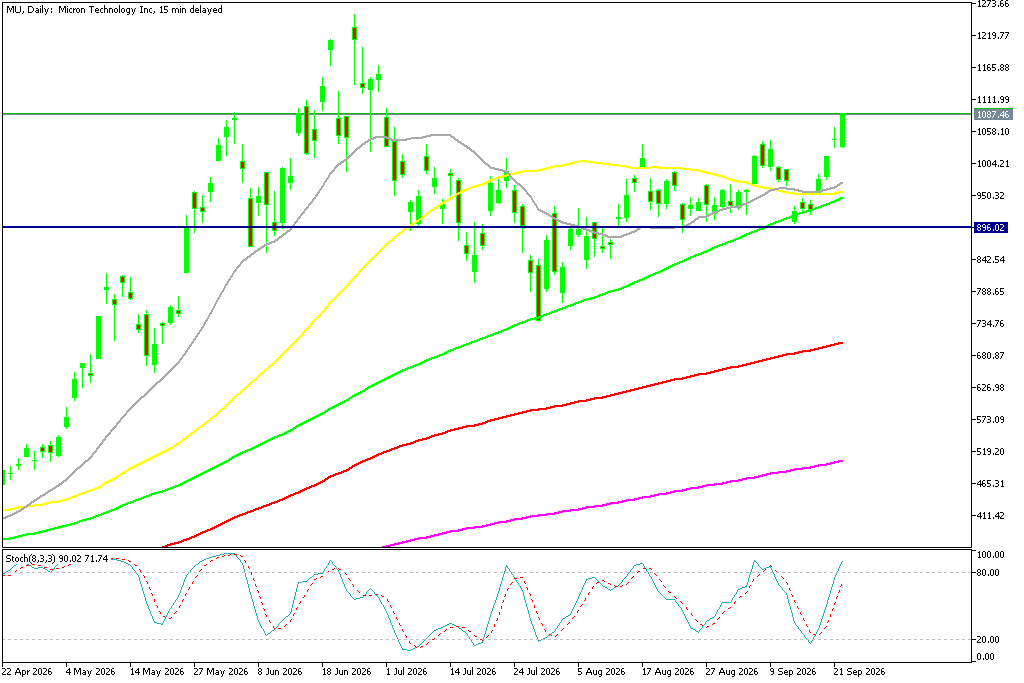
$1,500 Price Target Raises the Bar
RBC Capital has maintained an Outperform rating and a $1,500 price target, arguing that Micron’s valuation does not fully reflect the strength of current memory demand.
The firm has highlighted limited cleanroom availability, constrained semiconductor equipment and the rapid expansion of HBM capacity as factors that could keep memory markets relatively tight.
Strategic customer agreements and minimum-price arrangements could also provide greater visibility into future revenue and margins if demand remains strong.
However, a $1,500 target also illustrates how much continued earnings growth investors are being asked to anticipate. Any deterioration in memory pricing, demand or margins could therefore trigger a sharp adjustment in expectations.
Infrastructure Spending Remains a Key Risk
The broader technology infrastructure cycle remains another potential headwind.
Companies continue committing enormous amounts of capital to data centers, processors and advanced computing infrastructure. If technology companies eventually reduce spending, demand for GPUs, HBM, DRAM and storage could also weaken.
Micron is simultaneously entering another major investment phase. Manish Bhatia has been promoted to president and COO, while Scott DeBoer becomes president and chief technology and products officer.
The company also plans to invest approximately $10 billion over the next decade in an advanced research laboratory in Boise, highlighting the capital-intensive nature of remaining competitive in memory technology.
Competition from Chinese manufacturers such as YMTC and CXMT also remains a longer-term consideration if their production capacity expands.
Micron Stock Outlook
Micron’s move above $1,085 strengthens the technical recovery and places greater attention on the upcoming earnings report. Tight memory supply, improving pricing and rapidly rising earnings have created a supportive backdrop.
However, the stock is also approaching earnings with exceptionally high expectations. The memory industry remains cyclical, while data-center spending and capacity expansion require substantial capital.
The $1,040 area now becomes an important level to monitor after the latest breakout. Holding above it could keep the technical recovery intact, while a failure back below the zone would raise questions about whether the latest move has enough momentum to continue.

Skerdian Meta
Lead Analyst
Skerdian Meta Lead Analyst.
Skerdian is a professional Forex trader and a market analyst. He has been actively engaged in market analysis for the past 11 years. Before becoming our head analyst, Skerdian served as a trader and market analyst in Saxo Bank’s local branch, Aksioner. Skerdian specialized in experimenting with developing models and hands-on trading. Skerdian has a masters degree in finance and investment.