
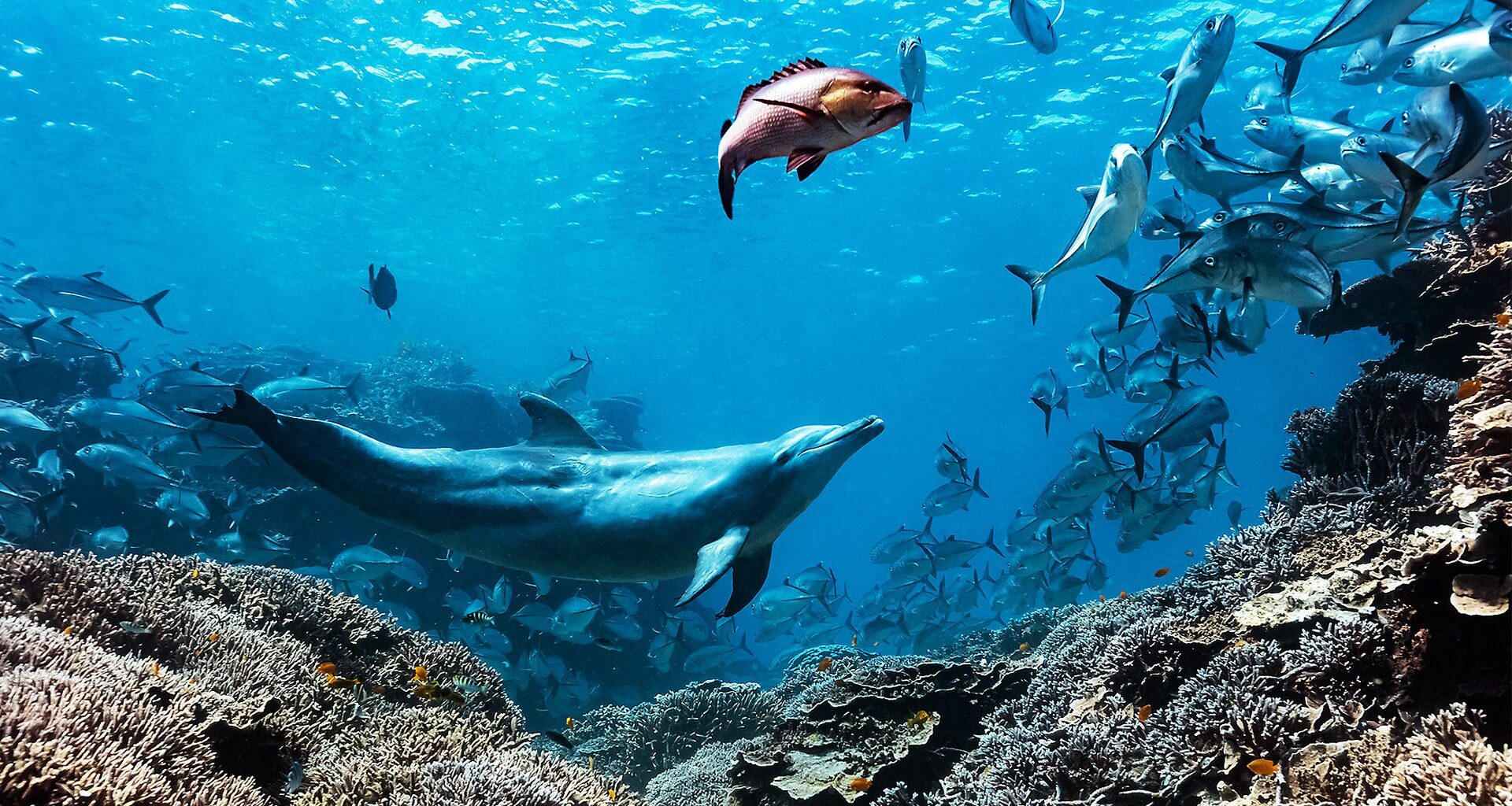
A bottlenose dolphin repeatedly chased fish until they spat up food, revealing an unusual food-stealing strategy in nature.
Animals do not always catch every meal themselves. Across nature, some steal food that another animal has already found, a behavior called kleptoparasitism. This has rarely been documented clearly in marine mammals.
A common bottlenose dolphin on Australia’s Great Barrier Reef appears to have turned food stealing into a regular feeding trick.
The male dolphin, nicknamed Bubbles, chases Bigeye Trevally until they spit up their food, then eats the meal they leave behind.
Bubbles repeatedly steals fish meals
The observations took place around Lady Elliot Island in the southern Great Barrier Reef, about 50 miles (80 kilometers) from mainland Australia.
Researchers saw the behavior in shallow water on the western side of the island, less than about 33 feet (10 meters) deep and close to shore.
Food stealing continued for years
Between 2021 and 2025, researchers recorded Bubbles hunting around schools of Bigeye Trevally 20 times.
In 11 of those cases, a fish spat up its food and Bubbles ate it. In the other cases, researchers did not see him get a meal.
The team included Dr. Asia Haines and Romney Edwards-Francis of the University of the Sunshine Coast.
Researchers used marks on Bubbles’ dorsal fin and a distinctive V-shaped scar on his right side to confirm that the same dolphin appeared across years of recordings.
“We observed him repeating this behavior over several years which suggests he may have learned to target the fish with the fullest bellies, providing the most rewarding meals,” Dr. Haines said.
How the dolphin chooses targets
The video showed that Bubbles followed the same pattern each time, instead of chasing fish at random.
He first swam slowly, moving his head from side to side while making echolocation clicks.
Dolphins use these sounds to learn about objects around them by listening to the echoes that bounce back.
Bubbles then appeared to choose one Bigeye Trevally and chase it, while ignoring the other fish nearby.
He stayed close to the chosen fish and followed its movements until it spat up its food. Bubbles then ate the food while the trevally swam away.
He sometimes repeated this behavior several times. In one 30-minute period, researchers saw him do it up to 10 times.
Bubbles the dolphin hunts food alone
Bubbles also sometimes returned to the same fish after coming to the surface to breathe.
Researchers only saw him use this feeding trick with bigeye trevally.
They never saw him eat the trevally, and he always carried out the behavior alone.
Stealing food may save energy
“Common bottlenose dolphins tend to forage in groups, yet Bubbles was always observed foraging alone. It may be that this specialized tactic requires less energy than directly pursuing fast-moving prey, particularly when foraging solo,” Edwards-Francis said.
This behavior may help Bubbles get food without using as much energy as hunting on his own.
But the researchers did not measure how much energy he used or how many calories he gained, so they cannot say for sure that stealing food is easier.
Bigeye Trevally often gather in the same area, giving Bubbles plenty of possible targets.
The researchers suggest that this could be useful for a dolphin that hunts alone. Instead of chasing small, fast-moving fish himself, Bubbles may be taking advantage of prey that the trevally have already caught.
“His behavior does demonstrate the species’ adaptability and flexibility when it comes to foraging,” Edwards-Francis said.
Sounds during the chase
One short recording also captured the sounds Bubbles made while chasing a fish.
In a 75-second clip from 2021, researchers recorded 200 sounds, including many low-pitched calls and bursts of echolocation clicks.
These low sounds appeared while Bubbles was chasing a trevally and continued until the fish spat up its food.
The researchers think the sounds might increase the fish’s stress, but they cannot say that the sounds actually caused it to regurgitate.
Echolocation may help choose fish
Bubbles may also use echolocation to help choose which fish to chase.
Dolphins can detect small differences in objects through returning echoes, so the researchers wonder whether Bubbles could somehow identify trevally that have recently eaten.
For now, that idea remains unproven. The team did not test whether Bubbles could actually tell which fish had fuller stomachs.
One dolphin limits conclusions
The biggest limit in this study is that every confirmed case involved Bubbles.
The researchers know that he used this feeding trick many times, but they do not know whether other dolphins do the same thing.
The observations were also made when people happened to see Bubbles while snorkeling, rather than during a set monitoring schedule.
The sound analysis came from just one 75-second recording, and the team did not test whether the sounds caused the fish to spit up food or helped Bubbles choose fish that had recently eaten.
“We also suspect that rare or novel foraging tactics such as kleptoparasitism are likely underreported in dolphins or other cetaceans,” Edwards-Francis said.
“The challenge is monitoring the animals underwater over longer time periods to capture their full range of behaviors. Combining emerging technologies such as drones with underwater surveys may provide a way to overcome this.”
Hidden behaviors need watching
Bubbles’ behavior is a reminder that dolphins are not simply friendly or playful animals. They are predators, and this appears to be one unusual way that a dolphin can get food.
“This perception of dolphins as the ‘good guys of the sea’ has more to do with anthropomorphism – our tendency to assign human characteristics to them – and perhaps that’s because dolphins appear to be smiling,” Dr. Haines said.
“Dolphins are predators and actively hunt their prey, whether it has been stolen from another species or not.”
For now, the clearest takeaway is that one dolphin repeatedly found a way to steal food from fish. More underwater video, animal-borne cameras, and drones could reveal whether other dolphins use the same trick.
The study is published in the journal Ecology and Evolution.
—–
Like what you read? Subscribe to our newsletter for engaging articles, exclusive content, and the latest updates.
Check us out on EarthSnap, a free app brought to you by Eric Ralls and Earth.com.
—–