
Most of us grow up believing one simple rule about plants: they want as much direct sun as they can get, and shade is something to apologize for. Move the tomato pot to the brightest ledge in the house. Resent the tree that blocks the vegetable bed by mid-afternoon. It is such an unquestioned piece of advice that almost nobody stops to check whether it actually holds for every plant, in every climate, all the time.
A research team at the University of Arizona decided to test it properly, at a facility built for exactly this kind of question. Greg Barron-Gafford, a biogeographer who leads the work, planted three regional crops in matching rows at Biosphere 2, the sealed research campus outside Tucson. Some rows sat in open desert sun. Others grew underneath a raised bank of solar panels never designed to double as a farming trial. They ended up running one anyway, and the results argued directly against the rule most of us never question. “We found that many of our food crops do better in the shade of solar panels because they are spared from the direct sun,” Barron-Gafford said.
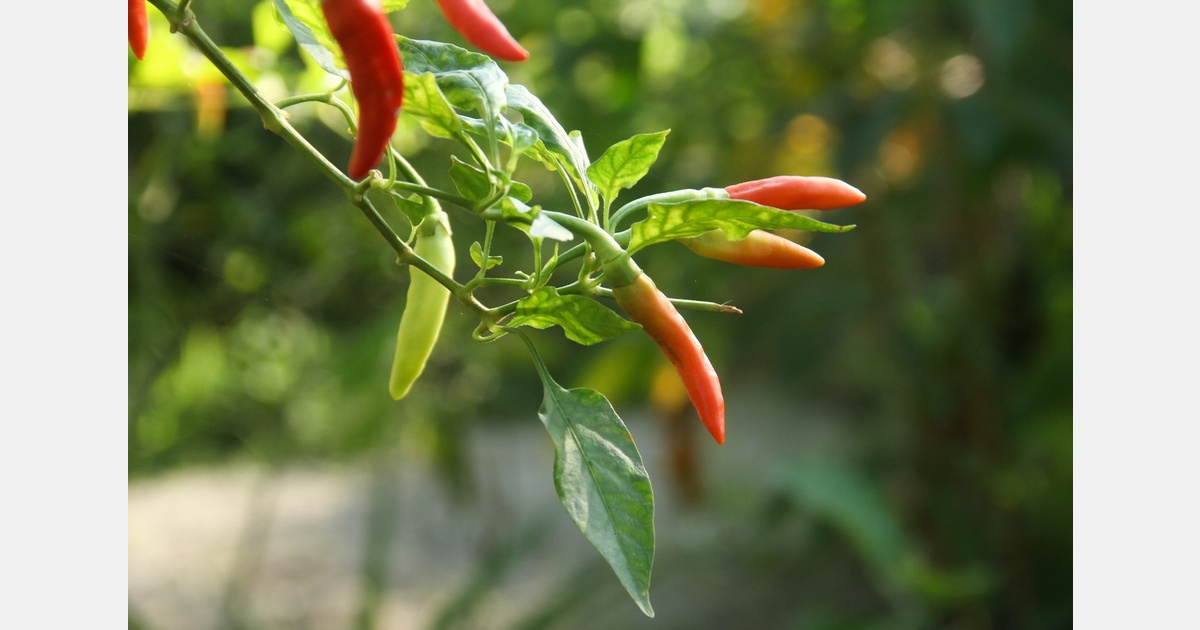
Barron-Gafford and his colleagues published their results in the journal Nature Sustainability in September 2019, and the numbers are specific enough to be worth sitting with rather than summarizing in one line. Chiltepin peppers, a small wild-type pepper native to this same desert region, produced three times as much fruit under the panels as the plants standing in open sun, with no drop in the plants’ water efficiency to explain the difference away. Cherry tomatoes, a crop that tends to abort its flowers under extreme heat before they ever become fruit, came in almost as strong: plants shaded by the panels yielded roughly twice as much as their open-sun counterparts.
Jalapeños told a different story, and it is worth being precise about that difference rather than folding it into the same headline. Fruit production in the shaded rows came out nearly identical to the open-sun rows, no meaningful yield bump in either direction. What changed was water. The same researchers found the shaded jalapeño plants reached that equal harvest while losing 65 percent less water to transpiration, the process by which a plant pulls moisture up through its roots and releases it through its leaves. Soil moisture, measured separately at ground level, told a similar story: under an every-other-day watering schedule, the soil beneath the panels stayed about 15 percent wetter than the open-sun control plot before the next irrigation was due. Two crops, two different kinds of benefit. Yield went up for one. Water use went down for the other. Treating those as the same finding would be sloppier than the actual research ever was.
Why this matters beyond one desert farm
Why should any of this matter beyond one experimental farm outside Tucson? Solar development and farmland have historically competed for the exact same acres, especially in dry regions where water is already the scarcest input in the whole system. A field of panels and a field of crops have usually meant picking one over the other, on the assumption that shade was a cost the crops would simply have to absorb. What this trial suggests, at least for these three plants in this specific climate, is that the choice was never as fixed as the land-use maps assumed.
That argument has kept traveling well past the original 2019 paper. By early 2026, the University of Arizona’s student-run Vertically Integrated Projects team was still pointing regional farmers back to the same finding, framing agrivoltaics as a way to stop treating food and energy production as competitors for the same square footage. None of that turns a pepper trial in Tucson into a universal fix. A crop that thrives in partial shade in the Sonoran Desert will not necessarily behave the same way in a cooler, wetter climate, and this was one controlled field trial, not a survey of every vegetable people grow. What it does show, within its own real scope, is that the default assumption, full sun equals full potential, did not hold for at least some of the plants we actually eat.
Source: Science Blog