

DULUTH — The boards of directors representing Essentia Health and HealthPartners have approved an agreement to merge the Minnesota-based nonprofit health systems, effective Jan. 1, 2027.
The partnership will provide patients with greater access to specialists, advanced clinical programs, telehealth and coordinated care, according to a news release from the health systems.
“The healthcare industry is under tremendous pressure,” HealthPartners President and CEO Andrea Walsh said in the news release. “By bringing our capabilities together, we will be able to share in the investments needed to make the future bright.”
Walsh will lead the new organization, while Essentia Health’s current CEO David Herman will serve as president of the combined clinical care group operations.
“Our organizations share similar missions and values, deep roots in this region, and a focus on improving health and well-being,” Herman said in the news release.
The combined organization will be called HealthPartners and includes 22 hospitals, more than 135 clinics and 6,000 clinicians.
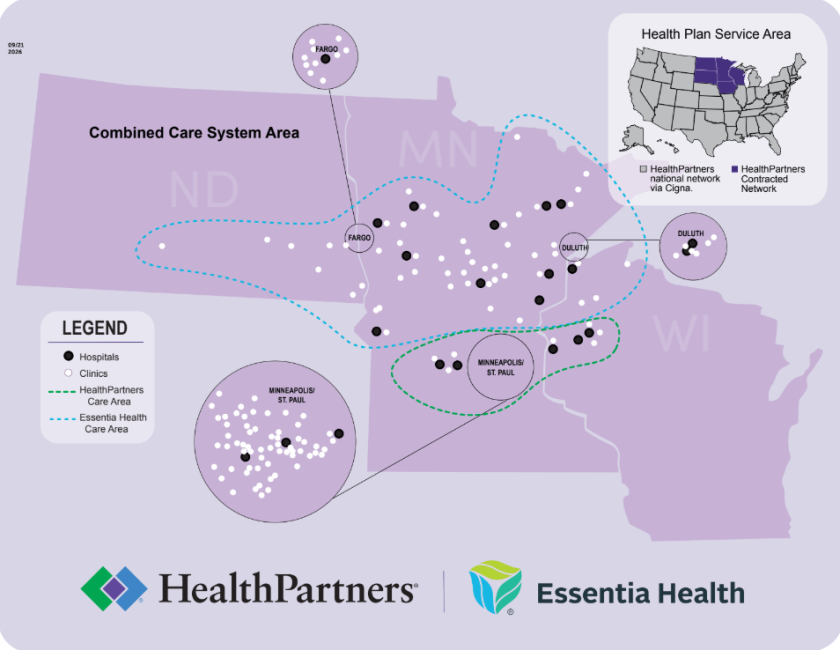
The footprint of HealthPartners and Essentia Health will include 22 hospitals, more than 135 clinics and 6,000 clinicians.
Contributed / HealthPartners and Essentia Health
Essentia facilities will retain the Essentia Health name while operations are integrated. According to the news release, patients are not expected to experience changes or interruptions to their care or coverage.
“We believe that together we’ll be able to provide stronger coordination of care across our organization, across the community, and most importantly across the continuum of care,” Walsh said, noting HealthPartners’ investment in digital care.
Leadership indicated that the organizations will also increase investments in research, data analytics and workforce development.
Herman said he does not expect the merger to result in layoffs.
“We have a lot of great people, a lot of great colleagues, and we look forward to working with them as we change the model of care and move forward,” he said. “Our premise right now is that our positions will not be eliminated, and we will continue at the sites of the service that we have now.”
The Minnesota Nurses Association on Tuesday, Sept. 29, called for full financial transparency, expressing “serious concerns” about the third major consolidation across Minnesota health systems in the past six months.
According to a news release from the association, closer scrutiny is needed to determine the impacts the merger could have on patient choice, healthcare costs, access to care and the healthcare workforce.
The proposed merger follows Sanford Health’s acquisition of North Memorial Health, which was announced in May and completed earlier this month, and Sutter Health’s proposed acquisition of Allina Health, which was announced in March.
“Every time control over healthcare is concentrated in fewer hands, we need to understand what patients and communities stand to gain, what they could lose and who will be accountable for those outcomes,” MNA President Chris Rubesch, a registered nurse at Essentia Health, said in the release. “HealthPartners and Essentia must show how this acquisition will lower costs, preserve patient choice, protect access to care and put resources where they belong: at the bedside.”

Essentia Health in Duluth is directly connected to the skywalk and to The Lakeview, left.
Jed Carlson / Duluth Media Group file photo
With escalating costs making it more difficult for patients and members to access healthcare, Walsh said affordability is the No. 1 challenge for patients, especially an aging population.
“The only way we can make healthcare more affordable is by changing the way we practice and changing our models of care,” Herman said. “We’ve actually been doing that in parallel. … As we looked at the capabilities of our two organizations, they’re very complementary.”
Walsh indicated that new models of care are also needed in order to effectively serve Medicare and Medicaid populations, as well as all patients. Herman noted that 24% of Minnesotans currently receive Medicaid, with as many as 140,000 people losing coverage by 2027.
“We felt very, very strongly, with the capabilities that each organization has, that we can serve those people better together than we could individually,” Herman said.
The MNA stated that the acquisition raises additional questions because HealthPartners operates as both a healthcare provider and health insurer.
The union called for regulators to closely examine what expanding a healthcare delivery system that is controlled by an organization that also administers insurance coverage and establishes provider networks could mean for patient choice, insurance networks, healthcare costs and access to providers.
“Nurses and other frontline healthcare workers must have a meaningful voice in that process because we see every day how decisions made at the corporate level affect care at the bedside,” Stacee Rosier, registered nurse at Essentia Health and member of the MNA Board of Directors, said in the news release.
For more information, visit