
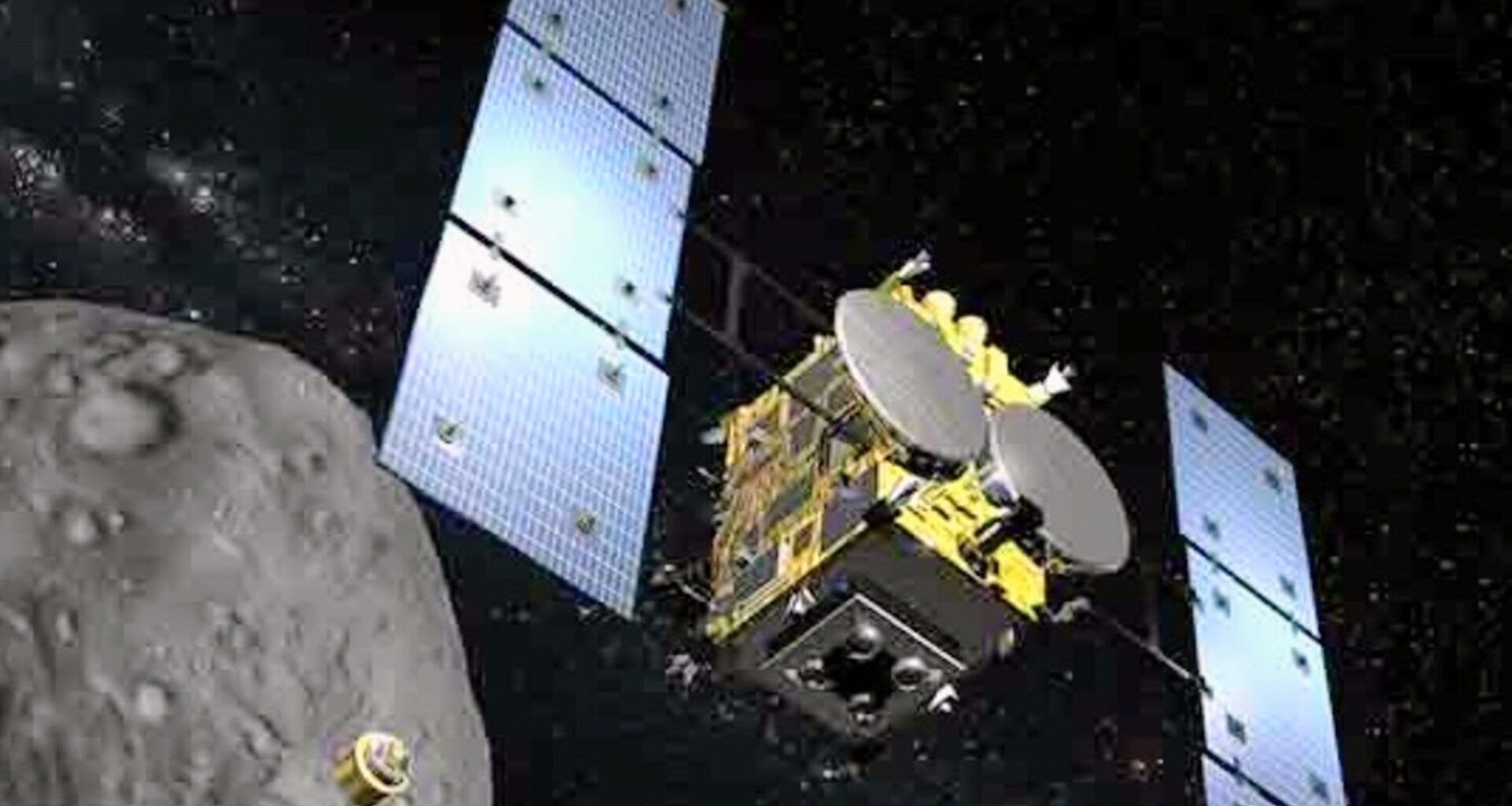
Ryugu’s parent body came together under 2 million years after the solar system’s first solids, before the beads in other meteorites formed.
Crack open one of the dark, carbon-rich meteorites that land on Earth and it’s usually packed with tiny beads of rock, each melted in open space and chilled hard. Asteroid Ryugu has none of them.
Based on new dating of its minerals, the body that Ryugu broke off from came together less than 2 million years after the solar system’s oldest solids, before the beads even existed.
Noriyuki Kawasaki of Hokkaido University ran the dating with Kazuhide Nagashima at the University of Hawaii and dozens of colleagues on the Hayabusa2 sample team.
Hayabusa2 collected the Ryugu samples
They had two Ryugu grains and one slice of a meteorite called Ivuna, and the answer shifts by about a million years depending on which of two calibrations you accept.
Hayabusa2, flown by JAXA, collected material at two spots on Ryugu and brought it home; the spacecraft is now bound for a much smaller asteroid.
Other teams have already read those grains for liquid water moving through the parent body a billion years on, and for the building blocks of DNA and RNA.
Magnetic fields from the young solar system turned up in the same asteroid dust.
Ryugu has no chondrules
Each bead is about a twenty-fifth of an inch (1 millimeter) across, roughly the size of a coarse sand grain.
Each was molten in the disk of gas and dust around the young Sun, then cooled fast. Scientists call them chondrules, and most carbonaceous meteorites are packed with them.
Ryugu isn’t, and neither is Ivuna. Even carbonaceous meteorites soaked in water until almost nothing original survived still have chondrules, or the outlines of chondrules.
A few grains in both did form hot: the presence of stray olivine grains, bits of high-temperature rock, provide the evidence. So the water didn’t erase everything older than itself. The beads simply weren’t there.
Dolomite dating gets a new standard
Water once ran through the rock that Ryugu came from, and it left minerals behind. One of them is dolomite, a carbonate that grows straight out of the fluid.
Dolomite takes in manganese as it grows, and one form of manganese decays into chromium with a half-life of about 3.7 million years. Measure what’s left of each, and the mineral dates itself.
That clock had a calibration problem. Labs running the same technique on the same asteroid had published dates for Ryugu’s carbonate that disagreed by about 5 million years.
Standards were the trouble: some teams calibrated against calcite, others against dolomite with an uneven mix of the two.
Kawasaki’s team used a synthetic dolomite with an even ratio instead, then measured the Ryugu particles A0058 and C0002 and the Ivuna sample with an ion beam.
Water kept working for millions of years
The two Ryugu grains dated differently, which is a result in itself. Dolomite in C0002 formed about 2.1 million years before the carbonate in A0058, give or take a million.
Water was still altering the parent body throughout that interval.
Oxygen isotopes in the same grains put a temperature on the fluid. C0002’s carbonate grew at about 198°F (92°C).
The Ivuna carbonate grew at about 169°F (76°C), and A0058’s at about 99°F (37°C), a figure from earlier work on the same particle.
The coolest is near body temperature, the warmest just under boiling, inside a rock in space. Radioactive decay did that to a ball of ice and dust.
On one calibration, C0002’s dolomite formed 1.95 million years after the solar system’s first solids, Ivuna’s at 2.87 million, and A0058’s at 4.05 million.
On the other, each date lands about a million years later. Kawasaki’s team said it isn’t clear which calibration fits these samples.
Heating models set the deadline
Dolomite can’t form without liquid water, and on a small, icy body that water comes from heat released by radioactive decay. The later a body assembles, the less of that heat is left, so it warms slowly.
A body that came together 2.0 million years after the first solids stays below about 194°F (90°C) inside until roughly 3.3 million years. That is later than the date measured for C0002’s carbonate.
That holds under either calibration, so the team set 2.0 million years as the upper limit on when Ryugu’s parent body assembled. The deadline comes from the cooling, not the mineral clock.
In one model that fits every date and temperature, the body has a 12-mile (20 km) radius and forms at 1.0 million years. It holds nearly as much water as rock by weight.
The dolomite conditions appear 8 to 9 miles (13 to 15 km) out from the center.
Kawasaki’s team modeled that body as arriving all at once. Real accretion is gradual, so it must have started earlier, and water moving inside would slow the warming further.
Ryugu’s family formed first
Chondrules in the other carbonaceous groups have been dated to roughly 2.2 to 2.8 million years after the first solids. Most in one group, the Renazzo type, came later, 3.5 million years on or more.
Ryugu’s parent body was finished before any of that. A rock can’t collect beads that don’t exist yet, and that turns Ryugu’s missing chondrules from an oddity into a timestamp.
So Ryugu and the Ivuna-type meteorites look like survivors of an earlier round of planetesimal building. Theorists have predicted that shape: a first generation inside a million years, then more later.
What the dating can’t settle
Whether Ryugu and Ivuna came off the same parent body stays open. Every date and temperature fits one 12-mile-radius object, but fitting isn’t the same as requiring, and the authors said as much.
Nobody knows what made the chondrules, either. A later round of planetesimal formation may have triggered whatever melted dust into beads, or the beads may have triggered the round.
Kawasaki’s team named both directions and chose neither.
Calibration is the question that could move soonest. The two accepted anchors are about a million years apart, and there’s no agreed test for which belongs on carbonate that grew in cool water on a small asteroid.
Running the same dating on more Ryugu particles, and on material from Bennu, the other carbonaceous asteroid sampled so far, would test whether the pattern holds beyond three rocks.
The full study was published in the journal Science.
—–
Like what you read? Subscribe to our newsletter for engaging articles, exclusive content, and the latest updates.
Check us out on EarthSnap, a free app brought to you by Eric Ralls and Earth.com.
—–